Here’s a summary of the construction and history of Tal-Qaret (Nigret) Windmill in Zurrieq, Malta:
📍 Location
35.823643, 14.468996Profile of the Tal-Qaret (Nigret) windmill, Żurrieq — construction, form, history, use, condition and recent issues.
Tal-Qaret (Nigret) Windmill — overview
Names: Tal-Qaret (commonly), also referred to locally as the Nigret windmill.
Village / place: Nigret area, Żurrieq (south-west part of the Żurrieq locality). The mill’s access/address is given as 107 Triq il-Mitħna (Tal-Qaret) in modern guides.
Built: 1674 — traditionally credited to the Cottoner period (Grandmaster Nicolás Cotoner); some local histories refer to Guże (Joseph) Galea as the mason/contractor who erected a group of Cottoner mills in 1674.

Construction & architectural description
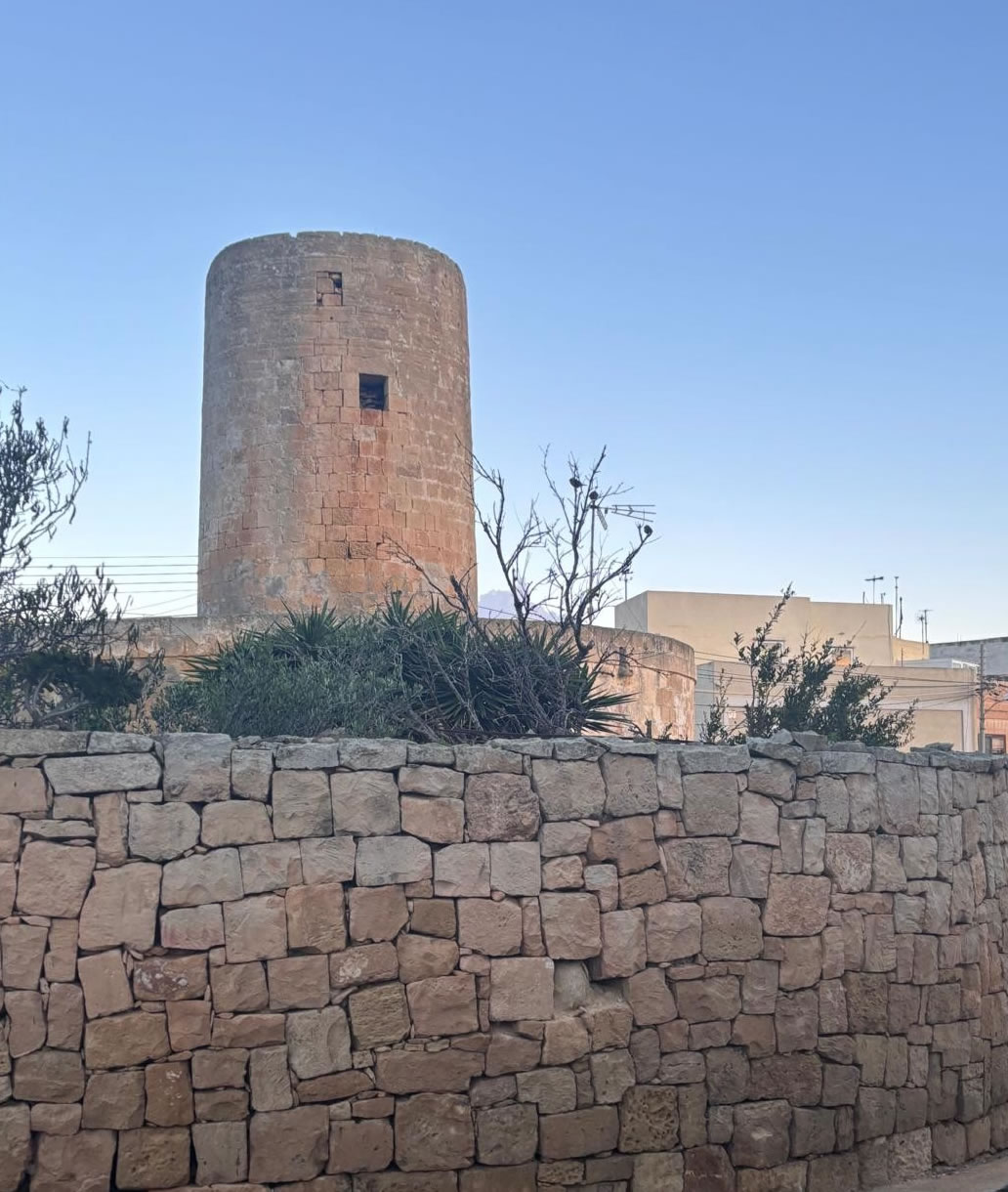
Type: Tower (round) windmill — the typical Maltese cylindrical stone tower (tapering masonry tower). The Windmills of Malta catalogue records Tal-Qaret as a tower mill with a round base.
Materials & form: local Maltese globigerina limestone masonry; internal floors for millstones and a timber cap which carried the sails in working life (standard Maltese tower-mill layout). Surviving mills of the same period in Malta confirm this construction model.
Sails / machinery: the mill’s sails have been removed (common for many historic Maltese mills). No public source describes the full survival of the internal gearing as of 2025.
Historical role and operation
Purpose: grain-milling for the local agricultural hinterland — producing flour / meal for Żurrieq and surrounding hamlets. Like other Cottoner-era mills it formed part of a programme of provisioning and rural-industry support.
Cluster context: Żurrieq historically had several mills (Tal-Qaret, Ta’ Marmarà, Xarolla and Tas-Salib, etc.). Tal-Qaret was one of the earlier Cottoner mills (1674) in the area; Xarolla (1724, Manoel Foundation) is the better known surviving, restored working mill nearby.

Later history, conservation & present condition
Survival: Tal-Qaret stands today as a recognisable tower mill in the Nigret / Triq il-Mitħna area; it is included on local heritage walks and visitor listings. Published guide entries and local council material treat the mill as an extant historic feature.
Conservation status & threats: the mill has attracted conservation interest — local NGOs (Din l-Art Ħelwa, student groups) objected strongly to a 2020 planning application (PC/00021/20) that would affect the mill’s setting. Media and heritage statements described the mill as a 17th-century scheduled/important vernacular monument whose landscape context should be protected.
Restoration: unlike Xarolla (which has had major restorations and functions as a museum), Tal-Qaret has not been widely publicised as having undergone a major, recent public restorative programme; references describe it as maintained as part of the local historic landscape but also vulnerable to insensitive development in its setting. For official conservation/reporting records you’d need the Planning Authority / Superintendence / NICPMI entry.

Significance
Age & patronage: being dated to 1674 and usually associated with the Cottoner foundation makes Tal-Qaret one of Malta’s older post-medieval tower mills — part of a deliberate programme of rural industry and provisioning under the Order of St John. That gives it architectural, technological and social value.
Landscape role: it is part of Żurrieq’s windmill ensemble that creates a locally distinctive historic skyline (together with Xarolla and the other mills) and helps interpret rural life and pre-industrial milling in southern Malta.

Practical details / visiting
Where to find it:107 Triq il-Mitħna (Tal-Qaret), Nigret, Żurrieq — local directions and public-transport stops (Franzina / Piano) are listed in trip and route guides. Use a Żurrieq village map and head for the Nigret / Xarolla windmill cluster.
