
Roman Baths Xemxija - Malta
A detailed, visitor-friendly guide .

Here’s a concise, field-useful briefing on the Roman baths at Xemxija (St Paul’s Bay), with what’s known about their layout, date, and how to find them.

What the site is
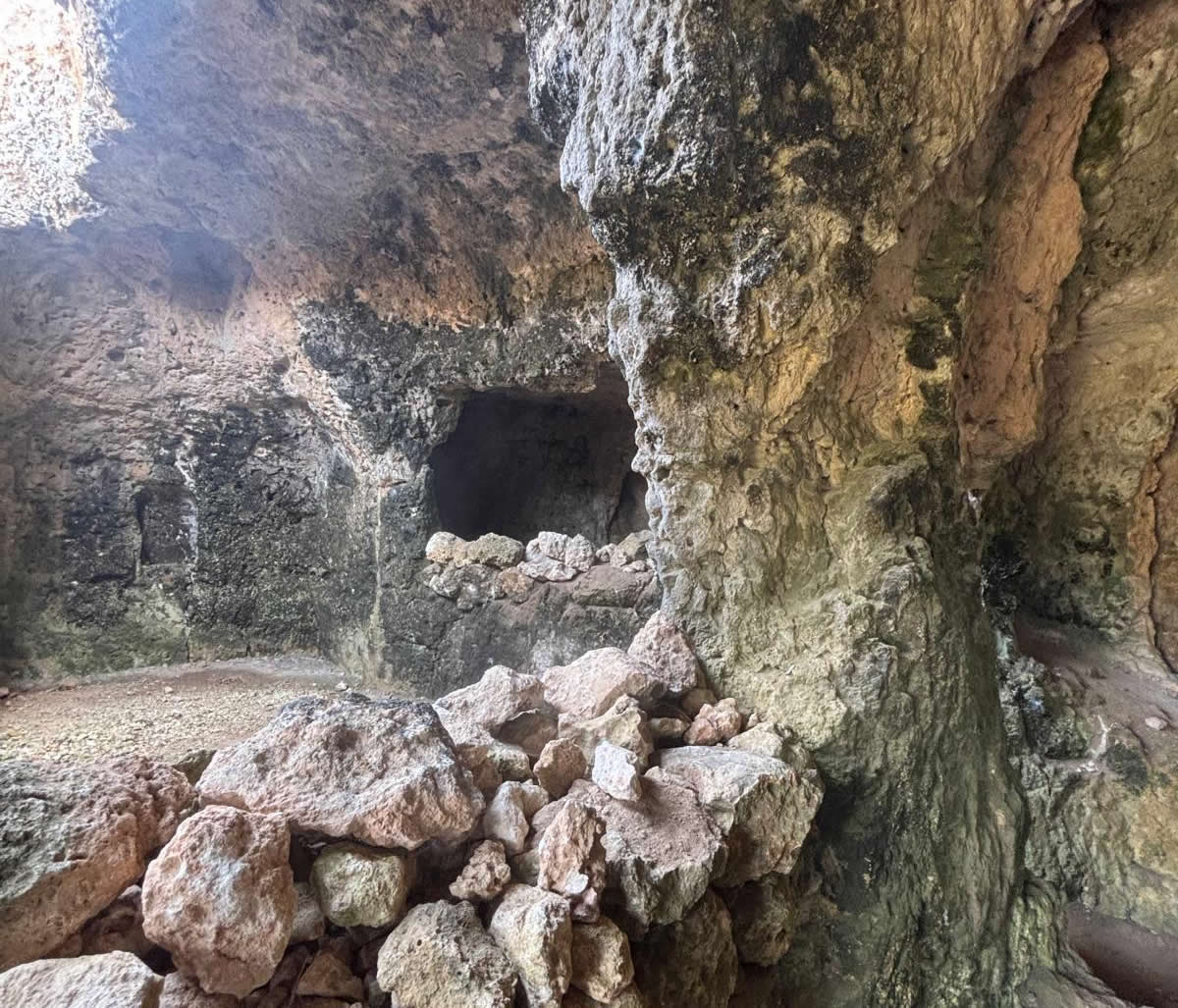
A small Roman-period bath suite cut into the cliff face** above Mistra Valley, reached from the Xemxija Heritage Trail. The interior is hewn from bedrock, with multiple chambers and rock-cut pools. Local descriptions identify spaces comparable to a frigidarium (cold), tepidarium (warm) and caldarium (hot), with partitions formed by rock pillars and rubble walling. Springs once fed the baths from the cliffs before they ran dry.

Where it is (GPS)
There is a map near the bottom of this page
35.95264° N, 14.38338° E (WGS84). That point lands at the rock-cut entrance commonly photographed as the “Roman Baths, Xemxija.”
Setting & access
The baths sit below the Bajda Ridge overlooking the Mistra/Pwales valleys. From the Heritage Trail, you descend narrow steps (often overgrown) to reach the entrance; take care—surfaces can be slick and crumbly.
The baths are one of \~20 stops on the Xemxija Heritage Trail (aka Old Roman Road / Pilgrims’ Way), which is signposted and described in local trail materials.

What you’ll see inside
Rock-cut pools/basins and small chambers in sequence, separated by rock pillars and masonry—consistent with a compact thermae plan. Several guides note the triad of cold/tepid/hot rooms; some also mention blackened walls in the heated end-chamber (an observation rather than a formal excavation report).
The suite is carved into the cliff rather than freestanding masonry, which is unusual but not unique in Malta’s landscape. The water source was spring-fed, now dry.

Date & interpretation
Attributed broadly to the Roman period; precise dating is not published from modern excavation. The layout (sequential temperature rooms and plunge basins) matches Roman bathing conventions found at better-preserved local comparanda (e.g., Għajn Tuffieħa baths), which show the typical caldarium/tepidarium/frigidarium arrangement. Xemxija is smaller and rock-hewn but interpreted in that same tradition.
Several local accounts note that some caves in the area began as Punic/Roman-period burials and were later adapted; one video-guide specifically suggests a pre-bath funerary use for the cavity here—treat this as a local interpretation, not a confirmed stratigraphic sequence.

Practical visit notes
Approach:Follow the Xemxija Heritage Trail from the hilltop above Xemxija; the baths are one of the signed stops. Expect a brief but steep, overgrown descent to the entrance. Good footwear and a small torch help.
Context on the trail: Nearby you’ll also pass Punic/Roman apiaries, cart ruts, rock-cut tombs, cave dwellings, and megalithic fragments—useful landmarks to confirm you’re on the right track.

Why it matters
Xemxija’s baths illustrate Roman bathing culture adapted to local geology (carved directly into limestone; spring-fed), and they sit inside a continuous ritual/settlement landscape that runs from the Neolithic through Punic/Roman times—a rare, walkable cross-section of Maltese prehistory and antiquity.

