Tat-Tank Windmill - Malta
History and construction description of the Tat-Tank Windmill, 29 triq il Mithna, Siggiewi, Malta.
📍 Location
The coordinates of Tat-Tank Windmill are:
- 35.855987, 14.435532
Tat-Tank Windmill — history & construction (Triq il-Mitħna 29, Siġġiewi)
Short version: Tat-Tank is a traditional Maltese tower-type windmill in the centre of Siġġiewi (address given as Triq il-Mitħna 29). It dates from the 18th century, worked as a corn mill, later had its sails removed and was at one stage used as a water tower. It is a scheduled cultural building.

Location & legal status
The windmill stands on Triq il-Mitħna in Siġġiewi (commonly listed at No. 29). It appears on the national schedule of historic properties.
When it was built
Published listings for Maltese windmills date Tat-Tank to the 18th century (most references simply give century rather than a precise year).

What type of mill it is / how it’s constructed
Tat-Tank is recorded as a round (tower) mill — the common Maltese design where a cylindrical limestone tower supports the milling mechanism and the cap (which originally carried the windshaft and sails). These mills were usually built of local globigerina limestone, have multiple internal floors (storage/“bin” floor, milling/grist floor, and cap), and an internal spiral or winding staircase that links the floors. The cap and sails (wood and canvas or timber lattice) provided the driving wind power to a horizontal/vertical shaft turning the millstones.

Special features of Tat-Tank
Unlike some other mills, Tat-Tank’s tower was later used to hold a water tank, so the tower served a secondary purpose as a small municipal/private water reservoir after the mill ceased operation. Photographs in public archives show the tower still standing but without sails.
Operational life & decline
As with most Maltese windmills, Tat-Tank would have been active during the period when wind power was the principal way to grind local grain (Order of St John → 18th/19th centuries). Mechanisation and changing agriculture led to windmills being abandoned: sails were commonly removed and many mills were converted to other uses (houses, store rooms, water towers, etc.). Tat-Tank is recorded in modern lists as having had its sails removed.
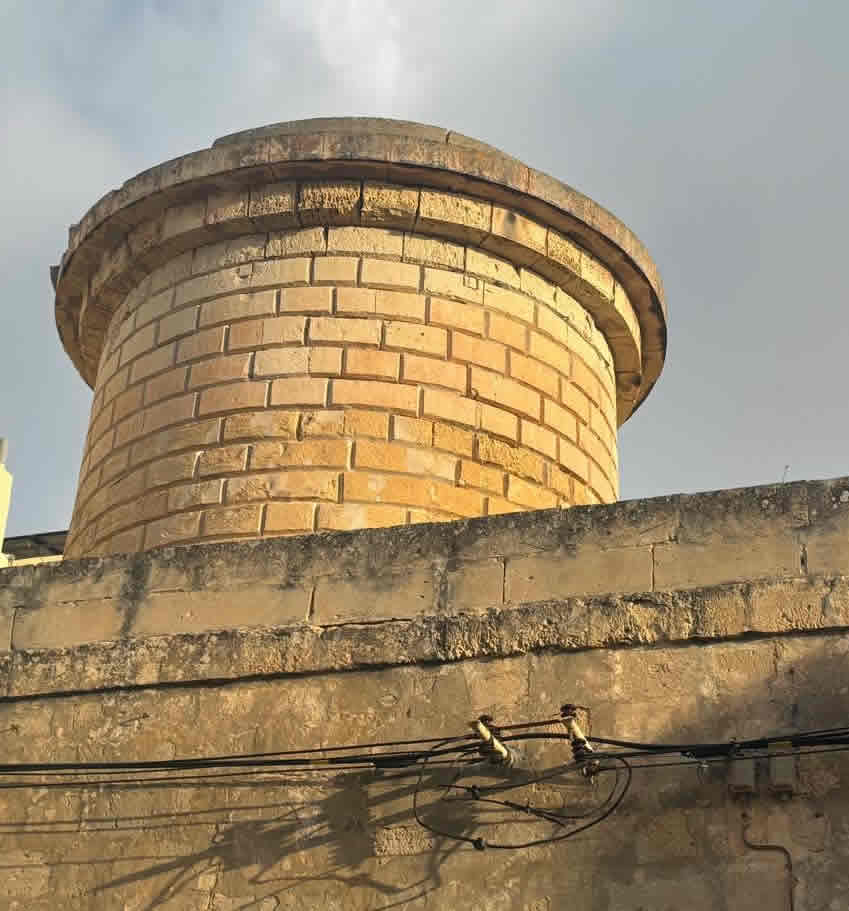
Current condition & where to see photos / records
The windmill also appears in specialised databases about Maltese windmills and is currently used as a private residence. For formal status the Government Gazette scheduling (2012 list) includes “Tat-Tank Windmill, Triq il-Mitħna, Siġġiewi”.
