Post Mill (Windmill Hill / Triq il-Portu Salvu), Senglea — history & construction
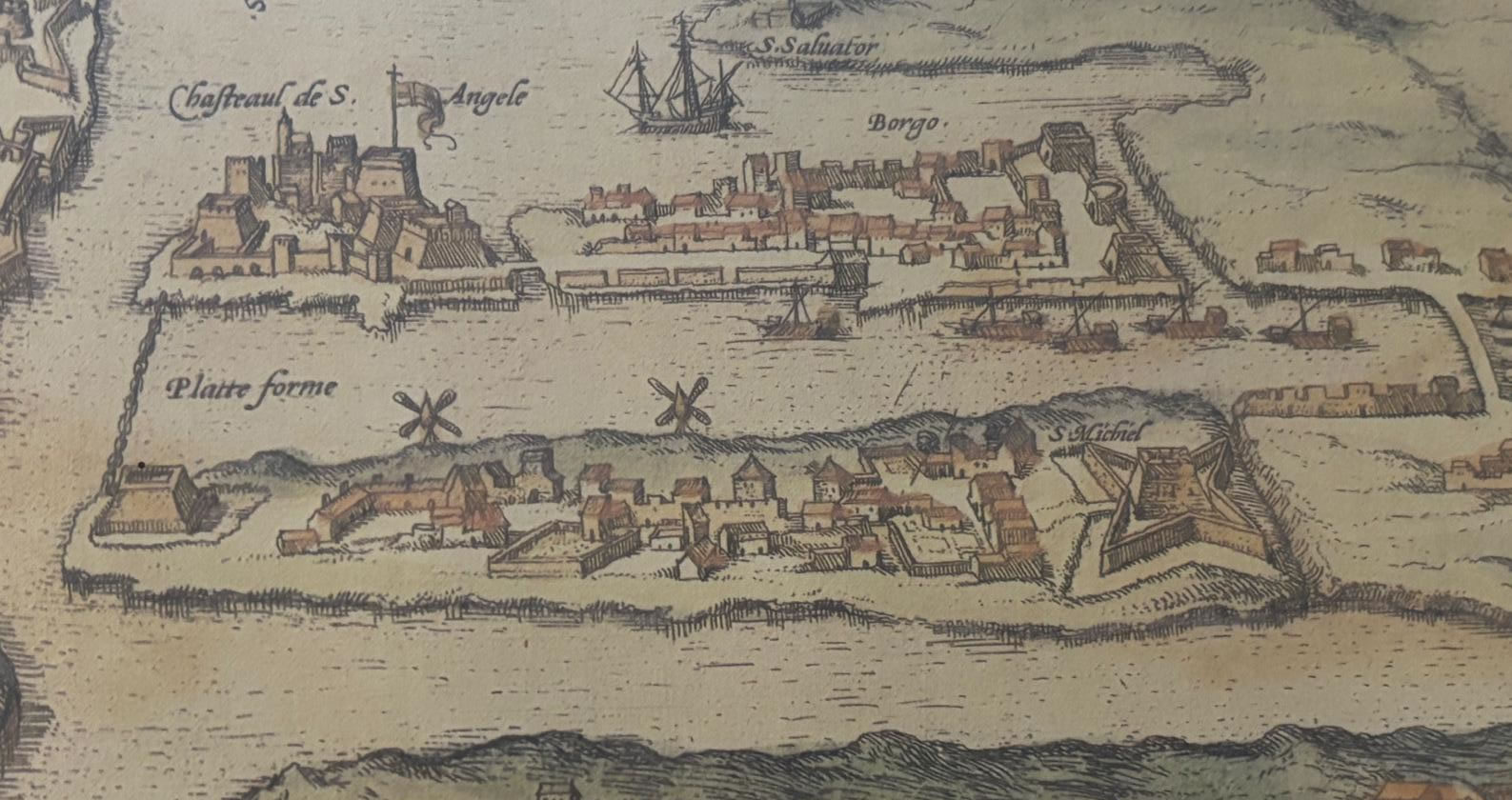
The Senglea post-mill at Windmill Hill (Triq il-Portu Salvu) is recorded in specialist Maltese windmill inventories as a post-type mill built in 1536 to serve the harbour-front communities of the Grand Harbour. It’s one of the earliest documented mills in the islands and reflects the early transfer of wind-milling technology to Malta under the Knights of St John.
Quick timeline / historical context
Built: recorded as 1536 (listed in specialist windmill inventories for Malta).
Context: The date places the mill early in the Knights of St John period (the Knights occupied Malta from 1530). Windmills and milling technology were introduced to Malta from Rhodes and other Mediterranean centres; mills were a strategic food-production asset for fortified harbour towns such as Senglea.
Function: primary use was grinding cereals (grain → flour) for local consumption and the naval/garrison needs of the harbour settlements.
Why a post mill in 1536 (not a tower mill)?
The post mill is the older European form of windmill: relatively quick to build in timber, economical, and able to face the wind by turning the whole body about a central post. In the early 16th century this design was common across the Mediterranean and Europe before stone tower mills became widespread. Malta shows both early post-and later tower mills in its historic record.
Anatomy & construction — how the Senglea post mill would have been built (technical details)
This section explains the typical structure of an early post mill and calls out which elements we expect for the 1536 Senglea example. Wherever possible I note what is known for Maltese examples.
Primary structure (timber superstructure)
Main post (the “post”): a large, vertical oak (or other durable hardwood) post anchored into a substantial timber trestle set into the ground or into a small masonry base. The whole mill body (the buck or body) turns around this post to face the wind. The main post is the single pivot bearing the mill’s weight.
Trestle (crosstrees & quarter-bars): heavy horizontal timbers (crosstrees) laid on stone supports, with diagonal and vertical braces (quarter-bars) forming a rigid timber framework that transfers loads into the foundation. For harbour towns, masons often set the trestle onto a small stone plinth or mound to protect the timbers from ground moisture.
Roundhouse (optional): some post mills have a low masonry or timber roundhouse built around the trestle to protect the timberwork and provide storage or ancillary rooms. In Malta, early mills sometimes sat on small stone bases or buttressing rooms (local tradition varies).
The buck (mill body)
Box/buck: a weatherproof timber housing containing the milling machinery — usually rectangular or slightly tapered, clad with vertical planks or horizontal weatherboarding. It contains the millstones, gearing, and grain-handling equipment.
Access & stair: an external stepped ladder or small stair gives access to the mill floor; inside there would be a small staging area, the sack floor and the stone floor.
Windshaft, sails & orientation
Windshaft & sails: a horizontal windshaft (timber in 1536) carried the sails outside the buck. The 16th-century sails would have been simple framed timber arms with cloth (canvas) or lattice coverings that could be reefed (furled) depending on wind strength.
Turning to the wind: on a post mill the entire buck is rotated on the post — early mills used a long rear tail-pole (a timber spar projecting from the back of the buck) which the miller pushed or hauled (sometimes with a winch) to turn the structure to face the wind. Later post mills sometimes had a small fantail or winch mechanism, but that is a later development.
Brake & safety: a wooden brake wheel on the windshaft, and wedges or clamps to secure the mill body when not in use.
Internal gearing & milling
Brake wheel → driven gear → vertical shaft: the brake wheel on the windshaft engages a smaller gear (or lantern pinion) that transfers rotation down to the millstones. In a compact post mill this gearing is simple and robust.
Millstones: one runner (top) stone and one bed (stationary) stone. Stones were frequently imported or locally sourced dressed stones; staddle stones or stone supports inside the buck carried the stones.
Ancillary gear: hoppers, meal spouts, grain elevators (hand-operated) and a sack floor for storage.
Materials (what builders in Malta would have used in 1536)
Timber: oak, elm or imported hardwoods for major structural members (post, crosstrees, windshaft). Because Malta has limited high-grade timber, some timbers were often imported (typical in the Mediterranean).
Stone: local globigerina limestone for footings, small plinths or any roundhouse/ancillary built around the trestle. Maltese mills often pair a timber upper structure with stone ground works.
Operational life & role in Senglea
As a harbour town with military and maritime importance, Senglea needed local milling capacity to supply garrisons, crews and civilians. A 1536 mill would have been a strategic asset — close to docks/warehouses and the residential quarter — and likely controlled or sanctioned by the authorities of the Order.
history, survival & archaeological traces
Survival many early timber post mills across Europe were replaced by more durable stone tower mills or were demolished as milling technology evolved. Specialist Maltese listings record this Senglea windmill as a 1536 post mill, but timber superstructures are perishable — so the original 1536 wooden body is unlikely to survive intact unless replaced by later fabric or conserved early. The site often retains a footprint, masonry foundations, or documentary traces (maps, notarial deeds, parish accounts).
What to look for on site: masonry plinths, roundhouse remains, unusual compact stone bases, millstone fragments, or embedded beam sockets in old walls. Old cadastral maps and notarial contracts (16th–18th c.) often mention mills, their owners and repair obligations.