Here’s a detailed historical overview of the Fort St. Elmo Lighthouse (inside Fort St. Elmo, Valletta, Malta)
Historical Background of the Fort & the Lighthouse
Fort St. Elmo is a star-fort located at the tip of the Sciberras (Sceberras) peninsula, guarding both the Grand Harbour and Marsamxett Harbour.
The original strategic point had a watch‐post as early as 1417.
The current fort was built by the Knights of St. John starting in 1552 under engineer Pietro Prato (Prado), following earlier vulnerabilities.
It played a major role in the Great Siege of Malta (1565), holding out for nearly a month.
Over the centuries, the fort was rebuilt, strengthened, and adapted: post-siege rebuild by Francesco Laparelli, additions in the 17th–18th centuries, and modernization under British rule.
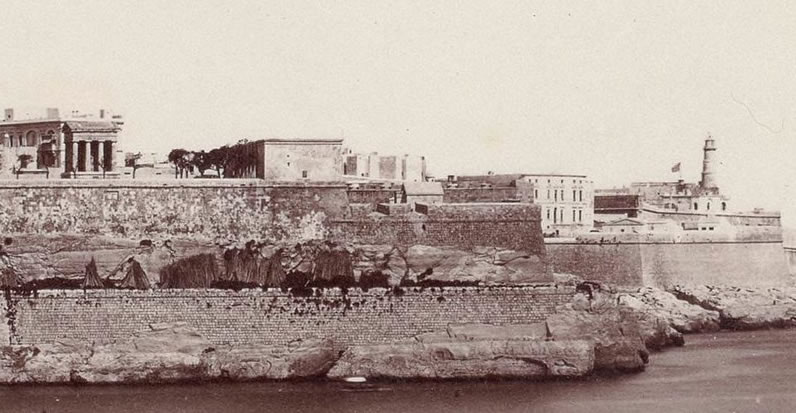
A lighthouse was added inside Fort St. Elmo sometime in the 19th century (during British rule).
According to the University of Malta report on lighthouses, by 1838 G.P. Badger noted improvements by the British: the lighthouse “rises from one of the angles [of Fort St Elmo]” and was about 17 m high, built on bastions more than 30 m above sea level.
There were keeper’s quarters nearby; records show modifications well into the 1920s.
The lighthouse was demolished in 1940, during World War II.
The primary reason for removal was security: it presented a conspicuous landmark that enemy aircraft could use for navigation / targeting.
After demolition, only the base (foundation) of the lighthouse remained within Fort St. Elmo.
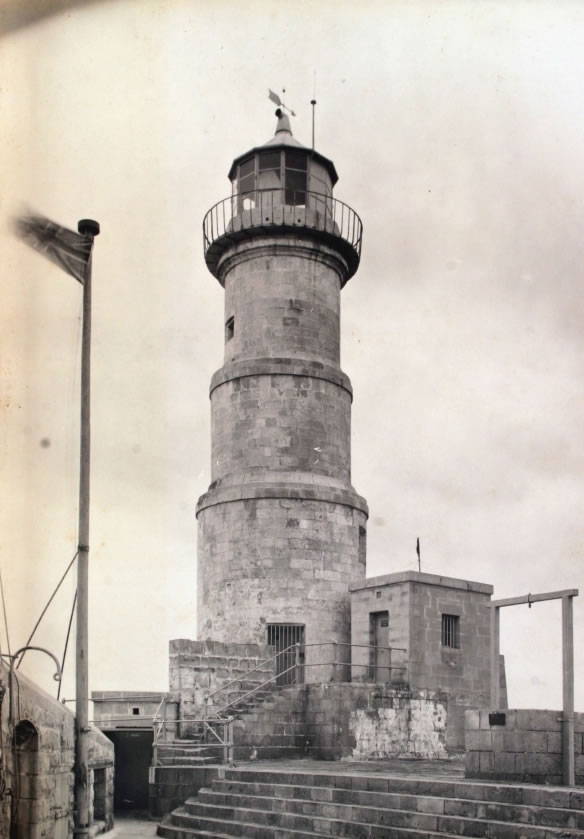
National Archives of Malta PHO 1972
The lighthouse is remembered as a distinctive part of 19th- and early 20th-century Valletta skyline.
There have been talks / proposals (e.g., mentioned in Times of Malta) of reconstructing or memorializing the lighthouse.
The fort itself has been restored (work completed in 2015) and now houses the National War Museum, which tells much of its layered history—including the story of the lighthouse.
The lighthouse was part of Malta’s maritime navigation network, guiding ships into Grand Harbour.
Its demolition reflects how wartime exigencies (air threat) can force the removal of even important navigational aids for defensive reasons.
Today, its absence is part of the historic memory of Valletta / St. Elmo — a “lost” landmark, but one with strong symbolic value.