Ta’ Kola Windmill - Gozo
History and construction description of the Ta’ Kola Windmill, Gozo.
📍 Location
The coordinates of Ta’ Kola Windmill are:
- 36.049667, 14.266816
A compact but thorough history, the building and machinery details, and the recent conservation story for Ta’ Kola, one of Gozo’s best-known mills.
Location: Triq Marija Bambina, Xagħra (near Ġgantija Temples), Gozo.
Significance: one of the few surviving Knights-period windmills on the Maltese islands, restored as a small local museum with original-style sails and working machinery.

Chronology — dates & major events
Built: commonly dated to 1725, constructed under the Fondazione Vilhena during the magistracy of Grand Master Manoel de Vilhena (1722–36).
Rebuilt / reconstructed: the original build used poor materials and the structure required dismantling/reconstruction in the 1780s (sources vary between 1780s–1787 for the rebuild).
Museum opening: converted to a museum in 1992 (Heritage Malta / local sources record its museum function).
Storm damage & restoration: damaged by a windstorm in 2008 ; detailed conservation and restoration work followed (woodwork and vanes assessed, many parts replaced for safe operation) and the windmill was repaired and conserved by Heritage Malta. This was damaged again in 2025

Name & social history
The popular name Ta’ Kola comes from the nickname of the last traditional miller family in the mill’s operation — Żeppu ta’ Kola (Joseph son of Nikola). The mill served Xagħra’s farmers for bread-grain milling and formed a village focal point (the miller would blow a horn/sea-shell to call villagers).

Architecture & construction details
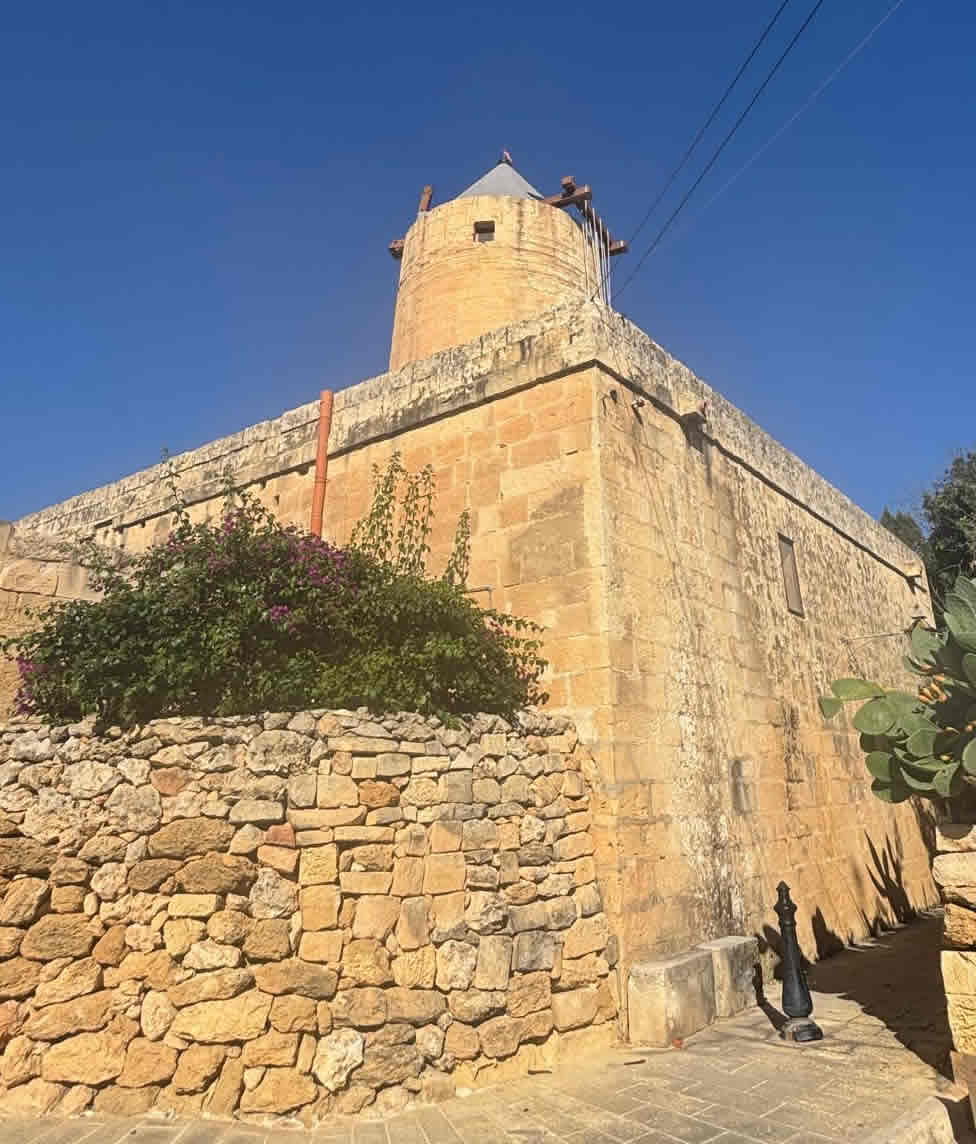
Tower mill: a cylindrical central tower rises from a low rectangular base of single-storey rooms (storage, bakery / miller’s quarters). This is the classic Maltese/Gozo “tower + base” windmill layout.
Local globigerina limestone masonry with lime mortar; the tower is built of ashlar/rubble masonry typical of 18th-century rural buildings. The rebuild in the 1780s used more durable materials and workmanship.
Cap & sails: historically the mill had a rotating cap carrying the sail arms (sweeps). The mill retains restored vanes and a working windshaft after conservation work; Heritage Malta reports that much of the old wood was in poor condition after the 2008 storm and had to be replaced or recreated to make the mill safe and (interpretively) functional.
Mill machinery (interior): the internal arrangement includes the horizontal windshaft, brakewheel, vertical shaft, and traditional runner and bed stones with wooden gearing — the museum preserves the millstones and associated milling equipment and also presents the miller’s living quarters and a collection of traditional tools (wood- and iron-working tools).
Use, decline & revival
The mill was actively used for local grain-milling through the 19th and early 20th centuries. Like other island mills it ceased regular commercial operation as motorised mills and modern transport made small windmills uneconomic. Ta’ Kola was converted into a museum (1992) and later underwent conservation after storm damage, returning to visitor use with interpretive displays and working-appearance machinery. ([Wikipedia][1])

Museum today
Operated / interpreted by Heritage Malta (visitor opening times listed on tourism pages), Ta’ Kola presents the miller’s rooms, the grinding area, millstones and a broad collection of traditional craft tools — making it both an industrial and ethnographic museum. It sits close to Ġgantija, so it is part of a common visitor route in Xagħra.

Short summary
Heritage Malta carried out a multi-phase restoration and mechanism reconstruction of Ta’ Kola between the late 2000s and the mid-2010s (with ongoing maintenance thereafter), restoring stone fabric, rebuilding/mechanically reconstructing the milling mechanism and vanes, repairing the wooden cap/cone and improving services/access while following conservation best practice.

Timeline of the conservation project
the windmill suffered damage from a windstorm, triggering a programme of consolidation and assessment. Heritage Malta’s reporting documents the storm as the event that led to a full assessment of the mill’s external and internal condition.
Heritage Malta’s annual reports record an early phase of works (status reports, shoring, detailed estimates, procurement of labour/materials) and refer to “extensive reconstruction works” that were underway and scheduled for completion around 2012–2013. These documents describe funding, risk mitigation (closing the tower to visitors while works took place) and the preparation of technical memórias (condition surveys and recommendations).
project news and technical summaries state that Heritage Malta rebuilt several components of the milling mechanism and reinstalled the mill’s antennae/vanes (wooden sail arms). The agency highlights that much of the new woodwork was made or refitted in-house by Heritage Malta technical teams and that the mechanism was restored to full working condition by 2016.
Heritage Malta and local reports mark the end of the reconstruction of the milling mechanism and the re-installation of the vanes (the mill’s operational/interpretive mechanism was declared restored). Local press noted public re-opening phases in 2016.
Follow-up maintenance and small interventions: successive Heritage Malta annual reports document periodic maintenance: removal, re-varnishing and reinstallation of the six vanes; maintenance of the cone/wooden superstructure; routine structural maintenance; and site service works (for example re-routing of drainage and improvements to visitor restrooms). These entries show ongoing conservation-grade maintenance rather than large new interventions.
What was physically done — technical interventions
A detailed status report and condition survey of external and internal fabric was prepared after the storm damage. Temporary shoring and closure to the public were used while assessments and estimates were obtained.
The stone fabric of the central tower and surrounding rooms underwent consolidation and masonry repairs. Heritage Malta descriptions refer to “full restoration of the stone fabric” and removal of later, unsympathetic accretions where appropriate. Works included repointing and repair with appropriate lime mortars consistent with conservation standards.
Heritage Malta rebuilt several components of the internal milling mechanism: replacement or reconstruction of the supporting wooden structure for the two millstones, repair/replacement of the wooden cone (cap), brake wheel and associated wooden gearing, and re-installation of the milling mechanism in the tower. Where possible, original approaches and traditional carpentry techniques were used; where old timber was unsalvageable, replacements were fitted to match form and function. The agency reports that many of these works were carried out in-house by its technical teams.

The six (6) vanes/arms were dismantled for conservation, revarnished and reinstalled; the poles and main jib were repainted and conserved. This work returned the mill’s external moving elements to an interpretive “working” appearance and, together with the reconstructed internal gearing, restored the mill to working status for demonstration.
Safety measures (anti-slip strips, secure access to rooftop doors), rerouting of drainage and upgrades to site restrooms and visitor facilities were undertaken as part of the conservation plan to improve visitor access while protecting the fabric. Heritage Malta annual reports detail several small-works packages for these items in 2021–2023.
The mill is subject to scheduled maintenance: routine checks on vanes, cone, doors, and ironwork; small conservation projects reported annually. Heritage Malta’s annual reports (2019–2023) list maintenance cycles and periodic conservation actions.
Conservation approach & standards ( Heritage Malta’s stated practice )
Heritage Malta’s documentation and annual reports make clear the project followed conservation best practice: minimal intervention on original fabric, reversing inappropriate additions, using compatible materials (lime mortar), and replacing unsalvageable timber with like-for-like carpentry while documenting interventions. The agency also emphasises interpretive aims: restoring the mechanism to working order for demonstration while ensuring interventions are reversible/recorded.
