Location Map Coordinates 35.881771, 14.398110
St Cathaldus Crypt & Catacombs, Rabat (San Katald Underground Complex)
Beneath St Cathaldus Chapel in Rabat lies a compact but remarkable underground site: a medieval crypt above an underlying Christian hypogeum (catacombs), carved into limestone and shaped by centuries of burial custom, memory, and devotion within the ancient cemetery landscape outside Roman Melite.

Quick facts
- Site: St Cathaldus Crypt & Catacombs (San Katald)
- Locality: Rabat, Malta
- Coordinates: 35.881771, 14.398110
- Underground layers: medieval crypt + underlying Christian hypogeum
- Above-ground context: St Cathaldus Chapel constructed in 1745 over the earlier crypt/hypogeum
- Distinctive feature: a chamber described as a Triclinium with an Agape Table
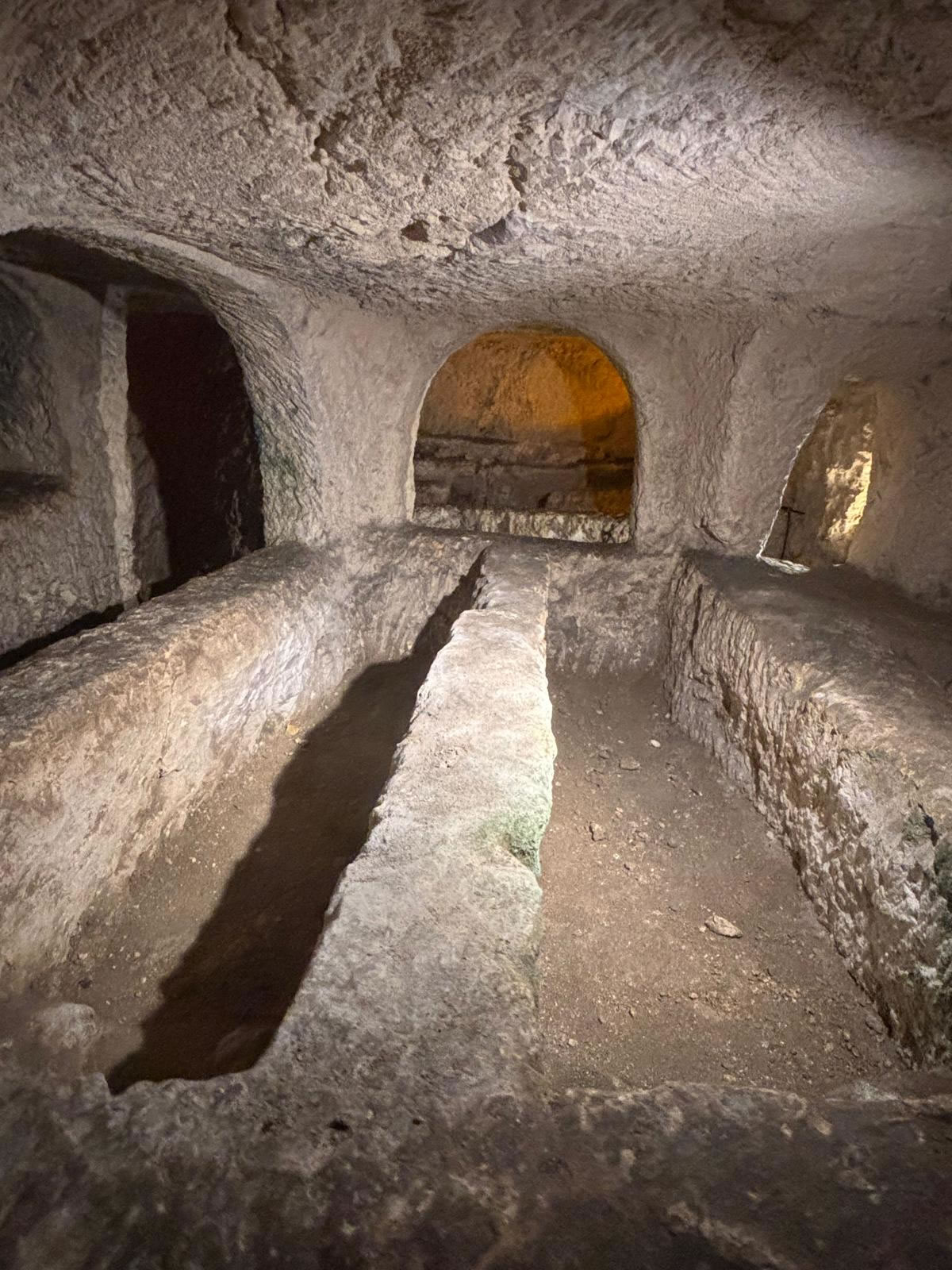
- Tomb repertoire: canopied table-grave, window grave, and loculi for infant burials
Related page (chapel above): St Cathaldus Chapel, Rabat.

Full history (site development and key dates)
1) The ancient cemetery outside Roman Melite
The St Cathaldus underground complex sits at the edge of a broader zone known for a high concentration of rock-cut burial spaces. In Roman custom, burials were placed outside city walls; heritage research links Rabat’s hypogea to this large cemetery zone beyond the limits of ancient Melite.
2) Early-Christian period: hypogeum (catacombs) and funerary ritual
The hypogeum beneath St Cathaldus is part of Malta’s Christian-era catacomb tradition, shaped for underground burials and remembrance. A hallmark of Maltese catacombs is the presence of rock-cut Agape Tables, associated with commemorative meals for the dead.

3) Medieval period: crypt and renewed veneration
Above the hypogeum, a medieval crypt and an overlying church developed on a site described as venerated from early medieval times. This layering reflects a common Maltese pattern: earlier burial spaces later becoming focal points of worship and local devotion.
4) 1575: closure of the medieval chapel
The medieval chapel of St Cathaldus was closed to the public in 1575 following a report by Apostolic Visitor Mons. Pietro Dusina. It was later redecorated and reopened before being replaced in the 18th century.
5) 1739–1745: replacement of the medieval chapel; the Baroque church above
The medieval chapel was demolished in 1739. A larger Baroque chapel was built over the medieval crypt and the underlying hypogeum, completed in 1745. This is why the underground complex is encountered today as a “vertical story” beneath an 18th-century church.

6) 2008–2010: restoration context and future-focused improvements
Public documentation from 2008 describes extensive restoration works underway at the chapel, noting it was constructed in 1745 above a medieval crypt with an underlying Christian hypogeum. A detailed study of restoration work reports that a first phase of external restoration had been completed, and notes plans including improved lighting for the underlying catacombs.
Underground layout: crypt → hypogeum
Access to the hypogeum is described as via a flight of steps from the crypt, emphasising the site’s layered structure: the crypt functions as a transitional sacred space above the earlier burial chambers.

Tomb types and what they mean
The St Cathaldus hypogeum is notable for presenting multiple tomb forms in a small area—useful for understanding how families and communities buried their dead. Documented tomb types include:
- Canopied table-grave: a prominent, free-standing “table” tomb with a canopy-like form.
- Window grave: a tomb type cut to a distinctive opening (“window”) form.
- Loculi: small wall-cut graves, including those used for the burials of babies.

The Triclinium chamber and Agape Table
A chamber in the hypogeum is described as a Triclinium. In Maltese Christian-era catacombs, triclinium-like settings and rock-cut Agape Tables are linked to commemorative meals and rituals connected with burial and remembrance.
The site is also recorded as having a prominent canopied table-grave positioned facing the Agape Table, highlighting the strong connection between burial placement and ritual space in the underground layout.
Decoration and surviving traces
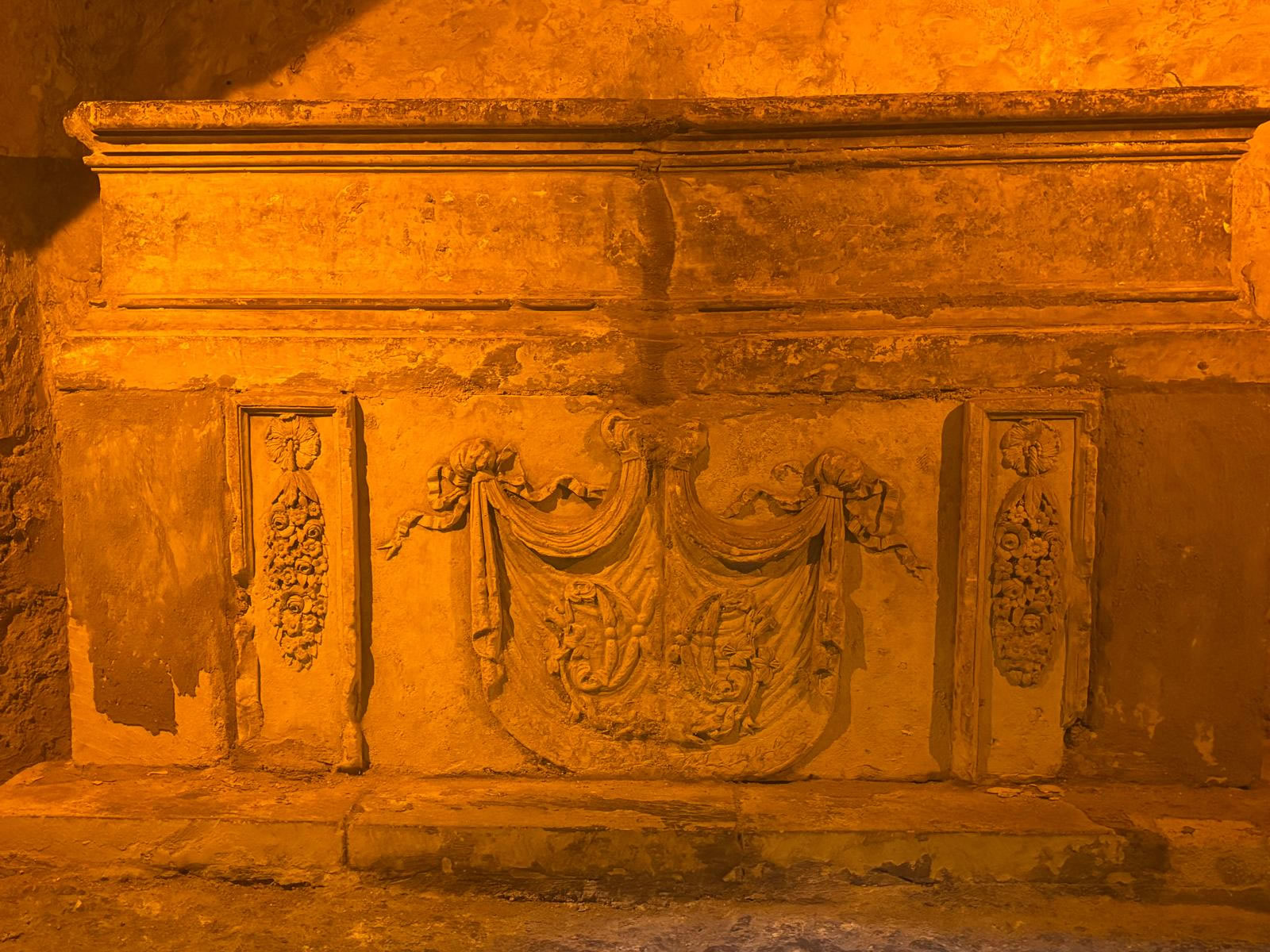
The canopied table-grave facing the Agape Table is recorded as having been decorated with frescoes, though only faint traces were noted as surviving. This matters: even fragmentary paint can provide evidence for use-phases and devotional meaning long after active burial ceased.
Conservation and responsible visiting
Underground limestone environments are highly sensitive to humidity changes, salts, soot, and physical contact. Even small actions—touching surfaces, leaning against walls, or using open flames—can cause irreversible damage. Where lighting is present, it should be carefully managed to limit biological growth.
- Do not touch stonework, tomb edges, or any painted traces.
- Avoid candles (soot and heat accelerate deterioration).
- Keep voices low and move carefully—tight spaces amplify vibration and accidental contact risk.
- Follow site guidance (access conditions may change for conservation reasons).
Visiting information
- Coordinates: 35.881771, 14.398110
- Locality: Rabat, Malta
- Experience: a small crypt and hypogeum with tomb diversity and an Agape Table feature
- Access note: underground access may be donation-based or limited to specific times; always respect closures and barriers.
FAQ
Is this the same as St Paul’s Catacombs?
No. St Cathaldus is a separate, smaller hypogeum/crypt complex beneath St Cathaldus Chapel. It sits within the wider Rabat area known for multiple catacomb clusters, including St Paul’s and St Agatha’s.
What makes St Cathaldus catacombs distinctive?
The site is especially known for combining a medieval crypt with an older Christian hypogeum, and for clearly documented features such as the Triclinium chamber, an Agape Table, and multiple tomb types (including loculi).
When was the chapel above built?
The chapel above was completed in 1745, constructed over a medieval crypt with an underlying Christian hypogeum.