Location Map Coordinates 35.919603, 14.431548
35.919603, 14.431548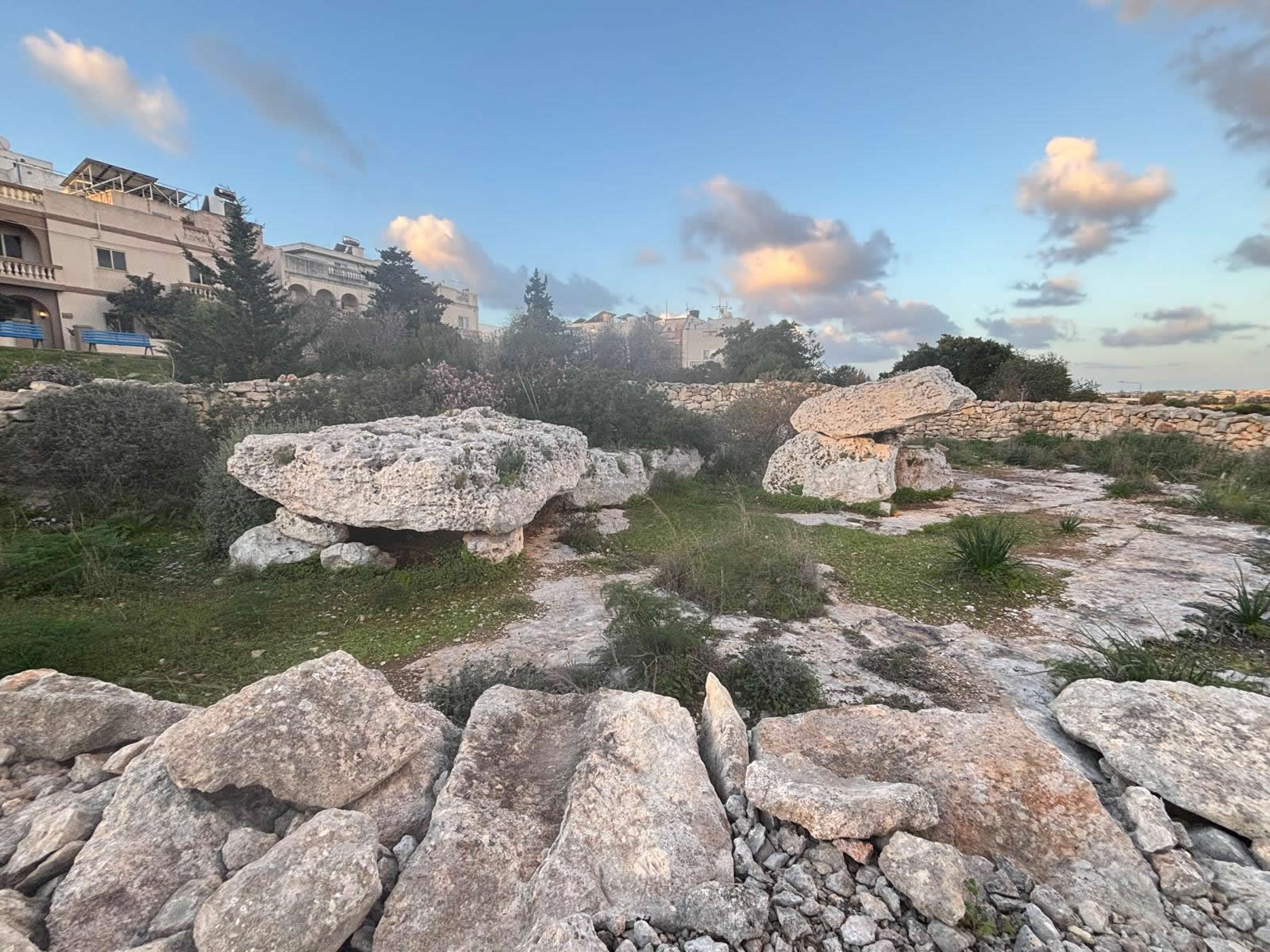
Overview
The Mosta Dolmen is one of the most accessible examples of a Maltese dolmen: a prehistoric megalithic monument formed by a large stone slab (the capstone) supported by smaller stones beneath. Dolmens are found across Europe and the Mediterranean, where they are often associated with burial and ritual landscapes. In Malta, however, their role is less certain: published research repeatedly notes that Maltese specimens are difficult to date directly and do not consistently preserve clear burial evidence.
This page uses the location you provided: 35.919603, 14.431548. (As with many small archaeological features, online map pins can be approximate; if you maintain your own field-checked points, these are the best reference for visitors.)
What is a dolmen?
A dolmen is a megalithic structure typically composed of:
- One large capstone laid horizontally, and
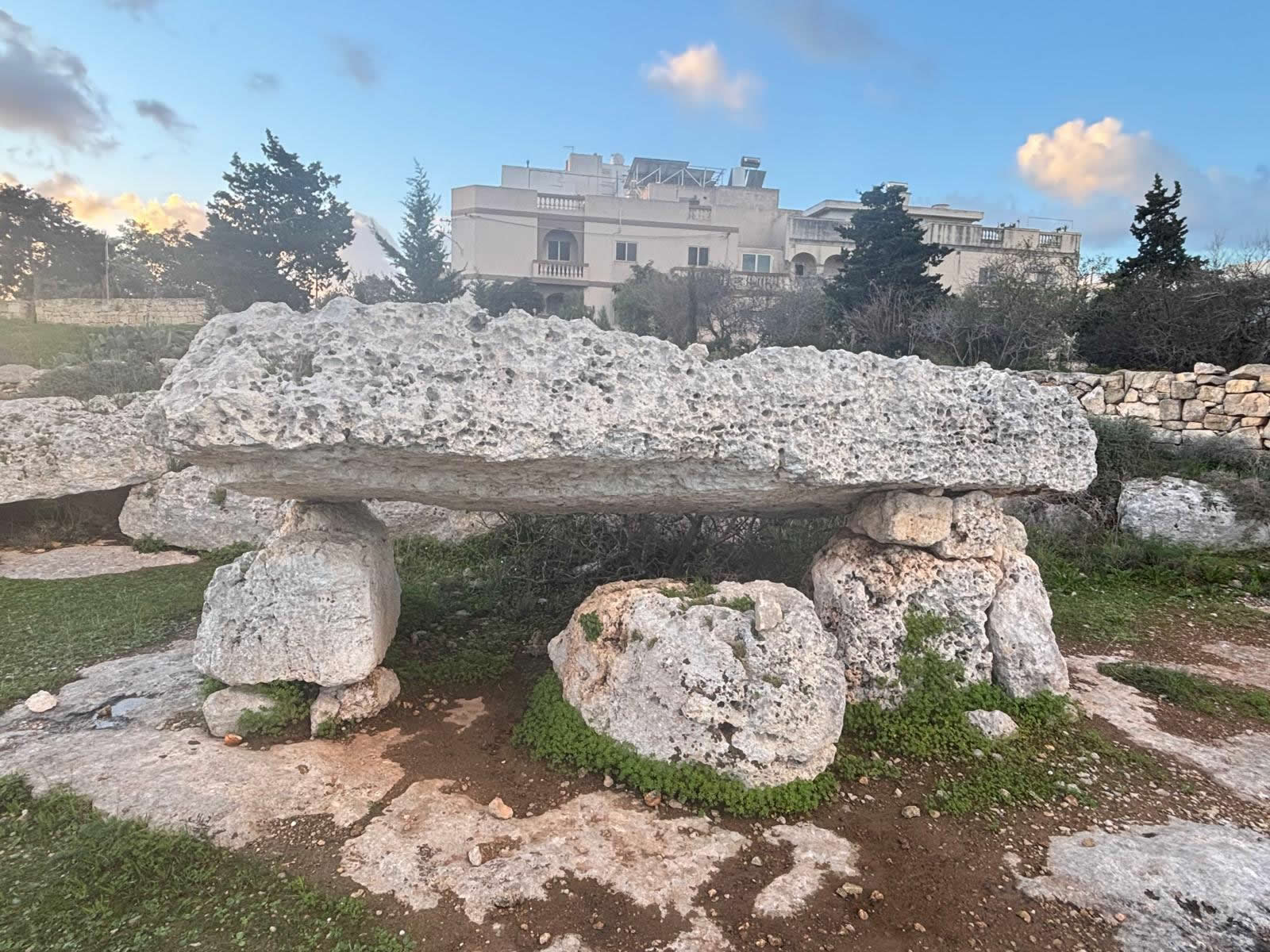
- Two or more upright stones (supports) creating a small space or chamber beneath.
In many countries, dolmens are linked to funerary traditions. In Malta and Gozo, dolmens are rarer than the islands’ famous temple complexes, but they form an important part of the wider prehistoric monument landscape.
What you’ll see at the site
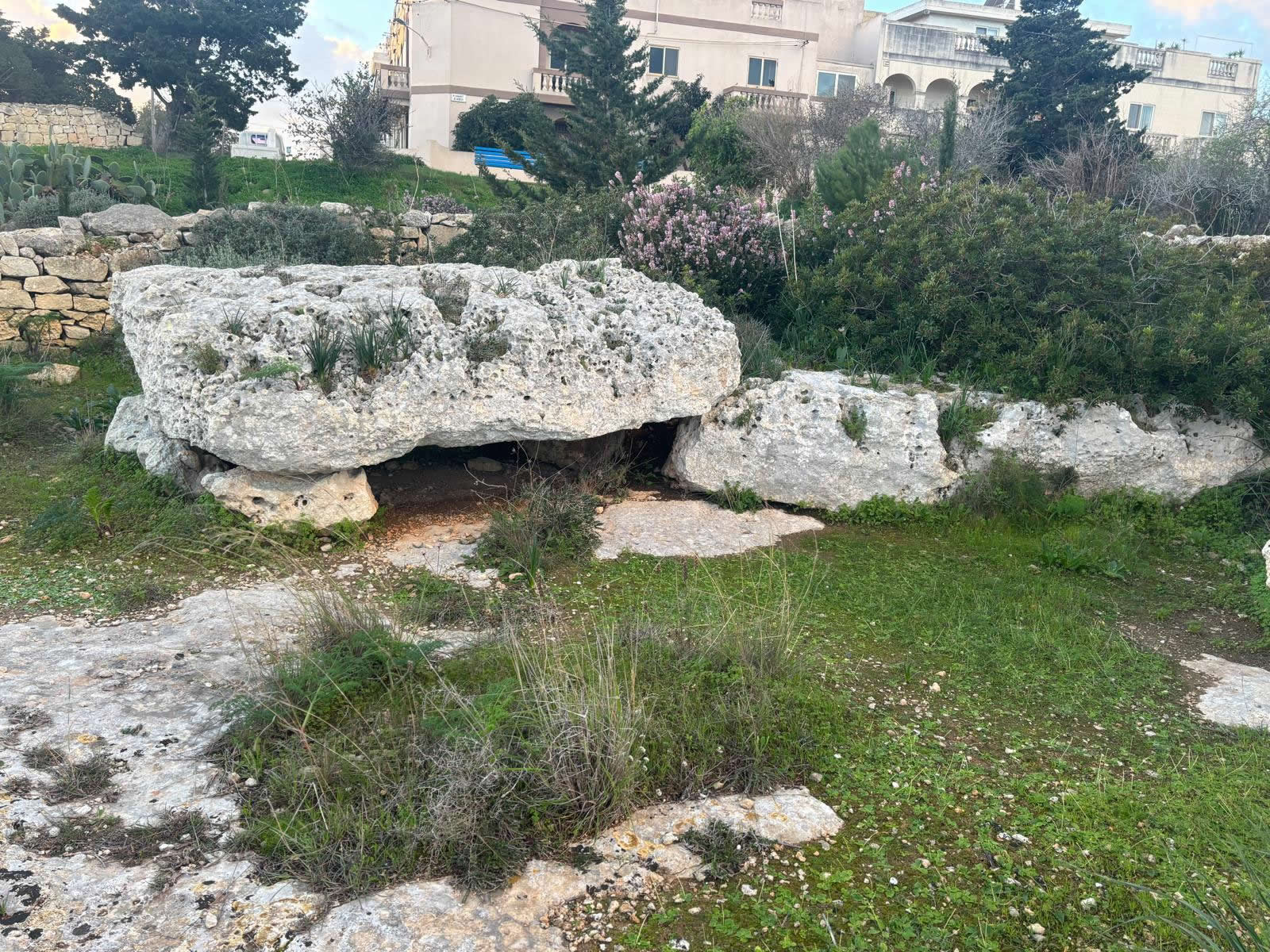
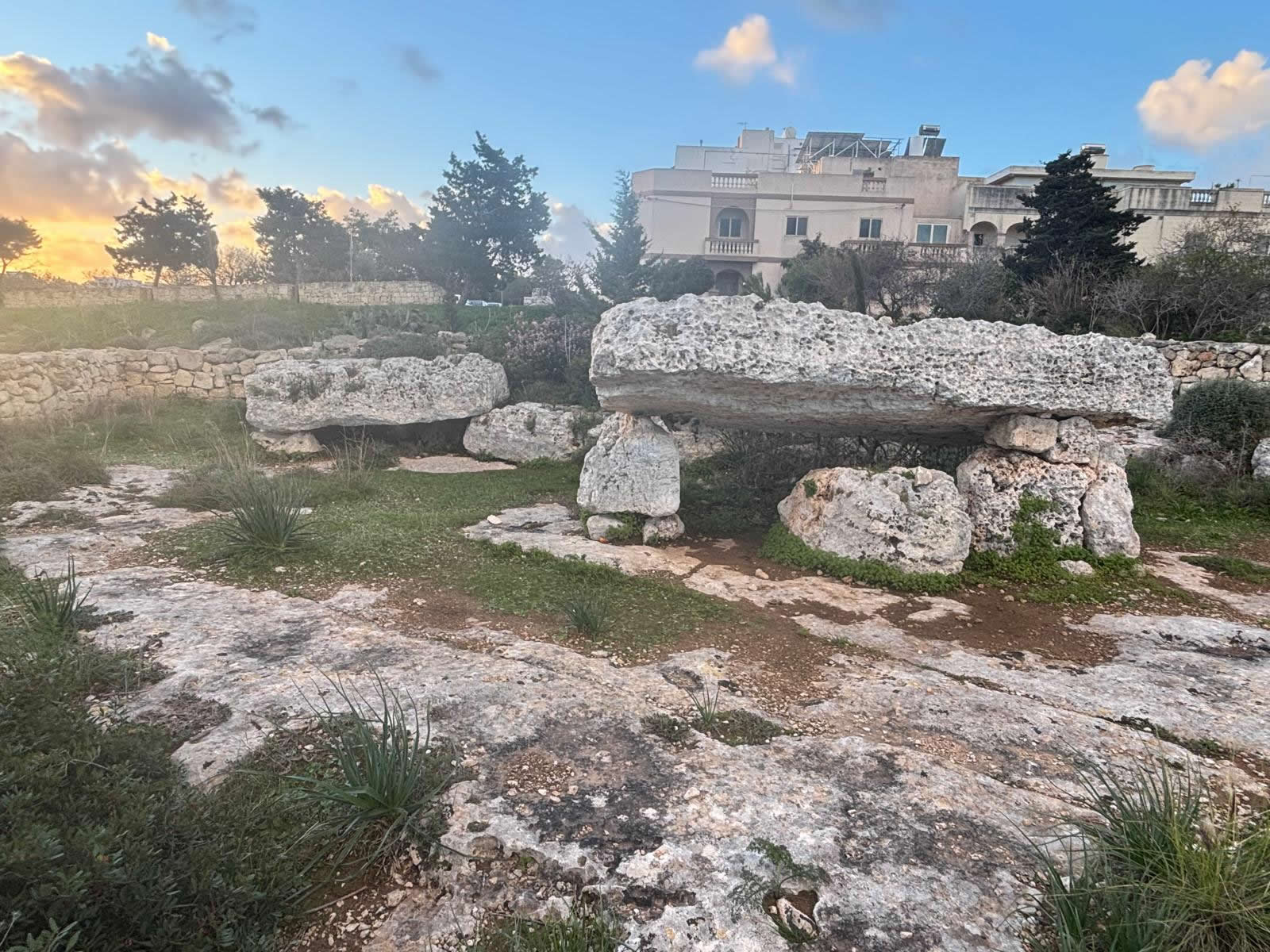
At the Mosta Dolmen location, focus on the overall “table-stone” geometry: the large slab resting on smaller supports, with a void beneath. Over centuries, vegetation growth, soil movement, and nearby human activity can change how clearly the base stones and the chamber-like space are visible.
Best way to view and photograph
- Low-angle sunlight (early morning/late afternoon) increases shadow contrast and makes edges clearer.
- Step back to capture the structure as a whole, then take close-ups of contact points (capstone-to-support).
- Avoid climbing: weight, vibration, and abrasion can damage the stone and the surrounding ground.
Full history: the Mosta area and Malta’s earliest dolmen discoveries
The Mosta area occupies Malta’s central-northern plateau and ridge landscape—an environment that has attracted people since prehistory. This broader region combines wide limestone expanses, valleys, and strategic movement routes that connected inland zones to other parts of the island. It is within this setting that some of Malta’s earliest recorded dolmen discoveries were made.
Early documentation of Maltese dolmens around Mosta
A key published account on Maltese dolmens notes that the first group of dolmens discovered in the Maltese Islands was found in a field described as “Ix-Xaghra ta’ fuq Wied Filep”, between the village of Mosta and Fort Mosta. The best-preserved example in that cluster is described as a hard coralline limestone slab approximately twelve feet long, five feet wide, and two feet thick, supported by roughly hewn stones and raised several feet above the ground.
The same source also references a pair of dolmens at Sta Margherita, Mosta, demonstrating that the Mosta district is not associated with a single isolated monument but rather with a broader prehistoric dolmen presence in the locality.
Function and interpretation
Dolmens elsewhere are frequently interpreted as funerary monuments. In Malta, the picture is less clear. Research on Maltese dolmens notes that clear burial evidence is often absent and that disturbance and landscape change make interpretation difficult. As a result, Maltese dolmens are best understood as multi-meaning megalithic monuments that may have served a range of roles—ritual, territorial, commemorative, or symbolic—within prehistoric communities.
What archaeologists look at when interpreting a dolmen
- Placement: prominent viewpoints, ridges, valley edges, and route corridors.
- Construction: stone type, how supports are set, and whether any “prepared” surface exists beneath.
- Associated traces: pottery, tool fragments, soil anomalies, or nearby features (often missing or disturbed in Malta).
- Comparisons: similarities and differences with other Maltese and Mediterranean dolmens.
Dating: what we can (and can’t) say
Dolmens in other regions are commonly placed in the Bronze Age, but published research stresses that Maltese dolmens are not comfortably dated with current evidence: material around them is frequently disturbed, and diagnostic finds are often absent. Because of this, it is safer to describe the Mosta Dolmen as a prehistoric megalithic monument rather than attach a single precise phase unless a site-specific excavation report exists.
eMalta editorial note: if you later add a confirmed Heritage Malta / Superintendence of Cultural Heritage entry or published site report for this exact monument, you can update this section with a narrower date range and official designation.
Visiting responsibly
- Do not climb on the stones or attempt to “test” movement.
- Leave no trace: avoid moving rocks, clearing vegetation aggressively, or widening informal paths.
- Respect boundaries: these monuments can sit close to residences, fields, or access limitations.
- Photography tip: use raking light and take wide shots that show the dolmen in its landscape setting.
FAQ
Where is the Mosta Dolmen?
Use 35.919603, 14.431548 for navigation.
Is the Mosta Dolmen a tomb?
Dolmens are often tombs elsewhere, but published research highlights that Maltese dolmens frequently lack clear associated burials. In Malta, the function remains debated, and it is best to avoid certainty without site-specific evidence.
What should I look for on-site?
Look for a large capstone supported by smaller stones beneath, creating a small void/chamber. Low-angle sunlight helps reveal the structure.