Overview
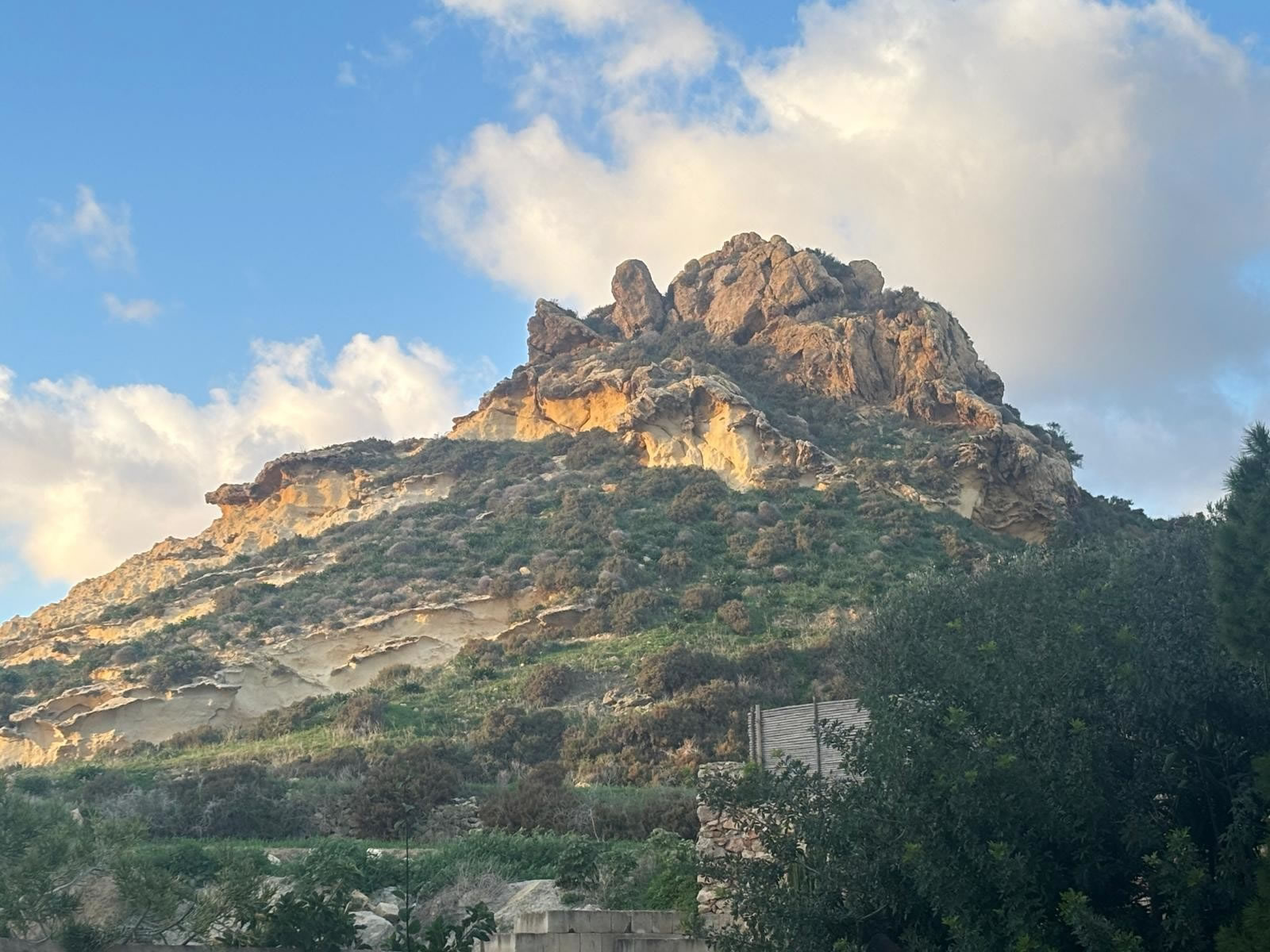
Il-Qolla s-Safra (“the Yellow Hillock”) is a distinctive natural knoll on Gozo’s north coast, overlooking the built-up shoreline between Marsalforn and Qbajjar. While not a large summit, it’s visually dramatic: steep faces of yellowish rock, a pointed crest, and a sculpted profile that makes it easy to spot from the bays and the coastal road.
Name origin (what “Il-Qolla s-Safra” means)
In Maltese, qolla can mean an earthen jar or jug, and the hillock’s name is commonly understood as “the yellow jug/hillock” — a nod to both the silhouette and the colouring of the rock.
Geology (why it’s yellow)
Local descriptions attribute the hillock’s distinctive colour to a weak yellowish material referred to as “Green Sand” (often described as “yellow rock” in lay terms). This rock is noted as unsuitable for construction because it is relatively weak, and it can contain fossilised sea shells—a reminder that Gozo’s geology records ancient marine environments.
Full detailed history (as a landmark through time)
19th-century scientific interest: A heritage trail account notes that in 1879, Andrew Leith Adams found fossilised seal teeth near the hillock, pointing to past fauna and palaeontological curiosity in the area.
Archaeological mentions nearby: The same heritage trail text also references an allusion (in a later book) to a small catacomb found in the vicinity of Il-Qolla s-Safra, suggesting the wider landscape around the hillock has attracted antiquarian interest beyond geology.
Coastal defence era (Order of Saint John): Marsalforn’s bays were historically part of Gozo’s defensive coastline. An artillery fortification known as Qolla s-Safra Battery (also called Saint Mary’s Battery) was built in 1715 by the Order of Saint John as part of a chain of coastal fortifications, and it was later demolished. The name connection reflects how strongly the hillock anchored local orientation and place-naming.
Early 20th-century identity: A Gozo Album entry describing a panoramic photo from around circa 1920 explicitly notes the hillock rising prominently in the background of Marsalforn—evidence of its long-standing role as an iconic visual marker for the area.
What we can confidently say: Il-Qolla s-Safra’s “history” is chiefly the story of a natural landmark—its geology, its appearance in local memory and photography, and its connection to nearby scientific/heritage notes and Marsalforn’s defensive coastline.

Folklore & local storytelling
Contemporary retellings describe a local myth in which a witch turns two fleeing young women into hillocks—the first becoming the Yellow Hillock and the second the White Hillock—while a third escapes by boat from the nearby coast. Whether taken literally or as symbolic folklore, the story shows how the landscape is woven into Gozo’s oral imagination.
How to visit (responsibly)
- Best viewpoints: coastal road and promenades around Marsalforn/Qbajjar; golden hour light brings out the hillock’s colour.
- On foot: routes commonly follow the coast toward saltpans and bays; stay on durable paths where possible.
- Conservation note: local heritage commentary warns about the visual impact of surrounding development—please keep the site respectful and litter-free.
FAQ
Where is Il-Qolla s-Safra?
It sits on Gozo’s north coast between Marsalforn and Qbajjar, overlooking the bays and nearby coastal road.
Why is it so yellow?
Descriptions link the colour to “Green Sand” rock (often called “yellow rock”), which can contain fossil shells and is considered weak for building stone.
Is there man-made heritage linked to the name?
Yes—an artillery battery known as Qolla s-Safra Battery (Saint Mary’s Battery) was built in 1715 by the Order of Saint John and later demolished.
