Hamrun Round Water Tower
Here’s a detailed history & construction overview of Il-Monument tat-Tromba (also known as it-Turretta ta’ Atoċja / the Hamrun Round Water Tower) in Ħamrun, Malta.
What is Il-Monument tat-Tromba
The structure is one of the water inspection / regulation towers on the Wignacourt Aqueduct route.
Locally called Il-Monument tat-Tromba, or it-Turretta ta’ Atoċja (or variants).
It is round in shape and built on the Hill of St Nicholas in Ħamrun, tucked between modern buildings.

History & Construction
| Aspect | Details |
| Date of construction / involvement | The tower was built around 1615 as part of the original work of the Wignacourt Aqueduct, under Grand Master Alof de Wignacourt. |
| Purpose | To serve as a water inspection tower / regulation point — to allow the aqueduct’s flow to be inspected, regulated, and possibly stored briefly. It was not itself a storage cistern of large volume but a control point. |
| Design / architecture | It has a round (cylindrical) form, which distinguishes it from the more turret-like or square “turretta” towers (such as the Santa Venera Turretta). It originally had an open water tank in the tower for inspection. The tower bears the coat of arms of Wignacourt and a Latin inscription. |
| Inscription | The commemorative inscription on the tower reads (in Latin): |
| “VT SPIRITVS IN AQVIS SIC SPIRITVS AB AQVIS.” | |
| Translated roughly: “As there is life in water, so (i.e. likewise) life from water.” | |
| Later modifications / commemorations | In 1780, when the aqueduct was improved by Grand Master de Rohan, a commemorative obelisk was erected some distance from this tower. That obelisk is said to have a coat of arms that was damaged during WWII and is located in a private garden . |

Current Condition & Significance
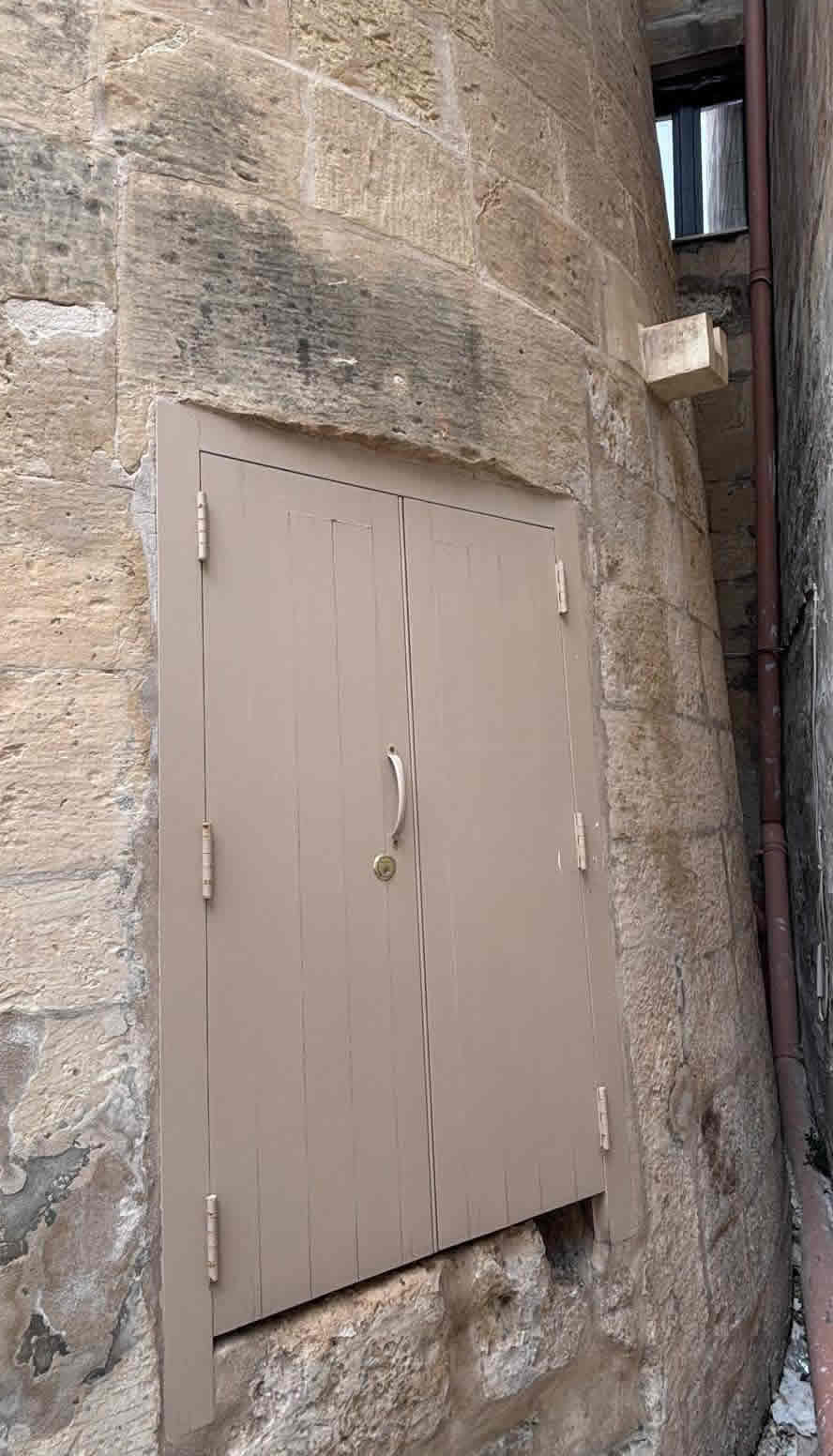
It is now surrounded by modern buildings, squeezed between them in a densely built area of Ħamrun.
The tower is in a dilapidated state in places, but is recognized for restoration. In fact, planning approval has been recently granted (2019-2020s) to restore this “iconic structure” back to better condition.
The tower remains an important historical landmark, as it represents not only Malta’s early modern water supply engineering, but also shows how water supply infrastructure was integrated into urban/rural areas. It’s one of the few surviving water inspection towers of the original aqueduct system.
Inscriptions & Local Names
Local Maltese name: Il-Monument tat-Tromba (“The Monument of the Spout / Spout-monument”) — likely referring to the idea of water “spouting” / flowing.
Also it-Turretta ta’ Atoċja (some sources spell Atocia / Atoċja).
The Latin inscription “VT SPIRITVS IN AQVIS SIC SPIRITVS AB AQVIS” is the key surviving carved text on it.
