The Cittadella (also called the Citadel or Castello) is Gozo’s historic fortified acropolis, standing above the town of Victoria (Rabat). It is one of the island’s most iconic sites, with a history spanning thousands of years. Here’s a detailed overview:

Historical Background
Prehistoric origins: Archaeological evidence indicates that the site was occupied during the Bronze Age (c. 1500 BC). The high vantage point gave natural defensive advantages.
Classical period: During Punic and Roman times, the site likely served as an acropolis. Remains of Roman structures and artefacts (including pottery and coins) have been found within the Cittadella’s perimeter.
Medieval fortification: After the Arab period (870–1091), the Normans and later rulers fortified the hilltop. It became the defensive stronghold for Gozo’s population against pirate and corsair raids.
1565 and Ottoman threat: After the Great Siege of Malta (1565), the Knights of St. John realized the importance of strengthening Gozo’s defences. The Cittadella was modernized with bastions, curtain walls, and gun platforms.
1551 raid: A crucial moment came before these fortifications, when Ottoman corsairs under Sinam Basha and Dragut attacked Gozo. Nearly the entire island population (estimated 5,000–6,000) was enslaved. This tragedy underlined the need for stronger fortifications.
Knights’ construction: Between the late 16th and early 17th centuries, the Knights rebuilt and expanded the Cittadella’s walls under Italian and military engineers, including Giovanni Rinaldini and Vincenzo Maculano. The fortifications were designed in the bastioned style, similar to Valletta’s.
Decline in military use: By the 18th century, advances in artillery reduced the Cittadella’s strategic military value. It remained a garrison, but its defensive role diminished.
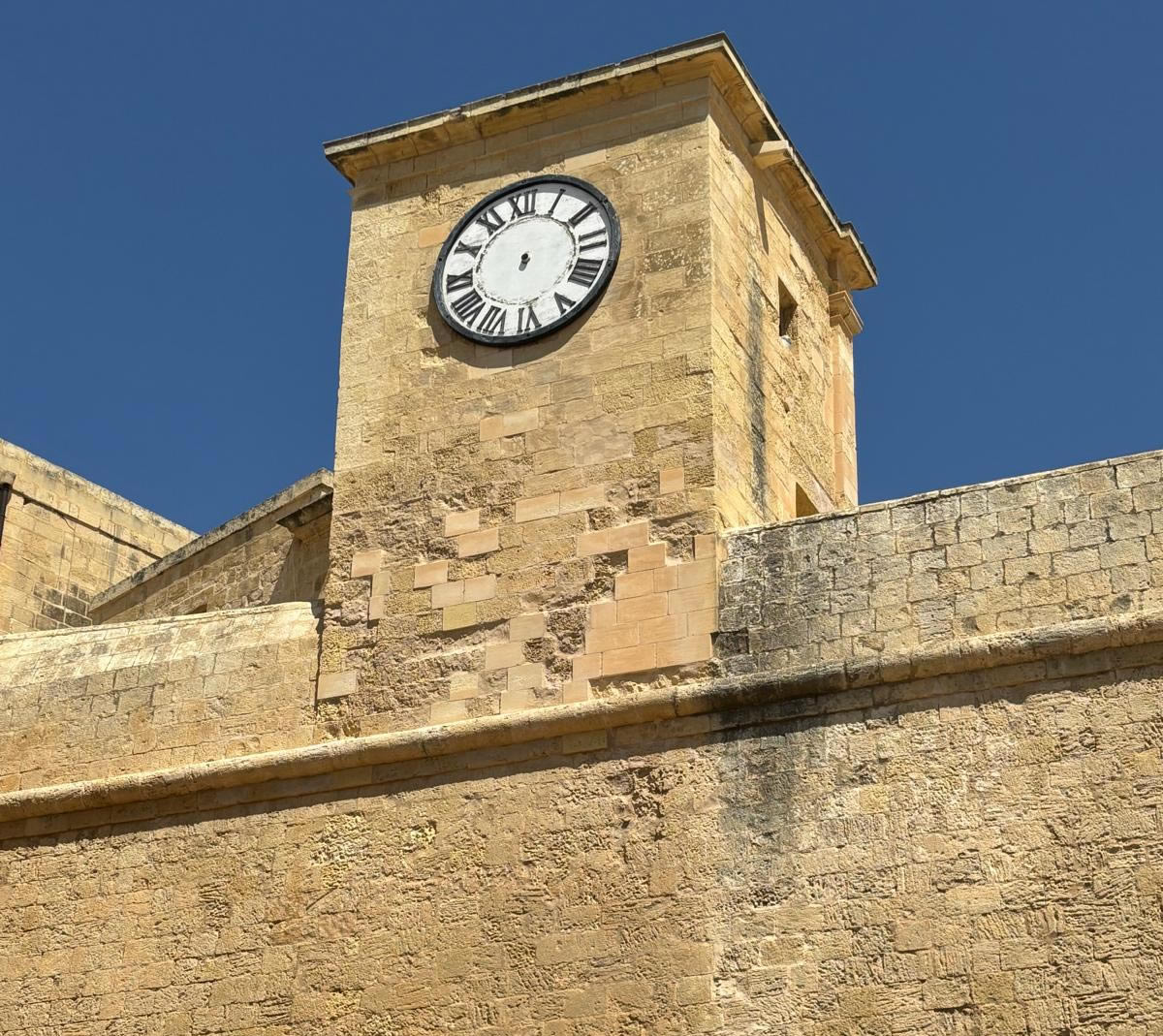
Architecture & Construction
1.Overall LayoutThe Cittadella occupies a prominent limestone hill in the center of Gozo, above modern Victoria (Rabat).
Its irregular polygonal shape follows the contours of the hilltop, maximizing defensive potential.
The fortifications form an integrated bastioned system, surrounding a compact town core with narrow alleys, residential houses, and the cathedral.
Size: Much smaller than Valletta’s fortifications — the Cittadella was designed to shelter Gozo’s population in times of attack rather than house a large garrison.
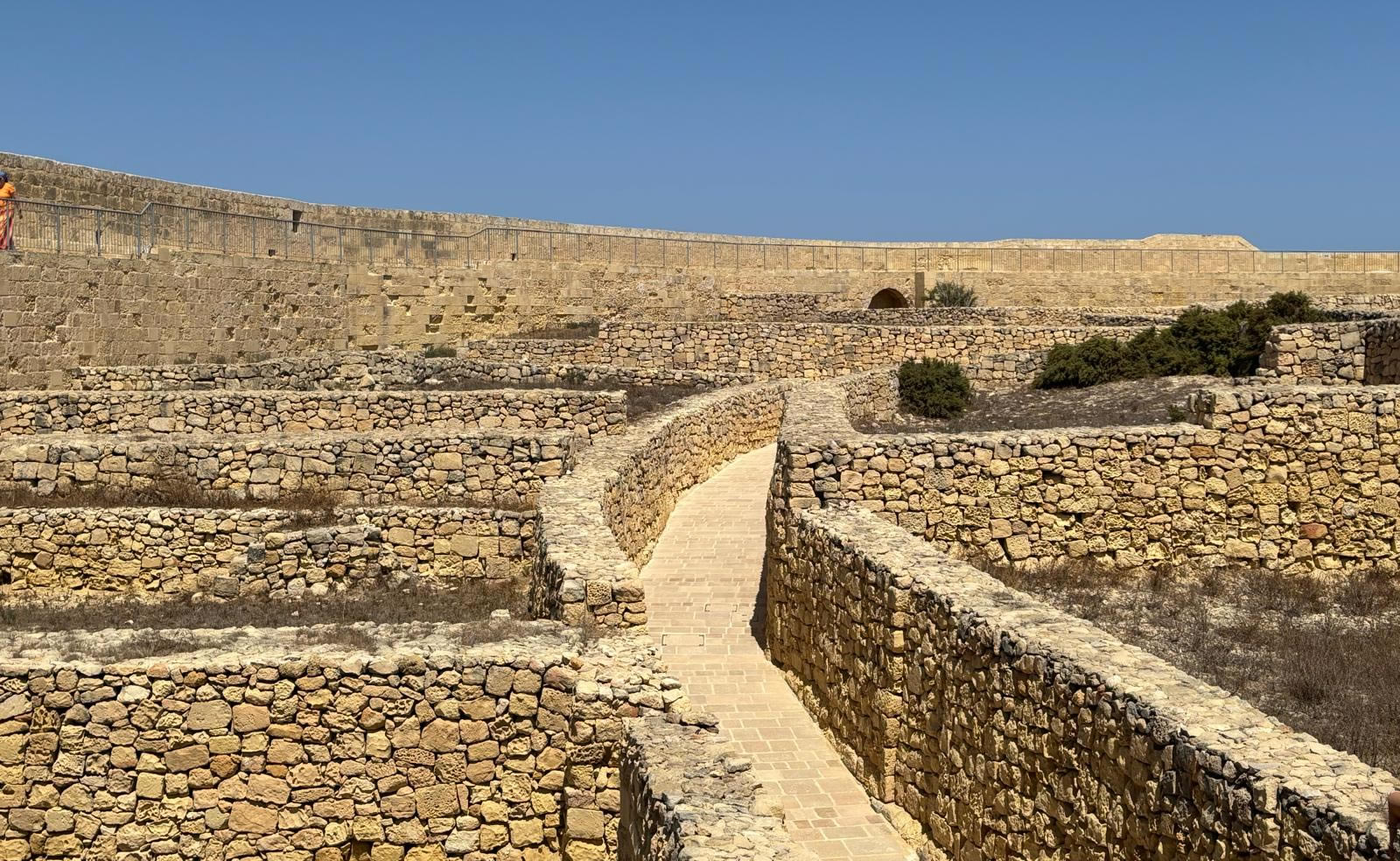
2. Fortification Features
The defensive structures reflect the military architecture of the Knights of St. John, especially the Italian school of bastioned design:
Curtain Walls:Thick sloping limestone walls enclose the entire citadel.
Built with an inner rubble core and outer ashlar blocks for strength.
Bastions (key to the design):St. Michael’s Bastion – guarding the south-west.
St. Martin’s Bastion – protecting the northern side.
St. John’s Bastion – overlooking the east.
Bastions were angled to allow flanking fire, preventing attackers from approaching the walls without being exposed to cannon fire.

The main entrance was redesigned by the Knights in the late 16th century.
It features a sloping ramp (for easier cannon movement) and an ornamental gateway, still visible today.
Ditch (Foss):A defensive ditch was cut around the outer walls, increasing the obstacle for attackers.
In modern times, it has been landscaped and is accessible to visitors.
Casemates & Artillery Platforms:Vaulted casemates provided storage and living quarters for soldiers.
Platforms were constructed on bastions to mount cannons with wide fields of fire.

3. Internal Structures
Inside the walls, the Cittadella had both religious and civic architecture:
Cathedral of the Assumption:
Built between 1697–1711, replacing an earlier church damaged in the 1693 earthquake.
Designed by Lorenzo Gafà, Malta’s foremost Baroque architect.
A Latin cross layout with side chapels, high nave, and dome (a painted illusion of a dome exists, as the ground was too unstable for a real dome).
Other Chapels:Chapels served different communities within the citadel.
Some were dedicated to St. Joseph, St. Barbara, and St. John.
Palazzo del Governatore (Governor’s Palace):Residence of the Knights’ appointed governor of Gozo./
Served as the administrative heart of the island during their rule.

Used by the Knights between the 16th–19th centuries.
Graffiti carved by prisoners (including ships, crosses, and names) survive on its limestone walls.
Cisterns and Storage:Water cisterns carved into bedrock ensured a supply during sieges.
Granaries and storerooms held food reserves.

4. Building Materials & Techniques
Globigerina limestone (local Maltese stone) was the primary material, easy to quarry but needing constant maintenance.
Corbelled techniques and thick walls were used to absorb cannon fire.
Finely cut ashlar blocks were used for visible faces, with rubble infill behind.
Defensive walls had sloping bases (talus) to deflect projectiles and make scaling harder.

5. Defensive Evolution
Originally a medieval fortress with simple curtain walls and towers.
After the 1551 Ottoman raid, the Knights commissioned Italian engineers to modernize it into a Renaissance bastioned fortress (late 16th–17th century).
The works were contemporary with the fortifications of Valletta, Birgu, and Senglea, though on a smaller scale.
By the 18th century, with changes in military technology and greater peace, the fortress became more symbolic than functional.

Summary:
The Cittadella’s architecture is a fusion of ancient settlement, medieval stronghold, and Renaissance fortress. Its bastions, walls, and cathedral symbolize Gozo’s resilience, while its compact urban core preserves the lived history of centuries of islanders who sought safety within its walls.

Modern Role and Restoration
UNESCO Tentative List: The Cittadella is included in the tentative list of UNESCO World Heritage Sites, together with Malta’s other fortifications.
Restoration: In the early 21st century, major EU-funded restoration projects stabilized the bastions, cleaned stonework, and upgraded visitor facilities.
Visitor experience: Today, it houses the Cathedral Museum, Gozo Museum of Archaeology, Old Prison, and Nature Museum.
Views: The ramparts offer panoramic views over Gozo’s countryside, making it both a cultural and scenic highlight.

How to Cittadella (Victoria, Gozo)
From the main island of Malta, you’ll first need to reach Ċirkewwa Ferry Terminal (north of Malta).
The Gozo Channel ferry operates every day, about every 30–45 minutes.
Crossing time: 25 minutes.
Arrives at Mġarr Harbour, Gozo.
2. From Mġarr Harbour to Victoria (Rabat)By Bus:
The main Gozo bus routes 301, 303, 323 all run from Mġarr to Victoria (Rabat), where the Cittadella is located.
Journey time: 15–20 minutes.
By Taxi / Ride-Hailing:
Taxis and ride apps are available at the harbour.
Cost: approx. €10–15 to Victoria./
By Car Rental:
Car hire is available at Mġarr Harbour.
The drive to Victoria is straightforward (about 7 km, 15 minutes).
3. On Foot in VictoriaThe Cittadella sits on a hill overlooking the town of Victoria.
From Victoria bus station, it’s a 5–10 minute walk uphill.
Signposts clearly direct visitors.
ParkingA public car park is located just outside the Cittadella’s main gate (Euro 2).
Spaces can fill up during peak hours, so mornings are best.

Summer (Apr–Sept): 9:00 AM – 5:00 PM
Winter (Oct–Mar): 9:00 AM – 4:00 PM
Closed: Good Friday, Christmas Day, New Year’s Day, Easter Sunday
Entrance FeesCitadel Visitor Centre + museums combo ticket:
Adults: ~€5
Children, students, seniors: ~€3
Entrance to the fortifications and Cathedral area is generally free to walk around.
Separate fee applies for the Cathedral of the Assumption and the Old Prison.
Tips for VisitorsWear comfortable shoes — lots of cobbled streets and uphill walking.
The Cathedral of the Assumption and Old Prison are must-see highlights.
Best views: from the bastion walls, you can see almost all of Gozo.
Arrive early morning or late afternoon for fewer crowds and softer light for photos.

The slab is a well-known plaque about Bernardo De Opuo (spelled OPVO on the stone).
Who he was (and why the plaque exists)
What the inscription says (line by line)
Extra Information