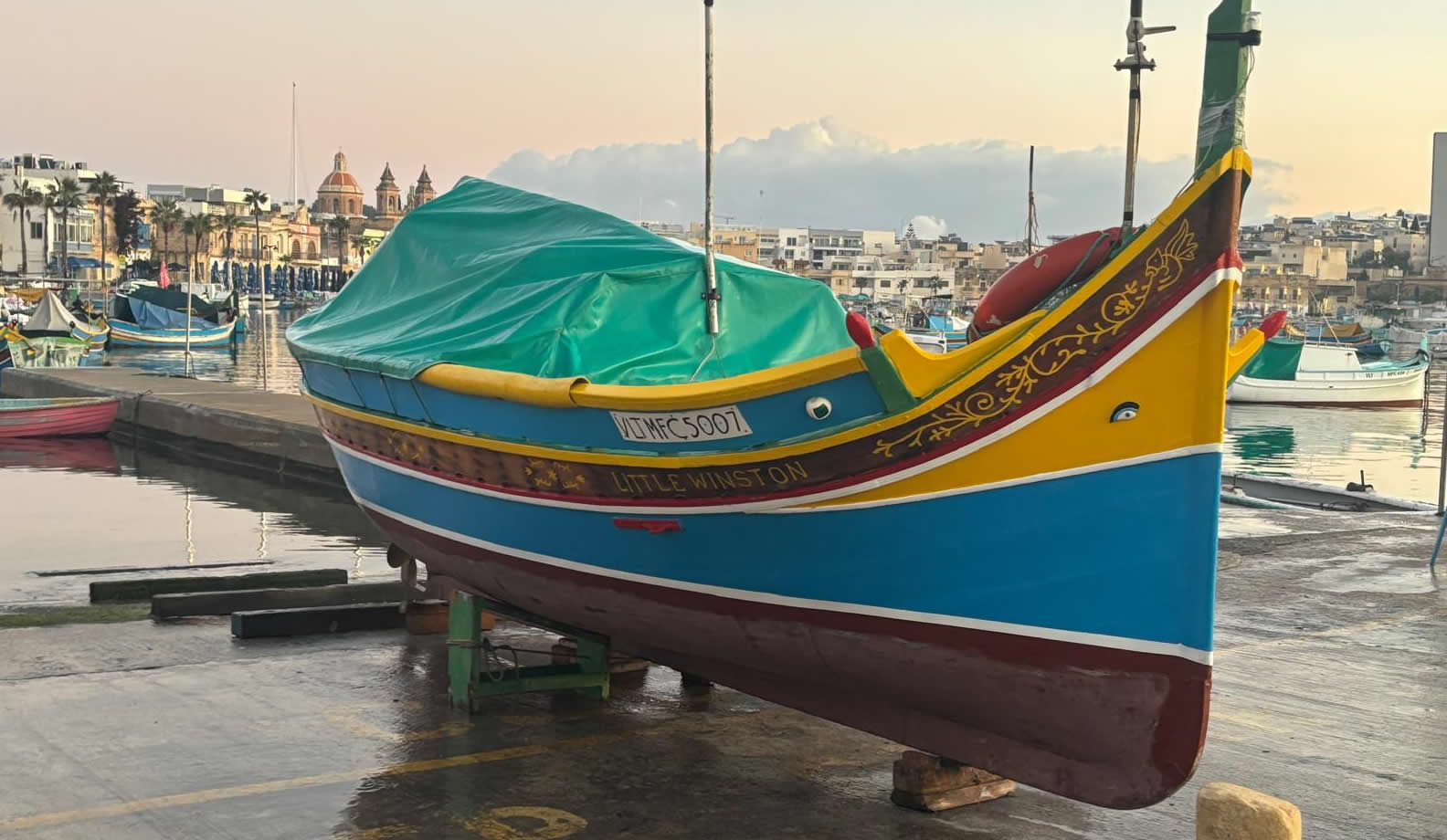
Malta's colourful fishing boat and one of the oldest surviving symbols of the island's maritime heritage.
Quick Facts
| Traditional Name | Luzzu |
|---|---|
| Country | Malta |
| Primary Purpose | Fishing |
| Construction | Traditionally built from timber |
| Distinctive Feature | Painted protective eyes on the bow |
| Typical Colours | Yellow, Blue, Green and Red |
| Best Place to See Luzzus | Marsaxlokk Fishing Village |
| Status | National symbol of Malta's maritime heritage |
Introduction
Few images capture the spirit of Malta as perfectly as the colourful Luzzu. Resting peacefully in fishing harbours or gently rocking on the crystal-clear waters of the Mediterranean, these traditional wooden boats have become internationally recognised as one of Malta's most enduring cultural symbols. Their brightly painted hulls, distinctive shape and mysterious eyes make them instantly recognisable to visitors from around the world.
Although today the Luzzu is admired by photographers and tourists alike, it was never created as a decorative object. It is first and foremost a hardworking fishing boat, designed over generations to cope with Malta's rocky coastline, changing weather conditions and the practical needs of local fishermen. Every curve of the hull, every timber beam and every splash of colour reflects centuries of experience passed from one boatbuilder to another.
The story of the Luzzu is closely intertwined with the history of Malta itself. For thousands of years, the Maltese Islands have occupied a strategic position at the heart of the Mediterranean Sea. Ancient Phoenicians, Greeks, Romans, Arabs, Normans, the Knights of St John and the British all recognised Malta's importance as a maritime crossroads. Their influence helped shape the island's seafaring traditions and contributed to the development of local boatbuilding techniques that survive to this day.
One of the most fascinating features of the Luzzu is the pair of painted eyes found on the bow. These striking symbols are believed to descend from ancient Mediterranean traditions dating back more than two thousand years. While historians continue to debate their precise origin, they remain a powerful reminder of the beliefs, superstitions and customs that once guided sailors across uncertain seas. For generations of Maltese fishermen, these eyes represented protection, good fortune and a safe return home.
Despite advances in modern technology and the introduction of fibreglass fishing vessels, the Luzzu continues to occupy a special place in Malta's identity. Traditional wooden examples are carefully restored, preserved and celebrated during local festivals, while working fishing boats continue to support coastal communities. The harbour at Marsaxlokk remains one of the best places to experience this living heritage, where colourful Luzzus line the waterfront against a backdrop of historic buildings and bustling fish markets.
This guide explores the complete story of the traditional Maltese Luzzu—from its ancient roots and unique construction to its cultural significance today. Whether you are planning a visit to Malta, researching maritime history or simply curious about one of Europe's most iconic traditional boats, the Luzzu offers a fascinating glimpse into the enduring relationship between the Maltese people and the sea.
History of the Maltese Luzzu
The Luzzu is one of Malta's best-known national symbols, yet its history is often misunderstood. While the brightly coloured fishing boat seen in Malta's harbours today is a relatively modern design, its origins lie in thousands of years of maritime tradition that stretches back to the earliest civilisations of the Mediterranean. Rather than being invented at a single point in history, the Luzzu developed gradually as generations of Maltese fishermen refined their boats to suit local waters, fishing methods and changing technology.
Malta's central position between Europe and North Africa made the islands an important stopping point for traders, explorers and naval powers long before…
Perhaps no feature of the traditional Maltese Luzzu is more distinctive than the pair of large painted eyes decorating the bow. Known in Maltese as l-għajnejn ("the eyes"), these colourful symbols immediately distinguish the Luzzu from almost every other fishing boat in the Mediterranean. To many visitors they are simply decorative, but for generations of Maltese fishermen they represented protection, guidance and good fortune at sea.
The exact origin of the painted eyes remains the subject of debate among historians. Similar symbols appear on ancient ships throughout the Mediterranean and have been found in archaeological evidence from Egypt, Phoenicia, Greece and other maritime civilisations. Rather than belonging exclusively to one culture, the practice seems to have spread naturally between seafaring peoples who shared ports, trade routes and navigation techniques.
Many researchers associate the Luzzu's eyes with the ancient Eye of Horus or Eye of Osiris from Egyptian mythology. These powerful symbols represented protection, healing and safe journeys. The Phoenicians, who established trading settlements in Malta around the eighth century BC, may have introduced similar protective imagery to the islands through their extensive maritime networks.
Other historians suggest the painted eyes simply evolved from the practical belief that a boat should be able to "see" the dangers ahead. Before modern navigation systems, sailors depended heavily upon observation, experience and favourable weather. Giving a vessel symbolic eyes reflected the hope that it would safely guide its crew through storms, hidden rocks and unpredictable seas.
Whatever their precise origin, the painted eyes became an enduring part of Maltese maritime tradition. Boatbuilders carefully painted each pair by hand, ensuring every Luzzu possessed its own distinctive expression. Even today, newly restored wooden Luzzus continue to display the characteristic eyes as a tribute to centuries of tradition.
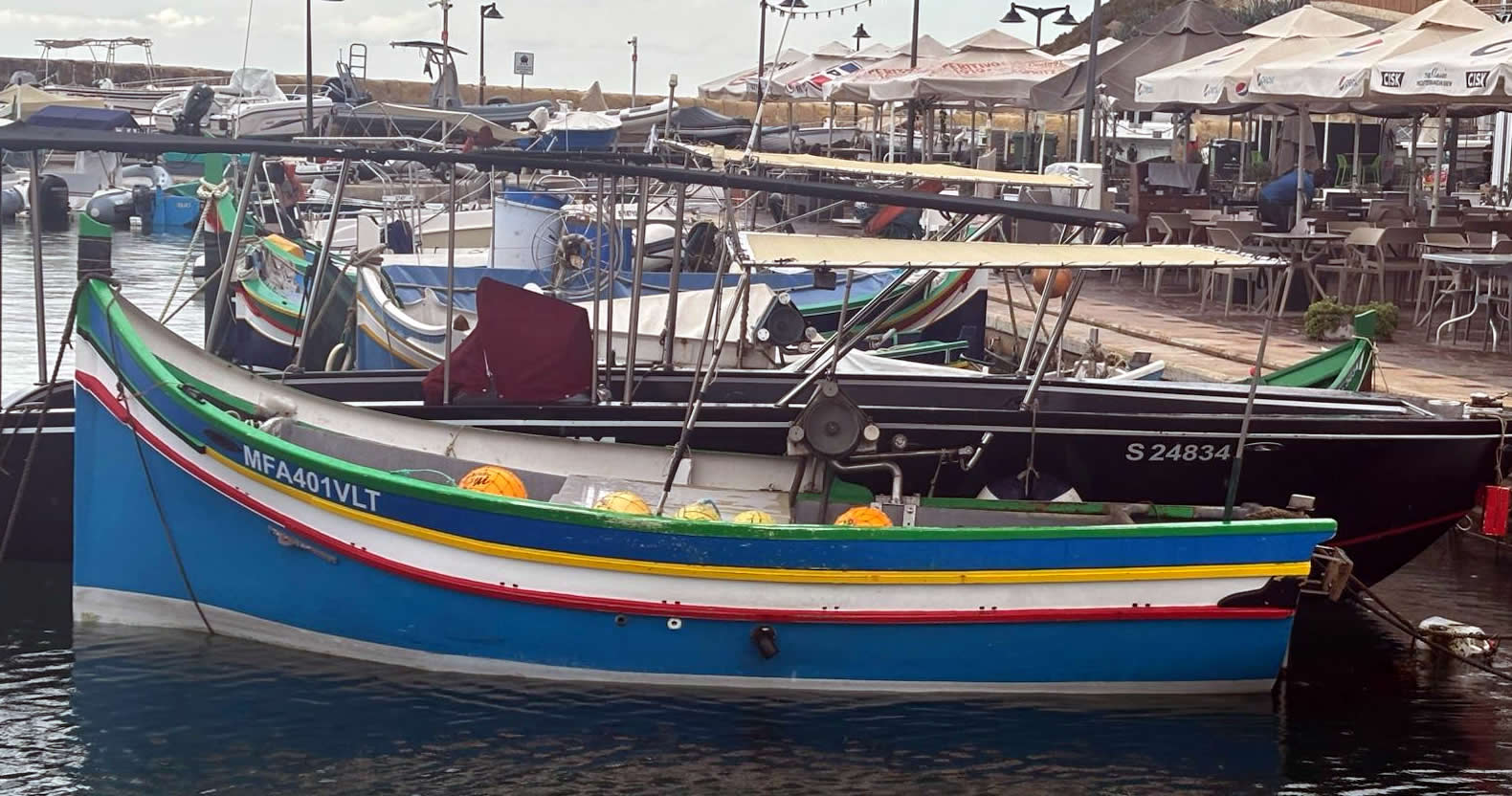
One of the reasons the Luzzu has become such a powerful symbol of Malta is its vibrant colour scheme. Bright shades of yellow, blue, red and green transform every harbour into a striking display that has inspired photographers, artists and travellers for generations.
Although no official colour standard has ever existed, certain combinations became traditional over time. Boat owners often selected colours based upon family preference, local customs or practical considerations. The brilliant paints also helped fishermen identify their own boats from a distance while returning to harbour.
Blue symbolises the Mediterranean Sea itself and has long been associated with calm waters, trust and stability. Many Luzzus feature deep blue hulls that blend naturally with Malta's coastal landscape.
Yellow is perhaps the most recognisable Luzzu colour. It reflects the bright Maltese sunshine and creates excellent visibility on the water. Combined with blue, it produces the classic appearance recognised throughout the world.
Red provides a striking contrast against the blue sea and has traditionally been associated with strength, courage and determination. It also helps highlight decorative details around the bow and stern.
Green is commonly used alongside the other colours and contributes to the distinctive visual identity of the boat. Together, these bright tones create a cheerful appearance that reflects the warmth and character of Malta's coastal communities.
The colourful finish is not merely decorative. Traditionally, regular repainting protected the wooden hull from the harsh Mediterranean climate, reducing damage caused by sunlight, salt water and constant exposure to the elements.
Every traditional Luzzu began life in the hands of a skilled Maltese boatbuilder. Before computer designs and factory production, each vessel was built almost entirely by hand using techniques passed from master craftsmen to apprentices over many generations.
Boatbuilding was once a respected profession found in several coastal communities throughout Malta. Workshops echoed with the sounds of saws, planes and hammers as experienced craftsmen carefully shaped each timber according to proportions learned through years of practical experience rather than written plans.
Unlike mass-produced boats, no two traditional Luzzus were exactly alike. Small differences in shape, beam and decoration reflected the individual preferences of both the builder and the fisherman who commissioned the vessel.
Durable woods such as pine and oak were commonly chosen for construction because they combined strength with sufficient flexibility to withstand the movement of the sea. Every plank had to be carefully selected, seasoned and shaped before becoming part of the hull.
Construction usually began with the keel, the backbone of the boat. Frames were then attached one by one before the outer planking was carefully fitted. Each plank required precise shaping to create the smooth curves that give the Luzzu its remarkable stability in rough water.
The broad beam and gently rounded hull allow the Luzzu to remain exceptionally steady while fishermen haul nets or traps aboard. This practical design proved ideal for the changing sea conditions surrounding the Maltese Islands.
After construction, the completed boat received several protective coats of paint before the famous eyes were added to the bow. Decorative trim, coloured borders and the boat's registration numbers completed its distinctive appearance.
Many owners took enormous pride in maintaining their boats. Annual repainting became an important tradition, ensuring each Luzzu remained both attractive and well protected against the harsh marine environment.
Today many working fishing boats are constructed from fibreglass because the material requires less maintenance than timber. Nevertheless, traditional wooden Luzzus continue to be restored by specialist craftsmen who preserve historic construction techniques and keep Malta's boatbuilding heritage alive for future generations.
For centuries, fishing has played an essential role in the lives of the Maltese people. Surrounded by the Mediterranean Sea, Malta has always relied on its coastal waters as a source of food, employment and trade. Long before tourism became one of the country's major industries, generations of fishermen ventured out before sunrise in their traditional Luzzus, returning later in the day with their catch to supply local markets and restaurants.
The design of the Luzzu made it particularly well suited to the conditions found around the Maltese Islands. Its broad beam provided excellent stability when hauling heavy fishing nets or lifting lobster pots and fish traps from the seabed. The high bow helped protect crews from waves during rough weather, while the relatively shallow draft allowed fishermen to work close to the rocky shoreline where many valuable fish species could be found.
Fishing was rarely an individual occupation. Entire families often depended upon the sea for their livelihood, with knowledge being passed from parents to children over many generations. Young boys frequently accompanied their fathers and grandfathers from an early age, learning not only how to handle a boat but also how to read the weather, understand the tides and recognise the seasonal movements of different fish species.
Although modern navigation equipment has transformed commercial fishing, many experienced Maltese fishermen still rely upon traditional knowledge that cannot easily be replaced by technology. Reading the wind, observing cloud formations and understanding local sea currents remain valuable skills developed through years of experience.
Throughout history, Maltese fishermen have used a variety of techniques depending on the season and the species being targeted. These methods have evolved over centuries while remaining closely connected to the natural rhythms of the Mediterranean Sea.
Each method required patience, experience and an intimate understanding of the surrounding marine environment. Sustainable fishing practices were traditionally encouraged because the same fishing grounds would support future generations.
No place is more closely associated with the traditional Luzzu than the picturesque fishing village of Marsaxlokk, located on Malta's south-eastern coast. The sheltered natural harbour has supported fishing communities for centuries and today remains one of the island's most photographed destinations.
Visitors arriving at Marsaxlokk are immediately greeted by rows of brightly painted Luzzus gently floating on the calm water. Their colourful reflections create one of Malta's most iconic views, attracting photographers, artists and travellers from around the world.
Despite its popularity with tourists, Marsaxlokk remains a genuine working fishing village. Local fishermen continue to leave the harbour before dawn, returning with fresh catches that are sold directly to restaurants, seafood vendors and the famous Sunday Fish Market.
Every Sunday morning, the waterfront comes alive as fishermen display freshly caught fish, octopus, shellfish and other seafood. The market has become one of Malta's best-known traditional attractions, offering visitors an authentic glimpse into the island's maritime culture.
Walking along the promenade, visitors can observe the close relationship between the harbour, the fishing fleet and the surrounding cafés and restaurants. Many establishments proudly serve fish landed only a few hours earlier.
Unlike many historic fishing villages that have become little more than tourist attractions, Marsaxlokk continues to function as an active fishing community. The presence of working Luzzus alongside restored historic vessels demonstrates that Malta's maritime traditions remain very much alive.
Although the Luzzu is undoubtedly Malta's most famous traditional boat, it forms part of a much larger family of locally developed vessels. Each type was designed for a particular purpose, reflecting the practical needs of island life.
The Firilla is widely regarded as one of the direct predecessors of the modern Luzzu. Smaller and lighter in construction, it served fishermen well before engines became common. Its elegant shape influenced the development of later Maltese fishing boats.
The Kajjik is a larger working boat that was traditionally used for transporting goods, fishing and coastal trading. Its generous carrying capacity made it particularly useful before modern road transport connected many of Malta's coastal communities.
The Dgħajsa is perhaps best known as Malta's traditional harbour boat. For generations it transported passengers across the Grand Harbour between Valletta and the Three Cities, serving as the island's equivalent of a water taxi.
Today, beautifully restored Dgħajjes continue to operate in the Grand Harbour, allowing visitors to experience one of Malta's oldest forms of public transport while enjoying spectacular views of the historic fortifications.
The Frejgatina is another traditional Maltese boat associated with inshore fishing. Although less common today, it represents another example of the remarkable diversity of Malta's maritime heritage.
Together, these traditional vessels illustrate the remarkable ingenuity of Maltese boatbuilders. While each served a different purpose, they shared common construction techniques, practical design principles and an ability to cope with the often challenging conditions of the Mediterranean Sea.
Today, museums, maritime organisations and dedicated craftsmen continue to preserve these boats through restoration projects, exhibitions and cultural events. Their work ensures that future generations can continue to appreciate one of Malta's richest and most enduring traditions.
Although modern fishing vessels made from fibreglass have become increasingly common throughout Malta, the traditional wooden Luzzu continues to occupy a special place in the nation's identity. Many working fishermen still operate classic Luzzus, while others have been lovingly restored as reminders of Malta's rich maritime heritage.
Today, the Luzzu is recognised not only as a practical fishing vessel but also as one of Malta's most photographed cultural icons. Visitors from around the world travel to Marsaxlokk to admire the colourful boats, learn about traditional fishing methods and experience one of the Mediterranean's oldest living maritime traditions.
Boat restoration projects carried out by skilled craftsmen continue to preserve traditional construction techniques that have been handed down through generations. These efforts ensure that the knowledge required to build and maintain wooden Maltese boats is not lost in an era dominated by modern materials.
The Luzzu also appears in countless works of art, photography, tourism campaigns and educational publications, symbolising Malta's enduring relationship with the sea. It has become far more than a fishing boat—it represents resilience, craftsmanship, tradition and national pride.
A Luzzu is a traditional Maltese wooden fishing boat recognised by its colourful paintwork and distinctive painted eyes. The modern Luzzu developed during the nineteenth century, although it evolved from much older Mediterranean boatbuilding traditions. The painted eyes are traditional protective symbols believed to bring good fortune and guide the boat safely through dangerous waters. Marsaxlokk Harbour is the best-known location, although traditional boats can also be seen in several other coastal communities. Yes. While many modern boats are built from fibreglass, a number of traditional wooden Luzzus continue to work as fishing vessels. Blue, yellow, red and green are the colours most commonly associated with traditional Maltese fishing boats. Boatbuilders commonly used durable timbers such as pine and oak, selected for their strength and flexibility. Yes. The colourful Luzzus of Marsaxlokk are among Malta's most photographed attractions. Examples include the Firilla, Kajjik, Dgħajsa and Frejgatina. It represents centuries of Maltese craftsmanship, fishing traditions and the islands' close relationship with the Mediterranean Sea.
The traditional Maltese Luzzu is far more than a fishing boat. It is a living symbol of Malta's maritime heritage, representing centuries of craftsmanship, resilience and the enduring bond between the Maltese people and the Mediterranean Sea. From its colourful hull and protective painted eyes to the skilled hands that continue to restore these remarkable vessels, the Luzzu tells a story that stretches across generations.
Whether admired in the peaceful harbour of Marsaxlokk, celebrated through local festivals or preserved by dedicated boatbuilders, the Luzzu remains one of Malta's greatest cultural treasures. Its continued presence ensures that future generations can appreciate not only a beautiful traditional boat but also the history, traditions and communities that shaped the Maltese Islands.
The information presented in this article has been researched using historical publications, maritime heritage resources and official Maltese cultural organisations. Readers wishing to explore the subject further may find the following sources useful.
Editorial Note: This article has been written and researched specifically for eMalta. It is an original work that draws upon historical research and publicly available heritage resources. Any historical interpretations remain subject to ongoing academic research, particularly regarding the ancient origins of symbolic features such as the painted eyes found on the traditional Luzzu.The Famous Painted Eyes (L-Għajnejn)
"The painted eyes are more than decoration; they represent one of the oldest surviving maritime traditions still visible in everyday life around the Mediterranean."
The Meaning Behind the Traditional Colours
Blue
Yellow
Red
Green
Traditional Boat Building
Selecting the Timber
Building the Hull
Painting and Decoration
Modern Changes
Fishing Traditions and the Maltese Luzzu
Traditional Fishing Methods
Marsaxlokk – Home of the Luzzu
The Sunday Fish Market
A Living Heritage
Other Traditional Maltese Boats
The Firilla
The Kajjik
The Dgħajsa
The Frejgatina
A Shared Heritage
The Luzzu Today
Historical Timeline
Period
Development
5200–2500 BC
Early settlers relied on boats to reach and supply the Maltese Islands.
8th Century BC
Phoenician traders established Malta as an important Mediterranean port.
218 BC
Malta became part of the Roman Empire, strengthening maritime trade.
870 AD
Arab rule introduced new agricultural and maritime influences.
1530
The Knights of St John transformed Malta into a major naval stronghold.
1800
British rule modernised Malta's harbours while local fishing traditions continued.
Late 1800s
The modern Luzzu evolved from earlier Maltese fishing boats.
20th Century
Engines gradually replaced sails and oars.
Today
The Luzzu remains one of Malta's greatest cultural and maritime symbols.
Did You Know?
Frequently Asked Questions
What is a Luzzu?
How old is the Luzzu?
Why do Maltese boats have painted eyes?
Where can I see a Luzzu in Malta?
Are Luzzus still used for fishing?
What colours are traditional Luzzus?
What wood was traditionally used?
Can visitors take photographs?
What other traditional Maltese boats exist?
Why is the Luzzu important?
Conclusion
Explore More Maltese Heritage
Article Information
References & Further Reading
https://heritagemalta.mt/
https://heritagemalta.mt/explore/malta-maritime-museum/
https://nationalarchives.gov.mt/
https://www.visitmalta.com/