Overview
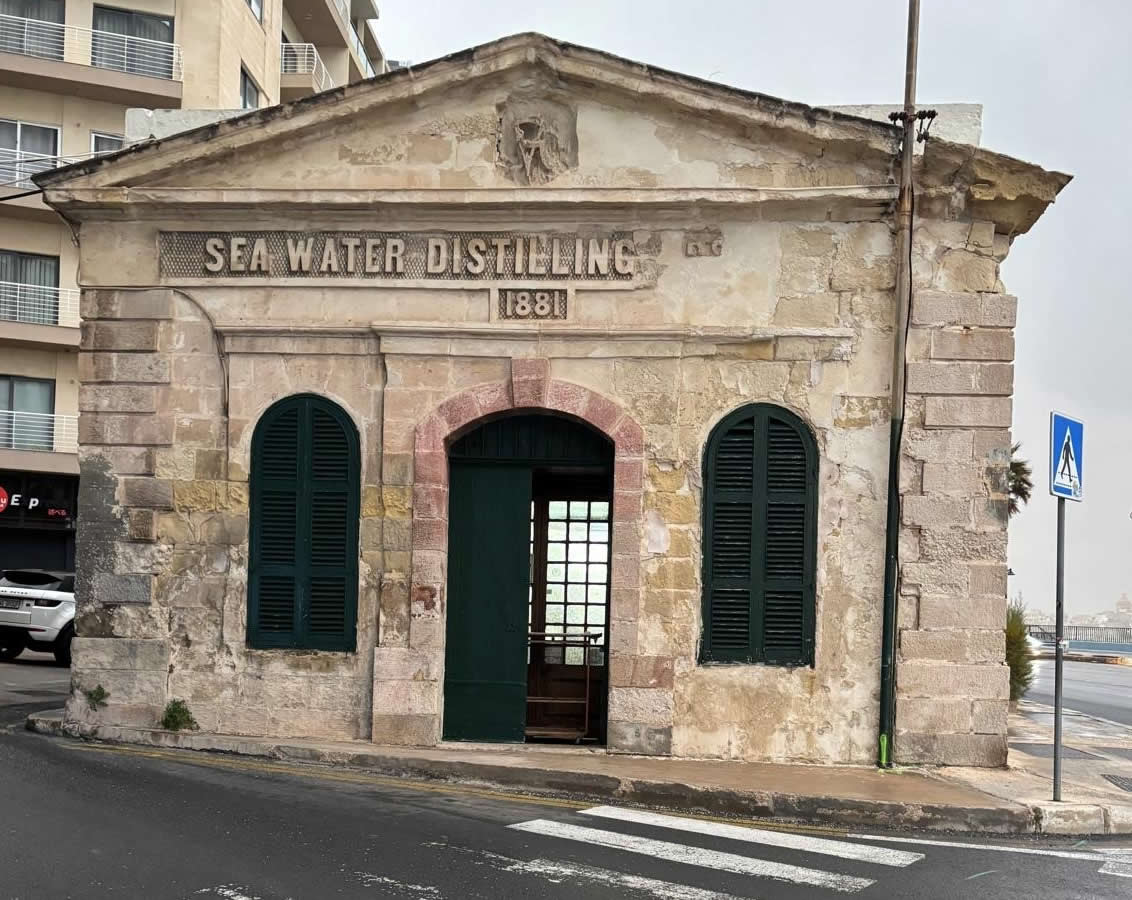
The Sea Water Distilling Building on Tigné Seafront is a rare survivor of Malta’s 19th-century public-works experimentation. As Sliema’s population expanded rapidly in the late 1800s, reliable water supply remained a major problem. Contemporary accounts describe a “sea water distilling apparatus” erected between the landing place and the fort as a practical stop-gap for chronic shortage—ultimately made unnecessary once improved infrastructure reached the area.
Emalta note: Although Fort Tigné was constructed by the Order of St John in the late 18th century, the distilling building is documented as a British-period installation (1881) intended to serve the Tigné barracks area.
Why it was built
Sliema’s growth in the second half of the 19th century put heavy pressure on basic services. Historical commentary on public works in Sliema describes the severity of seasonal water scarcity and notes that local government instructed the Superintendent of Public Works to devise remedies—one being the installation of a sea-water distilling apparatus along the Tigné waterfront.
In simple terms, distillation offered an emergency solution: heat seawater to produce steam, then condense the steam into freshwater. It was effective in principle but energy-intensive and quickly surpassed by better supply solutions once mains/aqueduct connections were expanded.
Construction and how it worked
The surviving structure is typically described as a small Victorian-era limestone building positioned directly on the seafront, close to the Tigné approach roads. While the original machinery is no longer in place, the plant was part of a “boiling” style distillation setup: seawater was heated, and the resulting steam condensed to yield fresh water.
- Setting: waterfront position made seawater intake straightforward.
- Purpose: supply potable water to the Tigné / barracks area and a fast-developing Sliema.
- Limitations: high fuel/energy demands and rapid obsolescence once improved mains supply was available.
A contemporary public-works description places the distilling apparatus “midway between the landing place and the fort” and explains that it was no longer needed once the aqueduct supply was available.
Key dates and timeline
- Late 18th century: Fort Tigné is built by the Order of St John; the surrounding peninsula later becomes a key military zone (further developed during the British period).
- 1881: The first sea-water distillery on the island is recorded as erected at Sliema / Tigné to supply the British barracks area.
- 1882: The distillery is decommissioned; later use of the building is widely reported as a printing press for a long period after its closure.
- 10 November 1995: The site is documented as having a Grade 1 heritage designation in listings commonly referenced online.
- Today: The structure survives as a distinctive waterfront landmark—valued as a physical reminder of early water-supply innovation and Sliema’s rapid 19th-century growth.
Modifications, reuse, and “restoration” status
The Sea Water Distilling Building’s most significant “modification” is functional rather than architectural: it ceased operating as a distillation plant after 1882 and was adapted for other uses over time. Multiple local and heritage summaries state that it was occupied as a printing press following its decommissioning, with later references indicating office-style use.
In terms of restoration, publicly visible documentation most consistently points to its status as a protected heritage structure (often cited as Grade 1). This typically implies that conservation and any repairs should preserve original fabric and character, even when the interior has been adapted for modern use.
If you have (or can obtain) a planning/heritage restoration permit reference or a dated conservation report, you can add a precise “Restoration works” subsection with year-by-year detail.
Visiting the site
- Location: Tigné Seafront area, Sliema (near Fort Tigné / Tigné Point zone).
- What to do: view the exterior, photograph the building, and combine with a short walk to nearby historic batteries and viewpoints.
- Access: the building is a landmark on the public seafront; interior access is not typically a visitor attraction.
- Best time: late afternoon for warm light across Marsamxett Harbour and Valletta views.
Please respect private occupancy and avoid entering any restricted areas. Appreciate the structure from the public promenade.
FAQ
Was it built by the Order of St John?
Fort Tigné dates to the Order of St John (late 18th century), but the sea-water distilling installation is documented as a British-period project erected in 1881 to supply the Tigné barracks area, and it was decommissioned in 1882.
Why did it close so quickly?
Contemporary descriptions frame it as a temporary remedy for water shortage, later made unnecessary by improved supply infrastructure reaching Sliema.
Is this the same as modern desalination?
It’s an early distillation approach (boiling/condensing), not modern reverse-osmosis desalination. It’s best understood as a pioneering local experiment tied to 19th-century public works and military supply needs.