📍 Location
Location Map Coordinates 35.882517, 14.474118
Tracking the Archival Lineage, Architectural Milestones, and Parish Governance of a Sacred Southern Landmark

1. Spatial Orientation and Technical Index
The historic Qormi Cemetery (known natively to local citizens as *Iċ-Ċimiterju ta' Ħal Qormi*) represents an exceptional layout of mid-to-late nineteenth-century ecclesiastical design. Located in the central-southern lowlands of the island within the dense, historical municipality of Qormi (Civitas Pinto), this sacred site occupies a key position that directly reflects the shifting demographic trends and urban expansion of the locality across the centuries.
From a strict topographical perspective, the cemetery grounds sit on a gently sloping limestone terrace. This positioning was calculated to ensure adequate natural water drainage away from the central burial avenues, while utilizing the soft yet durable characteristics of local Globigerina Limestone formations. The location forms a spatial bridge between the older residential cores of the town and its outer rural fringes.
| Site Survey & Archival Data Sheet | |
|---|---|
| Official Cemetery Name | Qormi Cemetery (Cimiterju ta' Ħal Qormi) |
| Locality Identification | Qormi, Southern Region, Malta |
| Geographical Coordinates | 35.882517, 14.474118 |
| Administrative Model | 100% Church-Run / Ecclesiastical Governance |
| Primary Structure Lithology | Globigerina Limestone (Franka) |
| Historical Foundations | Late 19th Century Expansion (Built over older extramural plots) |
| Current Operational Status | Active Sacred Burial Ground / Parish Cemetery |
2. Historical Chronology and Structural Discovery
The origin of a formalized, dedicated parish cemetery in Qormi follows the broader evolution of sanitary laws and religious transitions across the Maltese islands during the British colonial period. For centuries, the citizens of Ħal Qormi adhered to traditional Mediterranean practices, interring their deceased family members within subterranean crypts beneath the flagstones of their respective parish churches, most notably the ancient matrix church of Saint George.
However, by the mid-19th century, catastrophic epidemic outbreaks—including waves of Asiatic cholera and bubonic fevers—forced church authorities and colonial administrators to implement strict hygiene codes. It became clear that continuing to bury hundreds of individuals within indoor church floors posed severe long-term risks to community health and contaminated vital local groundwater systems.

Archival documentation reveals that the land chosen for the cemetery had long been utilized as a small, informal extramural burial field during times of public emergency or sudden plague spikes. In the late 1800s, the local ecclesiastical authorities formally acquired the site, consecrated the surrounding fields, and began constructing a grand, organized layout. This formal development elevated the site from a temporary emergency field into a permanent, highly structured religious landmark designed to serve the community for generations.
3. The Church-Run Model: Governance and Genealogic Archiving
A core defining element of the Qormi Cemetery is its status as a fully church-run institution. While large-scale national burial sites like the Addolorata Cemetery fell under centralized municipal or state management, the Qormi Cemetery stayed under the administrative, pastoral, and canonical care of the local parish authorities. This ecclesiastical model ensures that all site procedures follow strict canon law frameworks alongside modern environmental and healthcare regulations.
This church-led system directly shapes how historical records are kept. Every interment since the cemetery's formal opening is meticulously recorded by hand within the parish’s *Liber Mortuorum* (Book of the Dead). For historians, demographers, and family researchers, these archives offer an incredibly rich resource for tracing family lines across the 19th and 20th centuries.
The day-to-day operations are supervised by church caretakers who handle the allocation of family plots, manage seasonal memorial services, and protect the quiet sanctity of the grounds. This direct link with the parish ensures that the cemetery remains a living part of the town's identity, where annual remembrance masses—especially during the month of November—continue to connect current residents with their ancestral past.

4. Architectural Analysis: Vernacular Mortuary Monuments
Architecturally, the Qormi Cemetery stands as a stellar example of Maltese vernacular mortuary design, showcasing a layout optimized for privacy, structural longevity, and solemn religious beauty. The entirely limestone complex is crafted using local Globigerina stone, which over time develops a beautiful golden-amber hue under the Mediterranean sun.
The Entrance Gatehouse Architecture
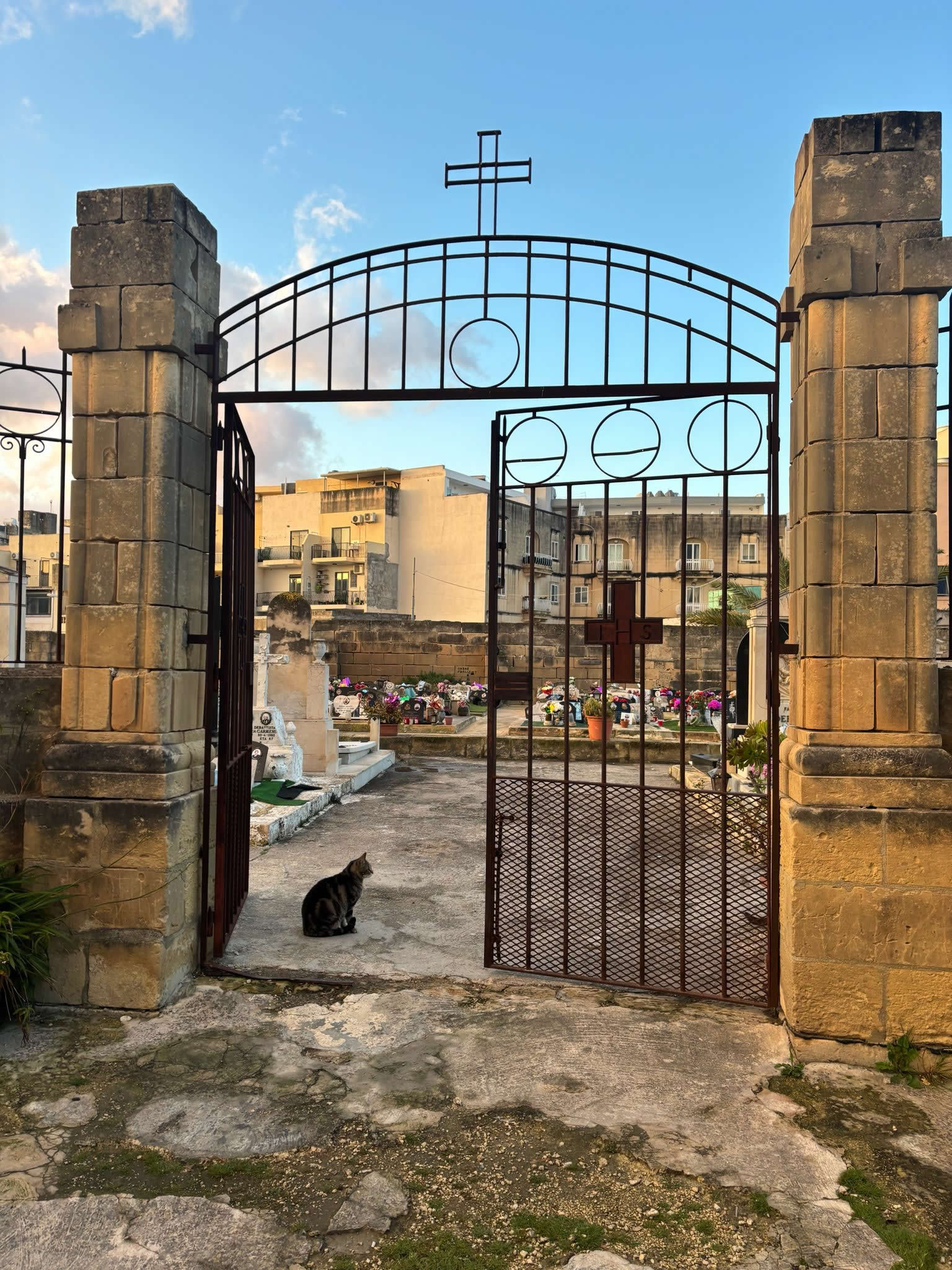
The primary entrance features an imposing facade, utilizing high boundary walls designed to create a respectful separation between the surrounding public pathways and the quiet peace of the sacred grounds within. The main entrance is framed by a grand stone portal, featuring classic revival pilasters and wrought-iron security gates. This design mirrors the architectural trends of late-nineteenth-century church properties in Malta, prioritizing strong vertical lines to evoke a sense of deep spiritual contemplation.
Internal Layout and Path Matrix
Inside the gates, the cemetery opens into a symmetrical grid of walkways lined with mature cypress trees. A central stone avenue runs straight through the property, dividing the grounds into neat quadrants and leading directly to a central mortuary chapel at the rear.
The individual graves and family vaults are arranged in orderly rows. These graves display a wide array of funerary art, ranging from simple, flat limestone markers to elaborate, hand-carved stone monuments. Many of the older graves feature traditional religious symbols, such as stylized anchor carvings, mourning angels, and detailed inscriptions celebrating the lives of past community members.

The Resurrection of Jesus Chapel
The architectural and spiritual focus of the cemetery grounds is the Resurrection of Jesus Chapel (Il-Kappella tal-Qawmien ta’ Ġesù), which was constructed in 1940. Designed by the highly prominent Maltese architect Joseph D'Amato—celebrated for his ambitious structural designs across the islands—the chapel deliberately breaks away from traditional rectangular layouts. Instead, it utilizes a distinct neo-classical octagonal geometry built with finely dressed Globigerina limestone blocks. The facade features a prominent, deeply recessed arched portal framed by smooth columns that support a classical stone pediment over the main double entrance. Rather than a traditional bell-cot, D'Amato crowned the flat roofline with a central stone pedestal holding a large Latin cross, creating a balanced and monumental silhouette. Standing within a clean, paved open courtyard next to a mature cypress tree, this unique church-run sanctuary serves as a solemn venue for final committal prayers, special parish liturgies, and annual All Souls' Day remembrances.
5. Preservation Challenges and Modern Restoration
Over the decades, the soft, porous nature of Globigerina Limestone has exposed the Qormi Cemetery to a variety of environmental challenges. Continuous wind erosion and rising damp pull ground salts up into the stone, which can lead to gradual flaking and decay. In older sections, this natural weathering process threatened to wear away historic inscriptions and delicate stone carvings.
To combat this decay and safeguard the site's history, the parish administration, working alongside local heritage restoration teams, launched a series of ongoing preservation programs. These restoration efforts focus on carefully cleaning the outer boundary walls and the main gatehouse using gentle, low-pressure techniques to remove layers of grime without scoring the fragile stone surfaces.
Restoration specialists systematically repair structural stone cracks along the perimeter walls, utilizing traditional lime-based mortar that matches the original materials. This ensures the stone can naturally release trapped moisture without cracking. Additionally, walkways have been leveled to improve safety and accessibility for visitors while keeping the surrounding family graves well-protected. These careful preservation projects ensure that the cemetery remains a beautifully maintained, secure space that respects the memory of generations past.
6. Contemporary Function and Visitor Etiquette
Today, the Qormi Cemetery continues to fulfill its original purpose as an active, sacred burial ground for the local population. It is a space where local history, family memory, and quiet reflection intertwine daily, drawing residents who come to tend family graves, light memorial candles, and reflect in the quiet surroundings.
The cemetery plays a prominent role during the month of November, a traditional time of remembrance across the Maltese islands. On All Souls' Day, the parish community gathers at the site for a formal evening service and candle-lit mass inside the mortuary chapel, bringing families together to honor those who came before them.
When visiting the site for historical research or family genealogy, visitors are asked to observe strict cemetery etiquette. Because this is an active place of rest and private mourning, flash photography should be avoided during burial services, and walking across the stone grave markers is discouraged. By maintaining a quiet, respectful presence, visitors can enjoy the rich history and peaceful character of this important southern landmark.
Frequently Asked Questions — Qormi Cemetery
Yes, the cemetery grounds are open to the public daily during daylight hours, allowing families to visit graves and pay respects. However, opening times can shift slightly between the summer and winter months, so visitors traveling from outside the locality are encouraged to confirm current hours with the Qormi parish office.
Because Qormi Cemetery is church-administered, its records are kept within the official parish registries rather than state registries. To trace a historical burial, you can contact the Qormi parish office directly to request an archival search in the hand-written *Liber Mortuorum*.
As a dedicated parish cemetery, plots and vaults are primarily reserved for residents of Qormi and individuals with long-standing family connections to the parish. All inquiries regarding grave ownership, transfers, and burial rights are managed strictly by the parish office.
The parish works with heritage professionals to apply lime-based restoration mortars and protective treatments to the stone. These measures help prevent rising damp and salt crystallization from eroding the historic inscriptions and carvings on older family vaults.