📍 Location
Location Map Coordinates 36.036730, 14.308946

Introduction
Il-Ħaġra l-Wieqfa, meaning “the standing stone,” is one of the most intriguing prehistoric monuments in Qala, Gozo. This solitary megalith stands as a silent witness to Malta’s ancient past, offering a tangible connection to the island’s early inhabitants and their mysterious culture.
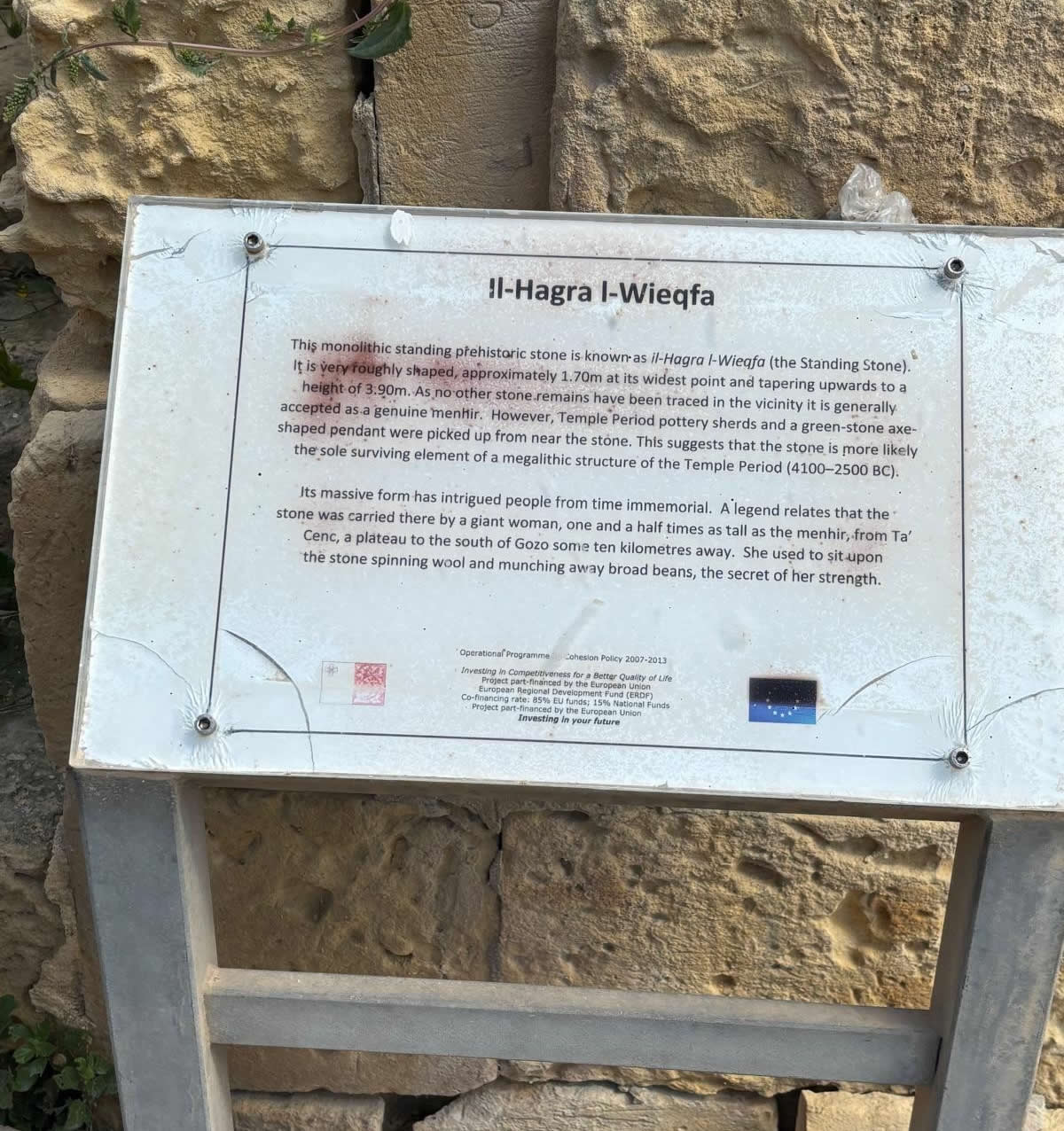
Although modest compared to the grand megalithic temples of Malta, this standing stone is believed to date back to the Neolithic or early Bronze Age, placing it among the oldest surviving human-made structures in the Maltese Islands.

Location and Setting
Il-Ħaġra l-Wieqfa is located in Qala, the easternmost village of Gozo. The site lies within a landscape rich in archaeological remains, including prehistoric settlements, cart ruts, and other megalithic features.
Qala itself has long been recognised as an area of early human activity, with evidence suggesting habitation dating back to prehistoric times. The presence of fertile land and strategic coastal access made it an ideal location for early settlers.

Physical Description
The standing stone rises prominently from the ground, reaching an estimated height of approximately 3 to 3.5 metres (around 10–11 feet).
Its irregular surface and weathered appearance suggest centuries of exposure to natural elements. The stone is composed of local limestone, consistent with the geology of the Maltese Islands.
Despite its age, the stone remains upright, demonstrating the durability of prehistoric construction techniques.

Prehistoric Origins
Il-Ħaġra l-Wieqfa is widely believed to date back to Malta’s Temple Period (circa 3600–2500 BC), a time when some of the world’s earliest free-standing stone structures were constructed.
Archaeological evidence suggests that the stone may once have been part of a larger megalithic complex or temple structure. Pottery fragments discovered in the surrounding area support this theory, indicating the presence of a prehistoric settlement or ritual site.
Today, the standing stone is considered a menhir—a type of upright stone commonly associated with prehistoric cultures across Europe.

Function and Interpretation
The exact purpose of Il-Ħaġra l-Wieqfa remains uncertain, as is the case with many prehistoric monuments. However, several theories have been proposed regarding its function:
- Religious or Ritual Site: The stone may have served as part of a ceremonial or sacred area.
- Boundary Marker: It could have marked territorial boundaries or important locations.
- Astronomical Alignment: Some researchers suggest that standing stones were aligned with celestial events.
While definitive conclusions remain elusive, the stone’s presence highlights the sophistication and symbolic thinking of Malta’s early inhabitants.

Relationship to Other Megalithic Sites
Il-Ħaġra l-Wieqfa is part of a broader prehistoric landscape that includes some of the most significant archaeological sites in the world. Nearby locations such as Ġgantija and other temple complexes demonstrate the advanced architectural capabilities of Malta’s ancient builders.
Although smaller in scale, the standing stone contributes to our understanding of how these larger complexes may have been structured and used.

Historical References and Documentation
The stone has been documented in historical records and photographs, including references held by the National Archives of Gozo.
These records provide valuable insights into how the site has changed over time and how it has been perceived by different generations.
Surrounding Landscape
The area around Il-Ħaġra l-Wieqfa is characterised by typical Gozitan countryside, including agricultural fields, valleys, and coastal views. This setting enhances the site’s historical atmosphere and provides context for its original use.
The proximity to other archaeological features further emphasises the importance of Qala as a centre of prehistoric activity.
Cultural Significance
For the local community, Il-Ħaġra l-Wieqfa represents a tangible link to the distant past. It serves as a reminder of the island’s long history and the achievements of its earliest inhabitants.
The site also contributes to Gozo’s identity as a destination rich in cultural and historical heritage.
Preservation and Conservation
As an exposed archaeological feature, the standing stone is subject to natural weathering and environmental factors. Efforts to preserve such sites are essential to ensure their survival for future generations.
Although not as heavily protected as major temple complexes, the stone remains an important part of Malta’s cultural heritage.
Visitor Experience
Visitors to Qala can easily access Il-Ħaġra l-Wieqfa, making it a convenient stop for those exploring the island’s archaeological sites. Its simplicity allows for a more personal and contemplative experience compared to larger, more crowded attractions.
The site is particularly appealing to those interested in history, archaeology, and photography.
Conclusion
Il-Ħaġra l-Wieqfa stands as a powerful symbol of Malta’s prehistoric past. Though modest in scale, it embodies the ingenuity and cultural depth of the island’s earliest inhabitants.
Its continued presence in the landscape of Qala serves as a reminder of a civilisation that thrived thousands of years ago, leaving behind monuments that continue to inspire curiosity and admiration.