OverviewŻebbuġ is a peaceful village with panoramic routes down to Gozo’s north coast. It’s a great base for short walks to bays and viewpoints, plus easy visits to the salt pans, Marsalforn area, and nearby valleys. |  |
History & key dates
These are widely cited milestones for Żebbuġ’s development and major heritage landmarks.
13th century — A community takes shape
A settled community is commonly dated to the 13th century, after which a small chapel served early spiritual life in the area.
28 April 1688 — Żebbuġ becomes a parish
Żebbuġ’s parish (dedicated to the Assumption of Mary) was established on 28 April 1688 by Bishop Davide Cocco Palmieri.
1690–1726 — The parish church is built; 30 September 1726 — consecration
The present baroque parish church was built mainly between 1690 and 1726 and is recorded as consecrated on 30 September 1726.
1938–1942 — Church enlargement
The church was enlarged between 1938 and 1942 to accommodate the village’s needs.
12 March 1963 — Archipresbyteral status
The parish church was raised to Archipresbyteral status on 12 March 1963.
1860s → today — Salt harvesting heritage at Xwejni
Traditional salt harvesting at the Xwejni Salt Pans is still practiced, with some families documented as continuing the craft since the 1860s.
14 May 1994 — First local council election (Żebbuġ)
Village governance shifted with local councils: Żebbuġ’s first local council election is recorded on 14 May 1994.
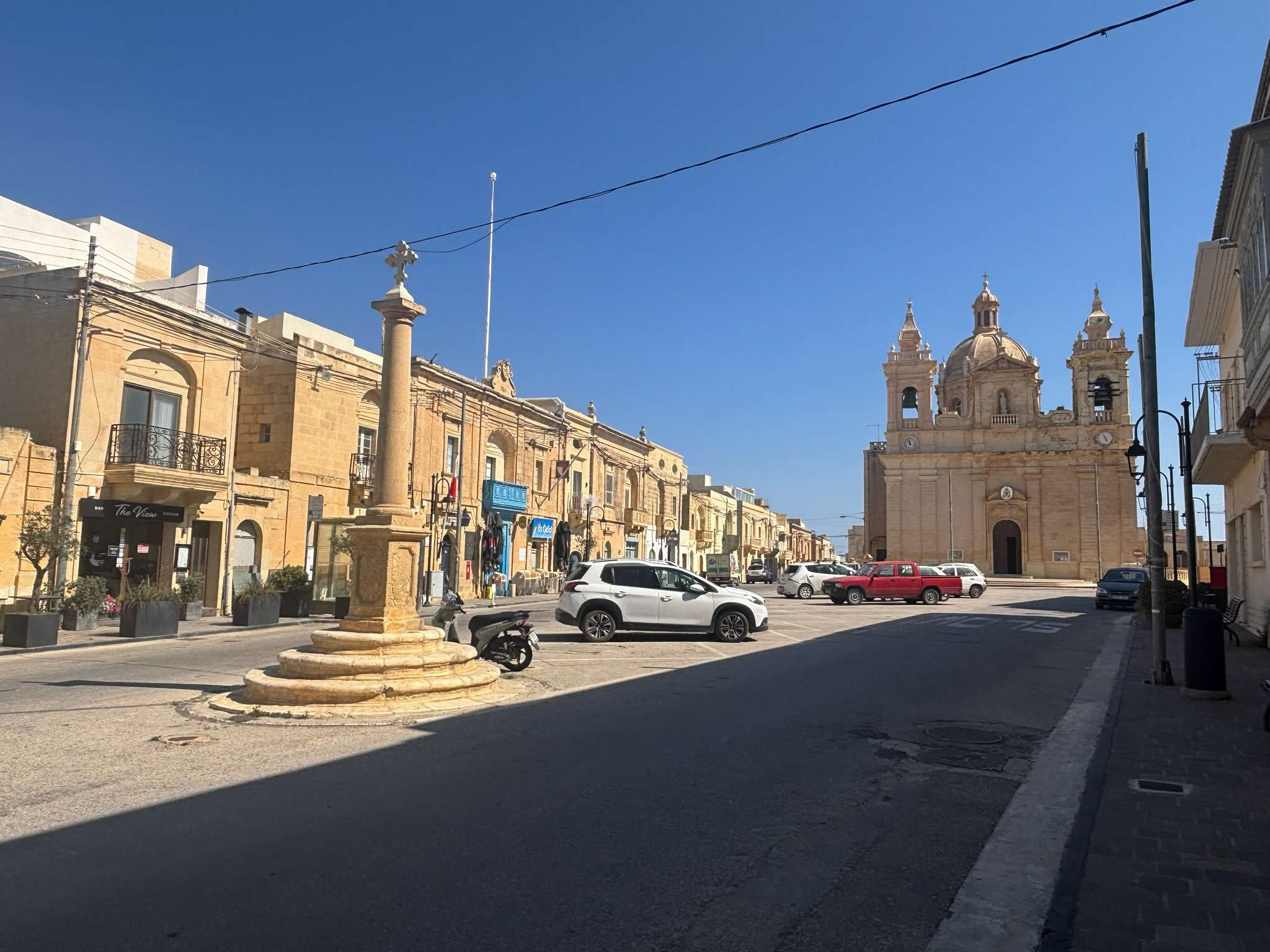
Top places to visit in Żebbuġ
1) Parish Church of the Assumption of Mary (Santa Marija Assunta)
- Admire the baroque architecture and the village square setting.
- Look out for interior decorative stonework often described as “onyx/alabaster” (travertine deposits).
- Time your visit with village life—early morning or late afternoon is especially atmospheric.
2) Xwejni Salt Pans (photo stop + living tradition)
- Walk the coastal edge (carefully—uneven rock) for the classic salt-pan geometry.
- In season, you may see active harvesting and be able to buy small packets locally.
- Golden hour is ideal for photos and calmer temperatures in summer.
3) Qbajjar Bay & Marsalforn area (nearby)
Żebbuġ sits a short distance from the Marsalforn coastline, including Qbajjar Bay, a convenient stop for sea views, swim spots, and sunsets.
4) Wied il-Għasri (nearby valley + sea inlet)
A dramatic narrow inlet reached via a valley walk—popular for coastal scenery, short hikes, and a dip on calm days.
5) Ta’ Kuljat hill (heritage landscape)
The surrounding hills are part of Żebbuġ’s long human story, with references to Bronze Age remains on Ta’ Kuljat.
Local feast
Żebbuġ’s patronal feast is the Assumption of Our Lady, celebrated on 15 August (Santa Marija), a major feast across Malta and Gozo.
Practical tips
- Best time to visit: Spring and autumn for walking; early mornings/evenings in summer.
- How long to spend: 1–2 hours in the village core, plus extra time for salt pans and coastal walks.
- Safety: The salt-pan coastline is rugged—wear sturdy shoes and keep a safe distance from cliff edges in windy weather.
