📍 Location
Location Map Coordinates 35.887454, 14.497670
Historic obelisk commemorating Captain Sir Robert Cavendish Spencer, Royal Navy

The Spencer Monument is a distinctive nineteenth-century obelisk standing at Blata l-Bajda on the road between Valletta and Ħamrun. It was erected in memory of Captain Sir Robert Cavendish Spencer, K.C.H., Royal Navy, captain of HMS Madagascar, who died at Alexandria on 4 November 1830 at the age of 39.
The monument was originally erected on Corradino Hill in 1831, where its prominent position allowed it to be seen by ships lying at anchor in the Grand Harbour. In 1893 it was dismantled and re-erected at its present location at Blata l-Bajda, close to the former British military cemetery.
Unlike many of Malta's twentieth-century war memorials, the Spencer Monument does not commemorate a group of wartime casualties. It is an early nineteenth- century naval memorial, erected by the officers, seamen and marines who served under Spencer and who wished to preserve the memory of their commander.
Location
| Location | Blata l-Bajda, Malta |
|---|---|
| Coordinates | 35.887454, 14.497670 |
| Google Maps | View Spencer Monument on Google Maps |
| Monument type | Commemorative obelisk |
| Person commemorated | Captain Sir Robert Cavendish Spencer, K.C.H., R.N. |
| Original location | Corradino Hill |
| Original construction | 1831 |
| Present location | Blata l-Bajda |
| Relocation | 1893 |
| Material | Maltese hard limestone |
| Architect | Giorgio Pullicino |
Captain Sir Robert Cavendish Spencer
Robert Cavendish Spencer was born in 1791, the third son of George John Spencer, 2nd Earl Spencer. He entered the Royal Navy at the age of thirteen and developed a distinguished naval career. He served in British waters, the Mediterranean and the Americas, and commanded a number of vessels during a career that included active service.
Among his commands were the brig Kite, the frigates Ganymede and Naiad, and eventually the 46-gun frigate HMS Madagascar. His service included operations in the Mediterranean, the Americas and during the Greek War of Independence.
Spencer was also connected with the British royal household. From 1827 he served as private secretary to the Duke of Clarence, the future King William IV, and was appointed a Knight Commander of the Royal Hanoverian Guelphic Order (K.C.H.).
In 1828 he was appointed to command HMS Madagascar. His final Mediterranean commission ended tragically when he became ill while the ship was at Alexandria. He died on 4 November 1830, aged only 39.
The University of Malta's historical account records that Spencer died after falling ill at Alexandria and that the Madagascar subsequently returned to Malta. The ship arrived on 11 December and Spencer's body was taken to Valletta for burial the following day.
The Funeral and Burial in Valletta
Because HMS Madagascar had been operating in the Mediterranean and Spencer had died at Alexandria, his body was brought back to Malta aboard the ship. Following quarantine, his coffin was taken by boat to Valletta.
A large military and naval procession accompanied the funeral. Officers, soldiers, British residents and Maltese took part, while the chaplain of the Madagascar, Reverend David Morton, conducted the service at St Michael's Bastion.
Spencer was buried on 12 December 1830. The portion of St Michael's Bastion where he was buried subsequently became known as Spencer Bastion.
His tomb in Valletta is therefore directly connected with the obelisk at Blata l-Bajda. The tomb and monument form two parts of the same story of Spencer's death and commemoration in Malta.
The Original Spencer Monument at Corradino Hill
Following Spencer's death, his fellow officers, seamen and marines subscribed to a monument in his memory. The first stone was laid on Corradino Hill on 23 April 1831.
The choice of Corradino Hill was significant. The hill occupied a commanding position overlooking the Grand Harbour, allowing the monument to be visible from ships at anchor. The obelisk was deliberately conceived as a prominent naval memorial rather than a small private monument.
The monument was designed by the Maltese architect Giorgio Pullicino, who was also a professor of drawing and architecture. Construction was carried out under the supervision of C. H. Smith of H.M. Naval Yard at Malta. According to the University of Malta account, the work was completed in approximately eight weeks.
The monument was constructed from Maltese stone and took the form of a tall obelisk, deliberately recalling the monumental tradition of ancient Egyptian obelisks. Its prominent original position made it an important landmark around the Grand Harbour.
Relocation to Blata l-Bajda
In April 1893, Lord Spencer, First Lord of the Admiralty, visited Malta. During his visit he saw the monument to his uncle as well as Spencer's grave in Valletta. The monument was subsequently removed from Corradino Hill and re-erected at Blata l-Bajda.
The relocation created the landmark that survives today. A later inscription was added to the monument recording its removal from Corradino Hill and re-erection at the new site.
The Monument and Its Inscriptions
The monument contains inscriptions in English and Latin. Together they identify Spencer, record his death and burial, explain who erected the memorial, and document the later relocation from Corradino Hill.
1. Dedication to Captain Spencer

| Original inscription | Explanation |
|---|---|
|
TO THE MEMORY OF THE HONOURABLE SIR R. CAVENDISH SPENCER K.C.H. CAPTAIN OF H.M. SHIP MADAGASCAR WHO DIED ON BOARD AT ALEXANDRIA NOVR 4 AND WAS BURIED AT VALLETTA DECR 12 1830 ERECTED BY THE OFFICERS SEAMEN & MARINES UNDER HIS COMMAND |
Transcription: To the memory of the Honourable Sir Robert Cavendish Spencer, K.C.H., Captain of H.M. Ship Madagascar, who died on board at Alexandria on November 4 and was buried at Valletta on December 12, 1830. The final lines state that the monument was erected by the officers, seamen and marines who served under his command. This inscription is particularly important because it identifies the memorial as a personal tribute from Spencer's own naval personnel. |
2. Relocation Inscription
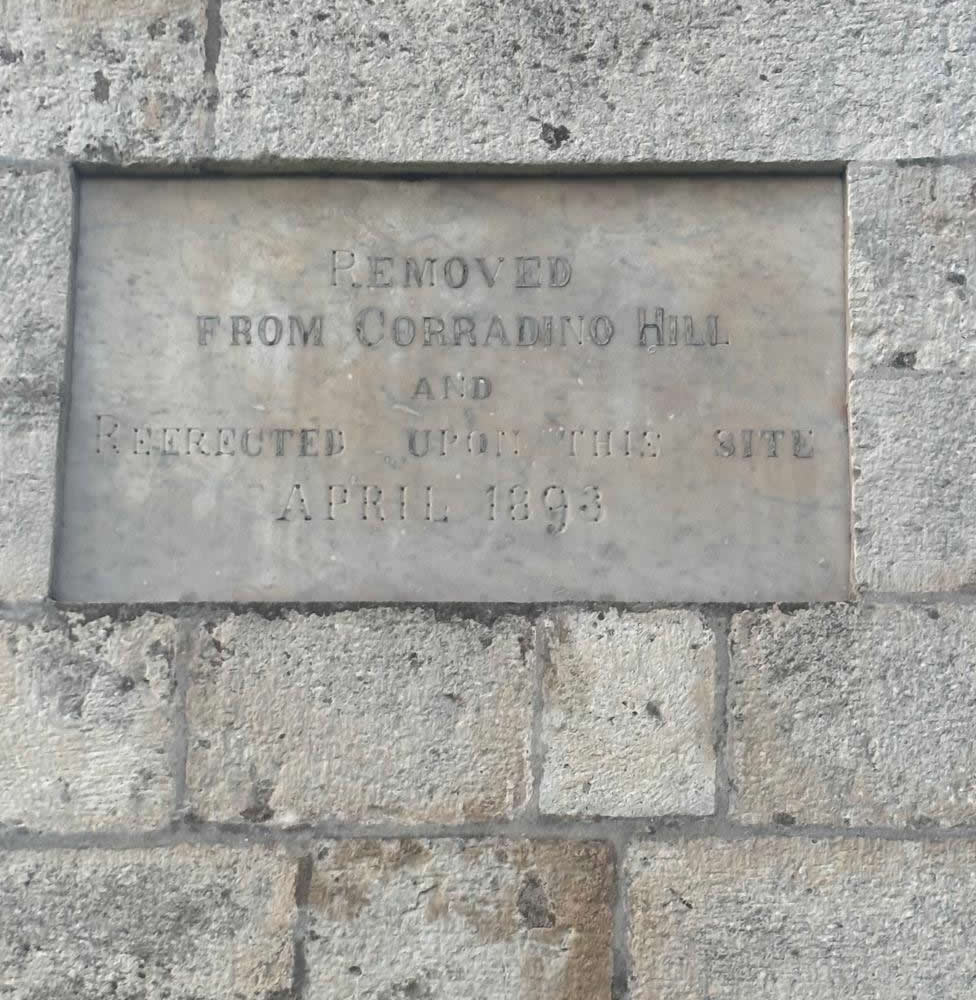
| Original inscription | Meaning |
|---|---|
|
REMOVED FROM CORRADINO HILL AND RE-ERECTED UPON THIS SITE APRIL 1893 |
The inscription records the removal of the original monument from Corradino Hill and its re-erection at the present Blata l-Bajda site in April 1893. |
3. Latin Dedication
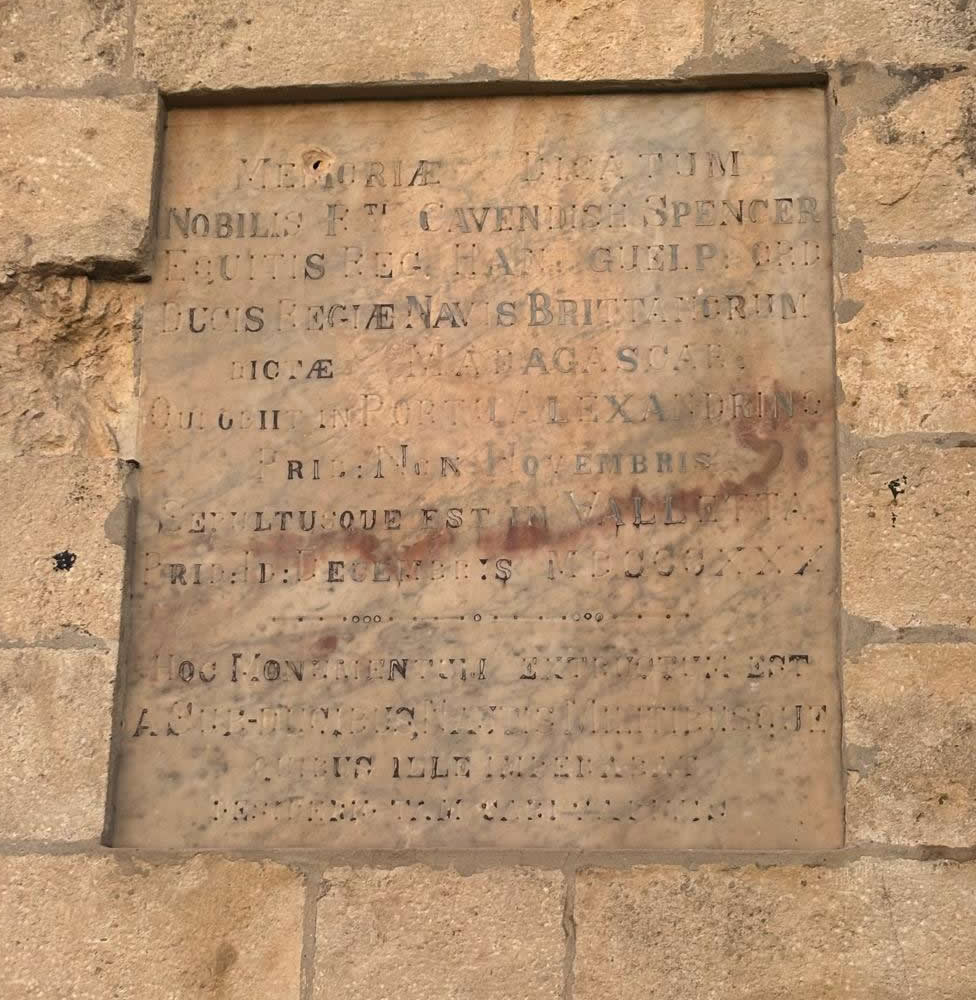
| Latin transcription | English translation |
|---|---|
|
MEMORIAE DICATUM NOBILISS. R. TI CAVENDISH SPENCER EQUITIS REG. HAN. GUELPH. ORD. DUCIS REGIAE NAVIS BRITANNORUM DICTAE MADAGASCAR QUI OBIIT IN PORTU ALEXANDRINO PRID. NON. NOVEMBRIS SEPULTUSQUE EST IN VALLETTA PRID. ID. DECEMBRIS MDCCCXXX HOC MONUMENTUM QUIBUS ILLE IMPETRABAT DESIDERIO TAM CARI CAPITIS |
Dedicated to the memory of the noble Robert Cavendish Spencer,
Knight of the Royal Hanoverian Guelphic Order, commander of the Royal
British ship Madagascar, who died in the port of Alexandria on
the fourth day before the Nones of November and was buried in Valletta on
the second day before the Ides of December, 1830.
This monument was erected by those under his command, who were moved by the loss of a commander so dear to them. The Roman calendar dates correspond to 4 November 1830 and 12 December 1830. |
Damage and Restoration
The Spencer Monument has survived for almost two centuries, but it has not escaped damage. During the twentieth century the monument suffered from weathering and wartime damage.
In October 1975 the upper part of the obelisk was struck by lightning, causing considerable damage. The monument was subsequently repaired.
The structure also suffered damage from bomb splinters during the Second World War. The Ħamrun Local Council records that a restoration project was undertaken in the late 1990s, with work beginning on 17 December 1997 in collaboration with the Mizzi Organisation and the Ħamrun Local Council. The restoration was completed in 1998.
The monument therefore preserves evidence of several different periods of Malta's history: British naval Malta in the nineteenth century, the development of Blata l-Bajda, the Second World War, and the modern conservation of Malta's historic monuments.
Spencer Monument During the Second World War
Although the monument predates both World Wars by many decades, its position meant that it became part of the wartime landscape of the area. During the Second World War the obelisk sustained damage from bomb fragments falling nearby.
Its survival is therefore significant not only because of its association with Captain Spencer but also because the monument itself carries physical evidence of Malta's wartime history.
Spencer, Ponsonby and Malta
Robert Spencer had an important family connection with Malta. Governor Sir Frederick Cavendish Ponsonby was his cousin. Spencer was therefore connected to one of the most prominent British officials in Malta during the early nineteenth century.
This family connection is particularly interesting because Ponsonby himself is commemorated by another nineteenth-century monument in Valletta. The two memorials are part of the wider story of Britain's presence in Malta after 1800.
Spencer's Tomb in Valletta
The Spencer Monument should not be confused with Spencer's actual burial place. Captain Spencer was buried in Valletta on 12 December 1830 at St Michael's Bastion, in the area subsequently known as Spencer Bastion.
The original grave was marked by a marble slab and enclosed by an iron railing. The University of Malta records that the tomb later fell into serious disrepair before the area was restored and the sarcophagus recreated.
The two sites are consequently closely connected: the Spencer Monument at Blata l-Bajda commemorates the naval officer, while the Spencer Tomb in Valletta marks his actual burial place.
Photographic Record
The photographs on this page document the monument in its present setting at Blata l-Bajda. The first photograph provides an overall view of the obelisk and its landscaped surroundings. The following photographs record the historic inscriptions on the monument in detail.
Location Map
Historical Significance
The Spencer Monument is an unusually important surviving nineteenth-century naval memorial in Malta. It links the island's British military history with the Royal Navy, the Grand Harbour, the British administration of Malta and the personal history of one of the island's early British naval figures.
Its inscriptions provide unusually detailed information: the identity and rank of the person commemorated, the ship he commanded, the place and date of his death, the place and date of his burial, the people responsible for erecting the memorial and the later relocation of the monument.
For this reason the monument is more than a landmark. Its carved inscriptions are an original historical record of British naval life in Malta during the early nineteenth century.
Research & References
The historical information on this page has been checked against published research held by the University of Malta, including the article Sir Robert Spencer's Tomb and Monument by Denis Anthony Darmanin and the later article Remembering Captain Sir Robert Cavendish Spencer.
- University of Malta — Sir Robert Spencer's Tomb and Monument
- University of Malta — Remembering Captain Sir Robert Cavendish Spencer
- Ħamrun Local Council — Spencer Monument