📍 Location
Location Map Coordinates 35.881315, 14.520660

Introduction
The Knisja Kolleġġjata tal-Kunċizzjoni, also known as the Collegiate Church of the Immaculate Conception, stands as the principal parish church of Bormla (Cospicua), one of the historic Three Cities of Malta. Dominating the skyline with its imposing Baroque structure, the church is a central landmark reflecting centuries of religious devotion, artistic achievement, and historical resilience.

Dedicated to the Immaculate Conception of the Virgin Mary, the church has played a pivotal role in the spiritual and social life of Bormla since the late 16th century.
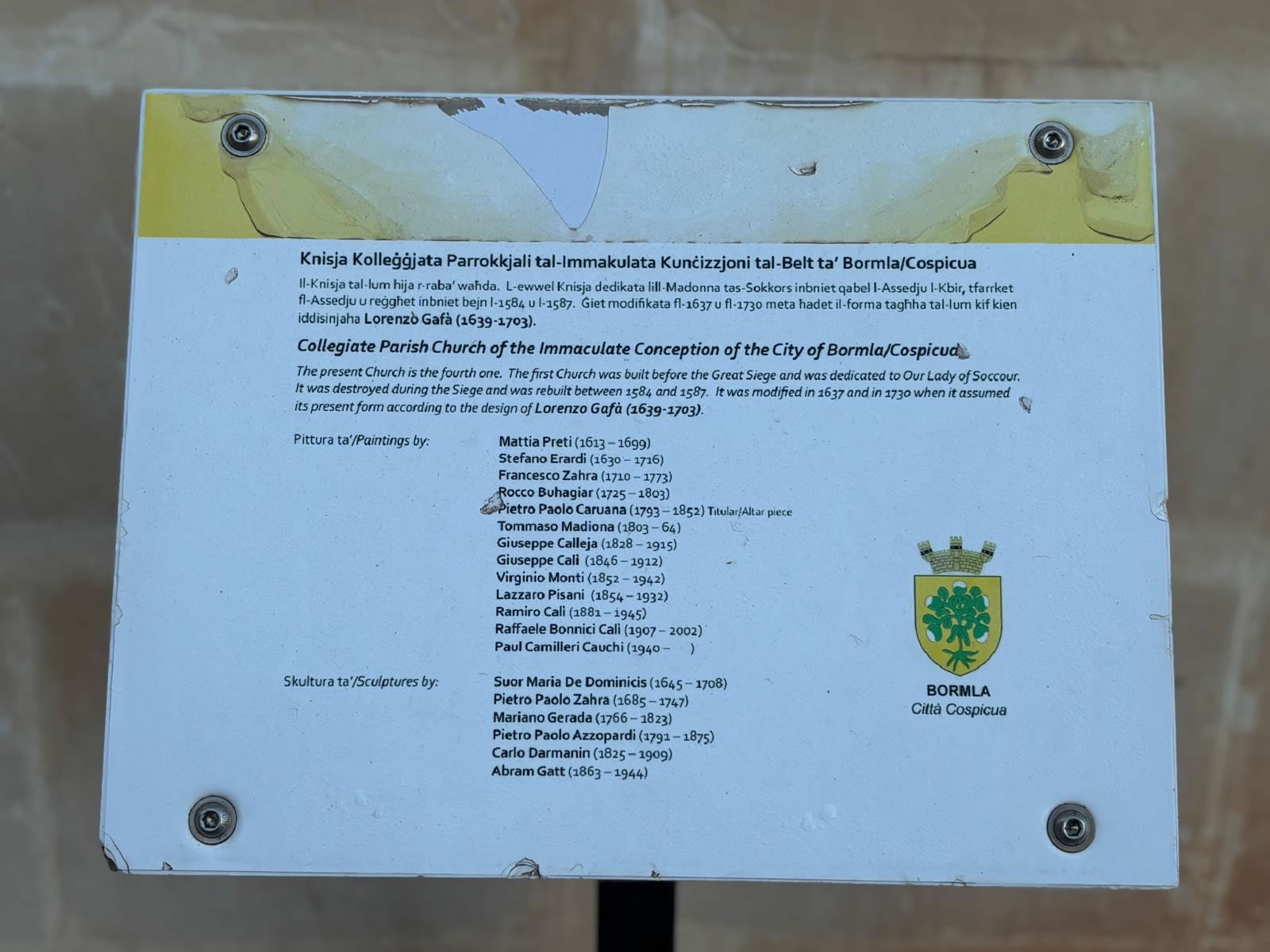
Early Origins and Parish Establishment (Before 1586)
A church existed on this site even before the Great Siege of Malta in 1565. The settlement of Bormla expanded rapidly during the early period of the Knights of St John, necessitating the establishment of a parish.
In 1586, Bormla was officially declared a parish, and the church dedicated to the Immaculate Conception became its principal place of worship.
This early parish church served a growing population in one of Malta’s most important maritime and military centres.

Rebuilding and Baroque Transformation (1684–1730)
By the late 17th century, the original church had become too small for the expanding community. In 1684, work began on a new, larger church on the same site.
The rebuilding project reflected the flourishing Baroque culture of Malta under the Knights of St John.

Key features of the reconstruction include:
- Design attributed to architect Vincenzo Casanova
- Bell towers designed by Lorenzo Gafà
- Completion of the main structure around 1730

The church was solemnly consecrated on 25 May 1732, marking the completion of its transformation into a grand Baroque parish church.

Elevation to Collegiate Status (1822)
In 1822, the church was elevated to the status of a collegiate church, reflecting its importance within the ecclesiastical hierarchy of Malta.

This designation meant that:
- The church was served by a chapter of canons
- Its liturgical functions were expanded
- Its prestige within the diocese increased significantly
The elevation confirmed the church’s central role in the religious life of Bormla.

Architecture and Design
Exterior
The façade of the church is a fine example of Maltese Baroque architecture:
- Symmetrical design with twin bell towers
- Central entrance framed by columns and decorative pediment
- Use of local limestone giving a warm golden appearance

The church’s prominent position allows it to dominate the urban skyline of Bormla.

Interior
The interior reflects the richness of Baroque design:
- Spacious nave with side chapels
- Ornate decorative elements
- Emphasis on light and verticality

The layout enhances both the aesthetic experience and the liturgical function of the space.

Artworks and Decoration
Ceiling Paintings
One of the most remarkable features of the church is its painted ceiling, created by renowned artists Virginio Monti and Giuseppe Calì.
These artworks include biblical figures such as:
- David
- Ezekiel
- Moses
- Isaiah
The paintings demonstrate the influence of Italian artistic traditions in Malta.

Title Painting and Statue
The titular image of the Immaculate Conception holds special significance. The painting was crowned in 1905, marking its importance within Maltese devotional life.
Processional statues associated with the feast further enrich the church’s artistic heritage.

World War II and Survival
During World War II, Bormla suffered extensive bombing due to its strategic location near the Grand Harbour. The church narrowly avoided complete destruction, although it experienced structural stress and damage.
The survival of the church is often regarded as remarkable, given the scale of devastation in the surrounding area.

Restoration and Conservation
In recent years, restoration efforts have focused on preserving the church’s artistic and structural integrity.
These works include:
- Restoration of ceiling paintings
- Repair of structural damage dating back to wartime vibrations
- Conservation of decorative elements
Such initiatives ensure that the church remains an important cultural and religious landmark.
Religious and Community Role
The Collegiate Church continues to serve as the main parish church of Bormla, hosting:
- Daily and Sunday Mass
- Feast celebrations of the Immaculate Conception
- Religious processions and community events
It remains a focal point for both spiritual life and local identity.
Cultural Significance
The church is an integral part of Malta’s cultural heritage:
- It reflects the Baroque artistic tradition of the Knights’ period
- It represents centuries of Marian devotion
- It stands as a symbol of resilience through war and change
Its inclusion in the National Inventory of Cultural Property highlights its importance within the Maltese Islands.
Visiting Information
Visitors can explore the church as part of a tour of the Three Cities.
- Location: Bormla (Cospicua)
- Coordinates: 35.881315, 14.520660
- Access: Open for worship and visitors
Conclusion
The Knisja Kolleġġjata tal-Kunċizzjoni in Bormla is one of Malta’s most important religious landmarks. From its origins as a 16th-century parish church to its transformation into a Baroque masterpiece and its elevation to collegiate status, it reflects the evolving spiritual and cultural life of the Maltese people.
Today, it continues to stand as a testament to faith, artistry, and resilience, making it an essential destination for anyone exploring Malta’s rich ecclesiastical heritage.