The magnificent Santa Maria Addolorata Cemetery (natively called *Iċ-Ċimiterju ta' Santa Marija Addolorata*) is the largest, most architecturally complex, and historically significant burial ground in the Maltese islands. Occupying an expansive, rolling landscape across Tal-Ħorr Hill in the town of Paola, the cemetery serves as a true national necropolis. The entire complex is carefully designed to cascade down the natural terraced ridges of the hillside, offering a striking blend of monumental stone construction and lush Mediterranean green spaces.
From a strict engineering standpoint, the site's layout follows a meticulously planned hierarchical system. Wide, stone-paved avenues cut through the hillside, branching out into an intricate web of narrow pedestrian paths, formal stone staircases, and organized burial terraces. This clever design maximizes the rocky terrain to create distinct zones, ensuring that the sprawling complex remains highly accessible for maintenance while maintaining an atmosphere of quiet, reverent isolation.
Site Survey & Landscape Data Sheet
Official Complex Name
Santa Maria Addolorata Cemetery (Ċimiterju ta' Santa Marija Addolorata)
Municipal Location
Tal-Ħorr Ridge, Paola, Southeastern Region, Malta
Geographical Coordinates
35.869776, 14.500774
Current Administrative Framework
Government-Run / Administered by the Environmental Health Directorate (Ministry for Health)
Historical Caretaker Era
Franciscan Capuchin Friars (Under Church Agreement until 2011 Handover)
Primary Material Typology
Dressed Globigerina Limestone (Franka) and Coralline Hardstone
Groundbreaking & Consecration
1862 (Inception) | Consecrated & Formally Opened on May 9, 1869
First Recorded Interment
Anna Magro (January 23, 1872)
Core Architectural Style
High Victorian Gothic Revival (Neo-Gothic)
2. Historical Origins: Sanitation Reform and Colonial Policy
The creation of the Addolorata Cemetery marked a massive turning point in the history of Maltese public health, civil engineering, and legal policy under British colonial rule. For centuries, the Maltese people had traditionally buried their dead within the stone crypts and floor spaces of local parish churches, or inside small village fields. However, by the mid-nineteenth century, rapid population growth around the Grand Harbor area had turned this centuries-old custom into a critical public health emergency. Under-ventilated church crypts frequently leaked dangerous gasses, polluting the air and threatening the vital underground water tables, which led to devastating cholera and plague outbreaks.
Facing an urgent sanitary crisis, the British colonial authorities passed strict legislation banning all traditional interior church burials. The government set out to fund a massive, centralized public cemetery situated safely outside the main urban boundaries. In 1862, the government officially tasked the island’s brilliant Chief Civil Engineer, Emanuele Luigi Galizia, with designing and executing the ambitious project.
Figure 1: The sprawling, beautifully terraced landscape of the Addolorata Cemetery, showing its layered stone monuments.
Galizia spent months traveling across Western Europe, studying progressive landscaped cemeteries like Highgate in London and Père Lachaise in Paris. He returned to Malta with a grand vision: a beautifully landscaped, terraced hillside necropolis built entirely in the High Victorian Gothic Revival style. Construction began in earnest later that year, transforming the wild, rocky slopes of Tal-Ħorr into an ordered sanctuary of stone. The cemetery was formally consecrated and opened on May 9, 1869, completely reshaping the island's funerary practices and introducing a new era of dignified, public sanitation management.
3. The State-Run Governance and the 2011 Administrative Handover
A vital structural detail regarding the Santa Maria Addolorata Cemetery is its operational evolution into a fully government-run civil facility. Legally founded upon state-owned public lands via the Addolorata Cemetery Ordinance (Chapter 17 of the Laws of Malta), the physical space has always stood as a crown asset. However, for well over a century, the day-to-day administrative reality, caretakership, and coordination of burials were managed directly by the Church. Under a long-standing pastoral agreement, the Franciscan Capuchin Friars resided in the on-site friary, acting as the ground guardians, registering interments, and managing plot allocations.
This collaborative administrative paradigm came to a decisive end in 2011. Due to shifting ecclesiastical resources and a desire by civil authorities to fully centralize public health infrastructure, the Church officially handed over all operational management, logistics, and historical logbooks to the state. Today, the facility is completely managed by the Environmental Health Directorate under the Ministry for Health, operating specifically through the Burials Regulatory Unit (BRU).
This centralized civil management ensures that a highly robust, secure, and continuous public record of Malta's modern demographic and genealogical history is maintained. Since the 2011 transition, the state cemetery administration has completely digitized and updated the official registries, grave deeds, and interment logs, ensuring precise tracing of lineage, titles, and structural plot data.
Genealogical and Archival Record Protocol:
Researchers, family historians, and citizens wishing to trace ancestors, verify plot locations, or access historical burial certificates must deal directly with the on-site Government Cemetery Administration Office (Burials Regulatory Unit). Because the facility is entirely government-run following the 2011 transition, plot data, exhumations, and burial authorizations are handled through national civil service channels, offering a highly systematic methodology for public research.
The on-site civil administration manages the complex deployment of municipal groundskeepers, environmental engineers, and security personnel. They ensure that all burial operations comply strictly with modern public health regulations, while carefully protecting the timeless peacefulness and monumental architectural beauty of the site.
4. Architectural Analysis: Neo-Gothic Design and Terracing
Architecturally, the Addolorata Cemetery is widely recognized as Galizia’s ultimate masterpiece, showcasing an incredibly cohesive and brilliant use of Neo-Gothic (Gothic Revival) design. Galizia chose to move away from the heavy, traditional Mediterranean Baroque styles that had dominated Malta for centuries, opting instead for the soaring, dramatic verticality of Northern European architecture.
The entire complex is built using premium local Globigerina limestone (*franka*), which was meticulously shaped, carved, and detailed by master Maltese stone-masons. The outer boundary feature is defined by heavy, defensive-style stone walls and grand entry archways fitted with intricate wrought-iron gates. These gateways are beautifully adorned with carved gargoyles, pointed arches (*ogives*), and delicate stone pinnacles, setting a solemn and dignified tone for anyone entering the grounds.
The master stroke of the design lies in how it seamlessly interacts with the natural topography. Galizia transformed the steep limestone hillside into a series of grand, sweeping tiers connected by monumental stone staircases and retaining walls. These terraces are lined with neat, uniform rows of family graves, allowing the sprawling city of the dead to rise in a balanced, harmonious fashion. To break up the massive stone structures, the layout integrates lush rows of tall Italian cypresses, wild olive trees, and sweet-scented Mediterranean flora, creating a beautiful contrast between the timeless stone monuments and the natural landscape.
5. Private Chapels and Monumental Family Mausoleums
As the Addolorata Cemetery grew in popularity during the late nineteenth and early twentieth centuries, wealthy Maltese aristocratic families, religious orders, and prominent professional guilds began purchasing large private plots along the upper terraces. This triggered a fascinating artistic rivalry, with families commissioning the island’s finest architects and sculptors to build magnificent private mortuary chapels and family mausoleums.
These private structures stand as incredible, miniature architectural marvels in their own right, lining the main avenues of the upper hill. Most of these mausoleums stay faithful to the cemetery’s overall Neo-Gothic theme, boasting beautifully detailed pinnacles, ribbed stone vaulting, private entrance steps, and custom-crafted wrought-iron doors. Many feature stunning marble statues of angels, weeping allegorical figures, and ornate family crests carved directly into the limestone facades. These grand private monuments turn the upper paths into a captivating, open-air gallery of Victorian and early 20th-century commemorative art.
6. Famous Interments and Historical Legacies
As Malta's national necropolis, the Addolorata Cemetery serves as the final resting place for many of the most influential figures in the modern political, cultural, and artistic history of the Maltese islands. Walking through the quiet avenues is like walking through a textbook of the nation's past, with monuments dedicated to leaders who shaped the identity of independent Malta.
Among the most notable political burials are several of Malta's post-independence Prime Ministers and Presidents, including Dr. Giorgio Borg Olivier, Dom Mintoff, and Agatha Barbara—the nation's first female president. Their monumental state tombs draw visitors year-round, particularly during national anniversaries. The cemetery also contains the remains of celebrated Maltese painters, poets, and musicians, alongside the grave of the master architect himself, Emanuele Luigi Galizia, who rests peacefully within the magnificent monument he dedicated his life to building.
The cemetery also plays a significant international role, housing large, immaculately maintained Commonwealth War Graves Commission (CWGC) sections. These dedicated military plots contain the remains of hundreds of soldiers, sailors, and airmen from across the British Empire who succumbed to their wounds when Malta served as the "Nurse of the Mediterranean" during World War I and World War II, anchoring the site as a landmark of global wartime history.
Commonwealth and Allied War Graves Allocation and Locations
The international military casualties resting within the Addolorata complex are not confined to a single enclosure. Instead, wartime burials are strategically allocated across distinct, topographically mapped zones across the hillside:
The Upper Eastern Terraces (WWI Commonwealth): Located on the right-hand slopes of the upper hill along the approach paths to the central chapel, containing service members evacuated during the Gallipoli and Salonika campaigns.
The North-Eastern Extension Lower Terraces (WWII Commonwealth): Located towards the rear sections of the hillside, holding casualties from the intensive 1940–1943 aerial siege of Malta.
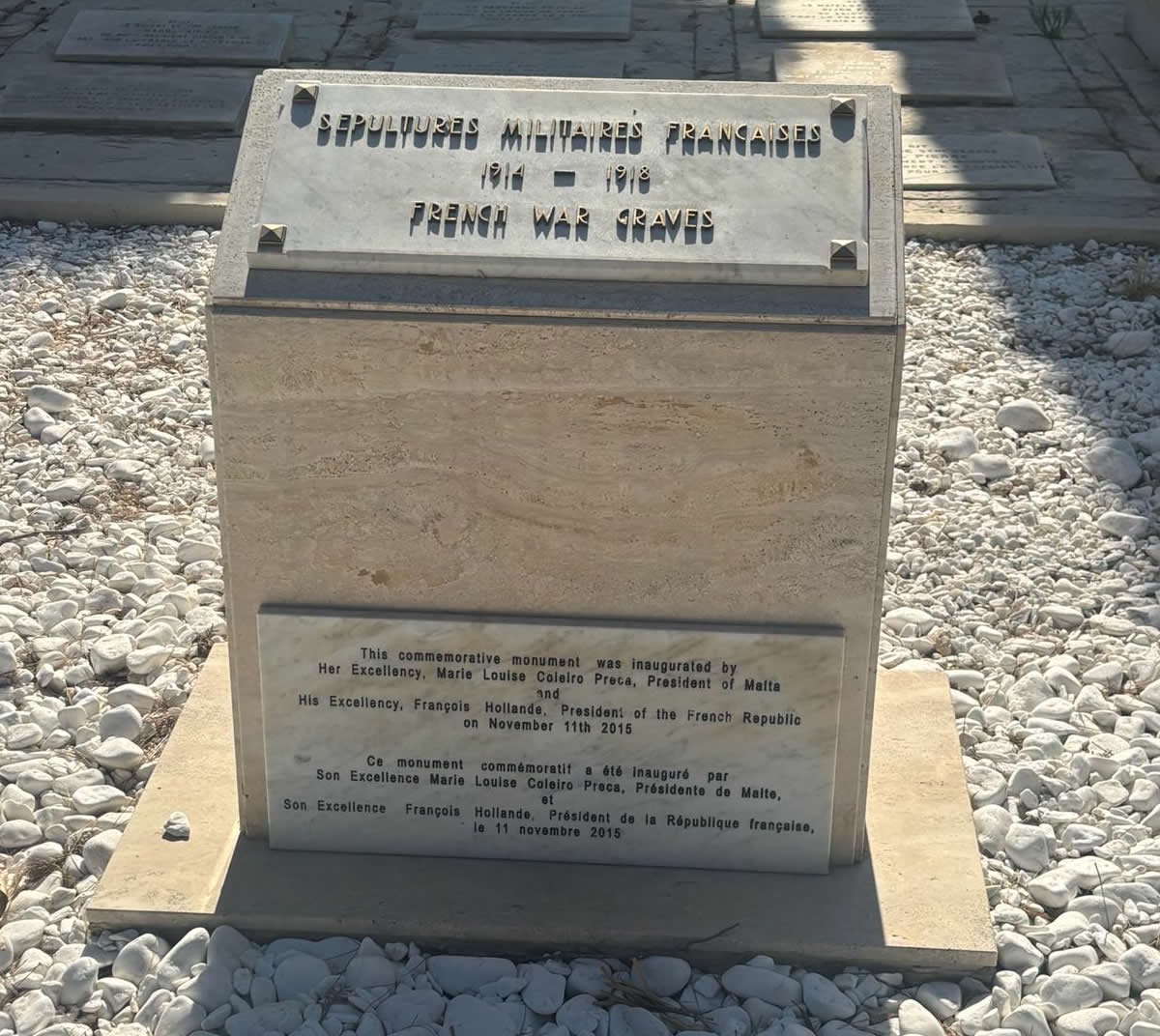
The Western Flank Plot (French & Allied Forces): Situated in a distinct, separate plot on the left-hand slopes of the hill. This area contains French sailors and Allied personnel from the First World War, easily identifiable by their unique stone crosses rather than standard British Commonwealth headstones.
Section EA of the cemetery next to the rear gate
Scattered Private Mausoleums: Over 20 identified casualties are resting within highly decorated private family vaults located on the premium tiers surrounding the apex chapel, where prominent Maltese families chose to bury their fallen relatives.
```
7. Spatial Demarcation from the Central Our Lady of Sorrows Chapel
To maintain structural clarity across your digital platform, it is necessary to establish a clear distinction between the sprawling cemetery grounds detailed on this page and the distinct, soaring chapel building that stands at its apex.
Perched at the absolute summit of the hill is the majestic Our Lady of Sorrows Chapel (structurally known as *Kappella tad-Duluri*). Also designed by Galizia and completed in 1869, this iconic church features a magnificent, sky-piercing stone spire and beautiful ribbed vaulting, serving as the visual anchor for the entire valley.
While the cemetery paths wrap gracefully around this monumental house of worship, the chapel functions under its own self-contained pastoral framework. It serves as a dedicated, sacred venue for seasonal funeral liturgies, national memorial masses, and final committal prayers. For a complete architectural, engineering, and artistic breakdown focusing strictly on that landmark spire, please visit our standalone page: The Our Lady of Sorrows Chapel, Paola In-Depth Profile.
8. Modern Maintenance and Visitor Etiquette
Today, the Santa Maria Addolorata Cemetery remains fully active, continuing to serve its vital role as a sacred space for family interments and quiet remembrance. To accommodate the needs of a modern population, the government and civil health authorities have completed large-scale expansion projects on the back slopes of the hill, carefully adding thousands of new, uniform family graves while ensuring the new architecture blends smoothly with Galizia's original historic designs.
The cemetery plays its most prominent cultural role during the traditional month of remembrance in November. On All Souls' Day, thousands of Maltese families visit the hillside to clean family vaults, light memorial lamps, and participate in a moving, national outdoor mass.
Because this is an active, deeply revered place of rest and private mourning, visitors are requested to follow strict site guidelines. Casual wandering off the paved pathways is discouraged, and commercial photography or large tour groups are strictly regulated to preserve the timeless peace, silence, and sacred dignity of this national monument.
9. Cartographic Layout and Grid Divisions
The physical cartography of the Addolorata complex transitions seamlessly from an expressive, organic Victorian hillside network to a modern rectangular civil grid system. For genealogical mapping and research tracking, the site layout is formally split into lettered compartments, sections, and numbered divisions:
Cemetery Sector
Topographical Layout style
Primary Registry Key Markers
The Lower Valley (Main Entrance)
Symmetrical Loop & Cloistered Arcades
Gatehouse Administration Hub / Compartment A
The Hillside Slopes (Upper Terraces)
Triangular Pointed Pathways & Terraced Steps
Mausoleum Rows / Paths Left & Right of Central Axis
The Summit Apex
Radial Loop surrounding Spire Church
Our Lady of Sorrows Sanctuary Perimeter
The Rear Plateau (Extensions)
Linear Grid Matrix
Compartment D, Section V & Newer Back Plots
As noted in international registries such as the CWGC logs, official military plots are precisely assigned using these specific grid markers—most notably cataloged under Compartment A, Section EA, Division E on the upper eastern slopes, and Compartment D, Section V, Division E within the flat rear grid extension.
Frequently Asked Questions — Addolorata Cemetery
1. Is the Addolorata Cemetery run by the church or the state?
The Santa Maria Addolorata Cemetery is entirely government-run, administered by the Environmental Health Directorate within the Ministry for Health. Though the burial plots are consecrated Catholic grounds and were historically managed on a daily basis by the Franciscan Capuchin Friars, complete administrative responsibility shifted entirely to the government in 2011.
2. When did the government officially take over administration from the Church?
The operational and administrative handover occurred in 2011. This transition consolidated all archival registries, grave deed tracking, and grounds upkeep under the state's centralized Burials Regulatory Unit (BRU).
3. How can I locate a specific family grave plot at the Addolorata?
Because the cemetery is government-run, all official burial registries and plot maps are handled by civil service personnel. Visitors and genealogical researchers can visit the administration offices at the main entrance to check specific grid coordinates for graves across the hillside terraces.
4. Are there military or war graves located within the cemetery?
Yes, the cemetery features large, beautifully maintained Commonwealth War Graves Commission (CWGC) plots. These sections contain the graves of hundreds of commonwealth servicemen from World War I and World War II, honoring Malta's historic wartime role.
5. Where can I find information about the grand spire chapel at the top of the hill?
The monumental chapel at the summit is the Our Lady of Sorrows Chapel. While it sits within the cemetery grounds, its detailed architectural engineering, history, and interior art are covered on our dedicated page for The Our Lady of Sorrows Chapel.