📍 Location
Location Map Coordinates 35.887227, 14.536781
Malta’s historic Royal Navy cemetery and one of the most important Commonwealth war grave sites in the Mediterranean.
Introduction
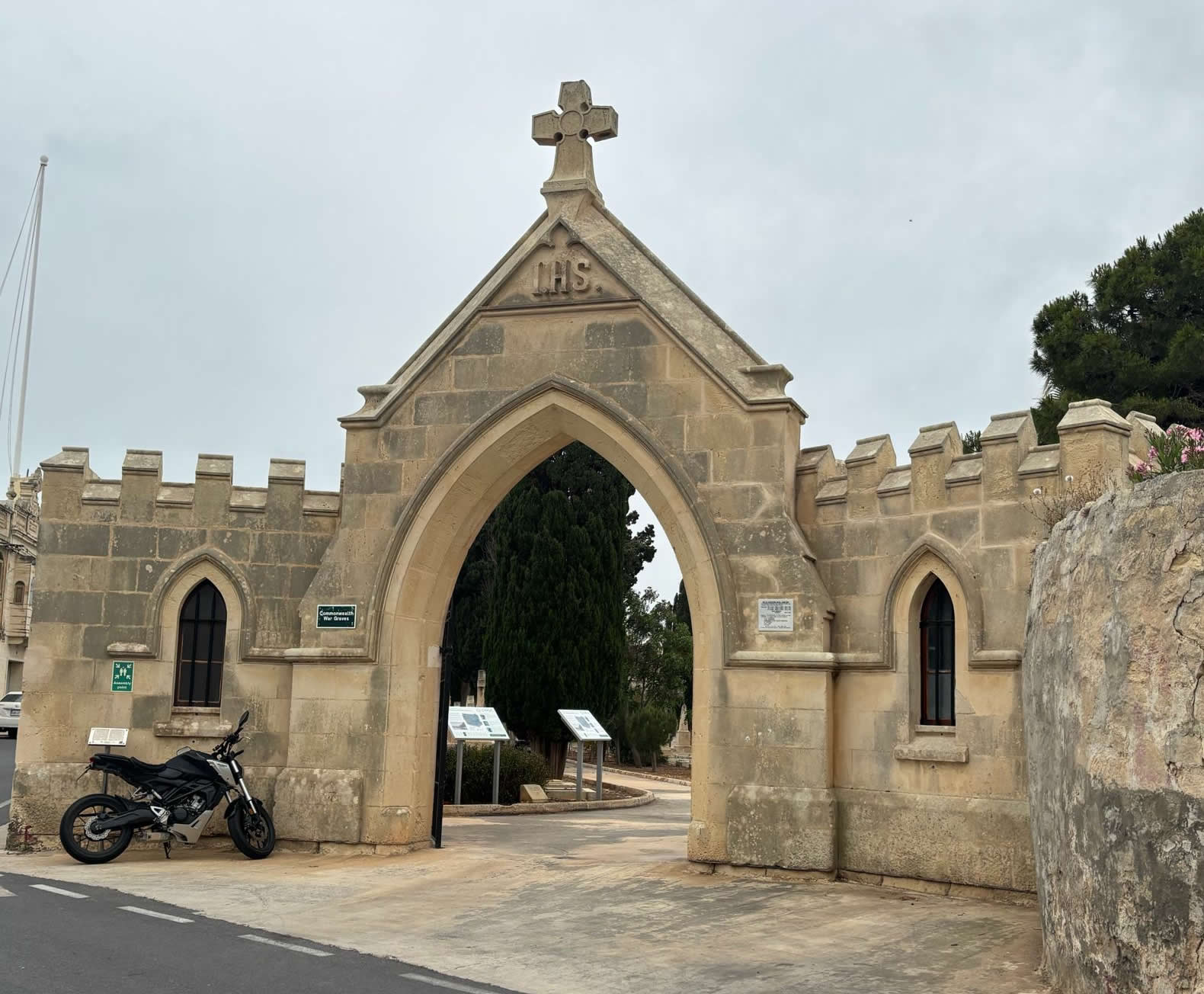
Capuccini Naval Cemetery, also known as Kalkara Naval Cemetery, is one of Malta’s most historically important military burial grounds. Located in Kalkara near the Grand Harbour, the cemetery preserves the graves of Royal Navy personnel, Commonwealth servicemen, civilians, and foreign military casualties connected with Malta’s strategic naval role during the British colonial period and the two World Wars.
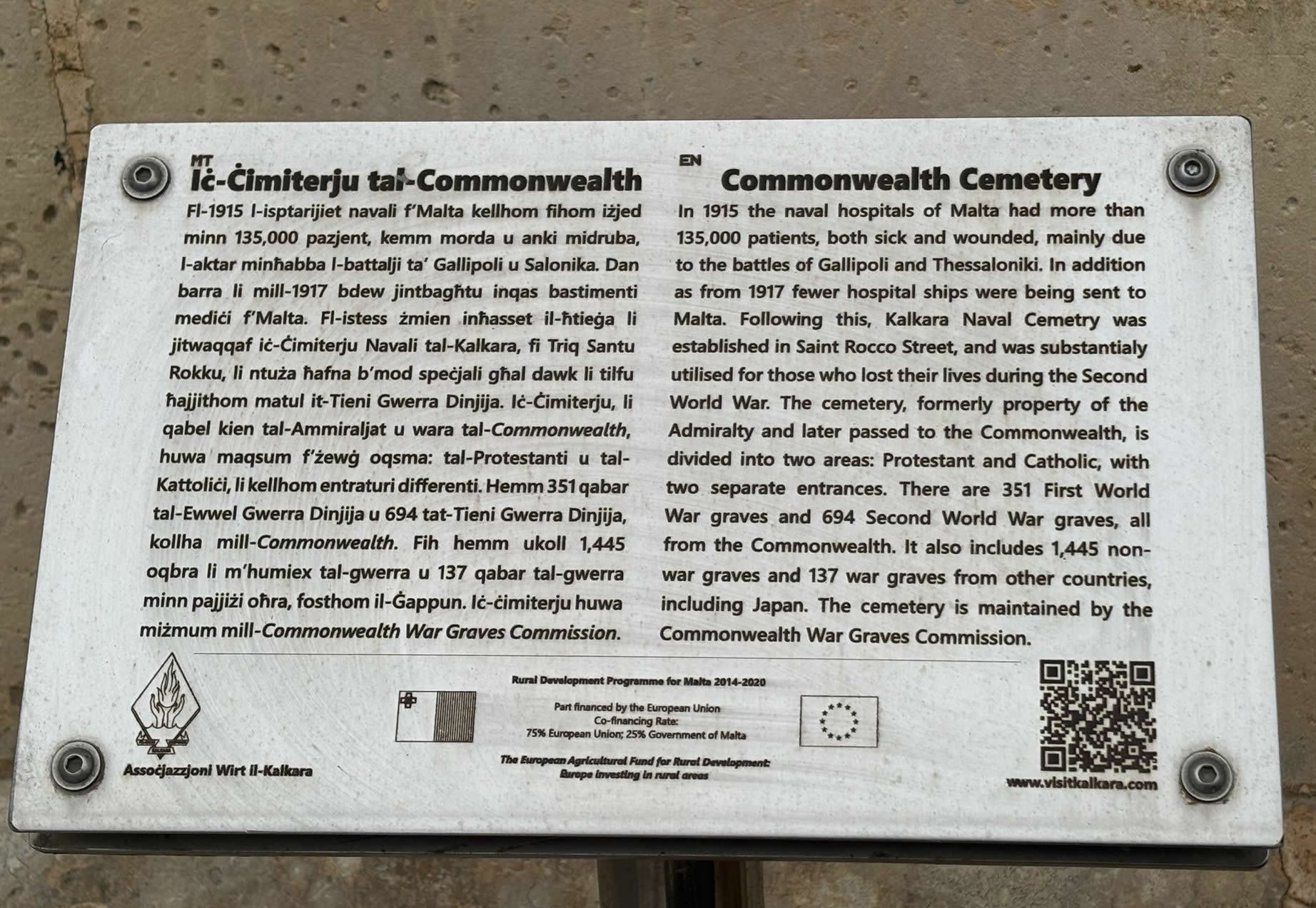
The cemetery occupies an especially significant place in Malta’s military heritage because of its close association with the British Royal Navy and the Mediterranean Fleet. During the 19th and early 20th centuries, Malta served as one of Britain’s principal naval bases in the Mediterranean, transforming the islands into a major military and maritime centre.
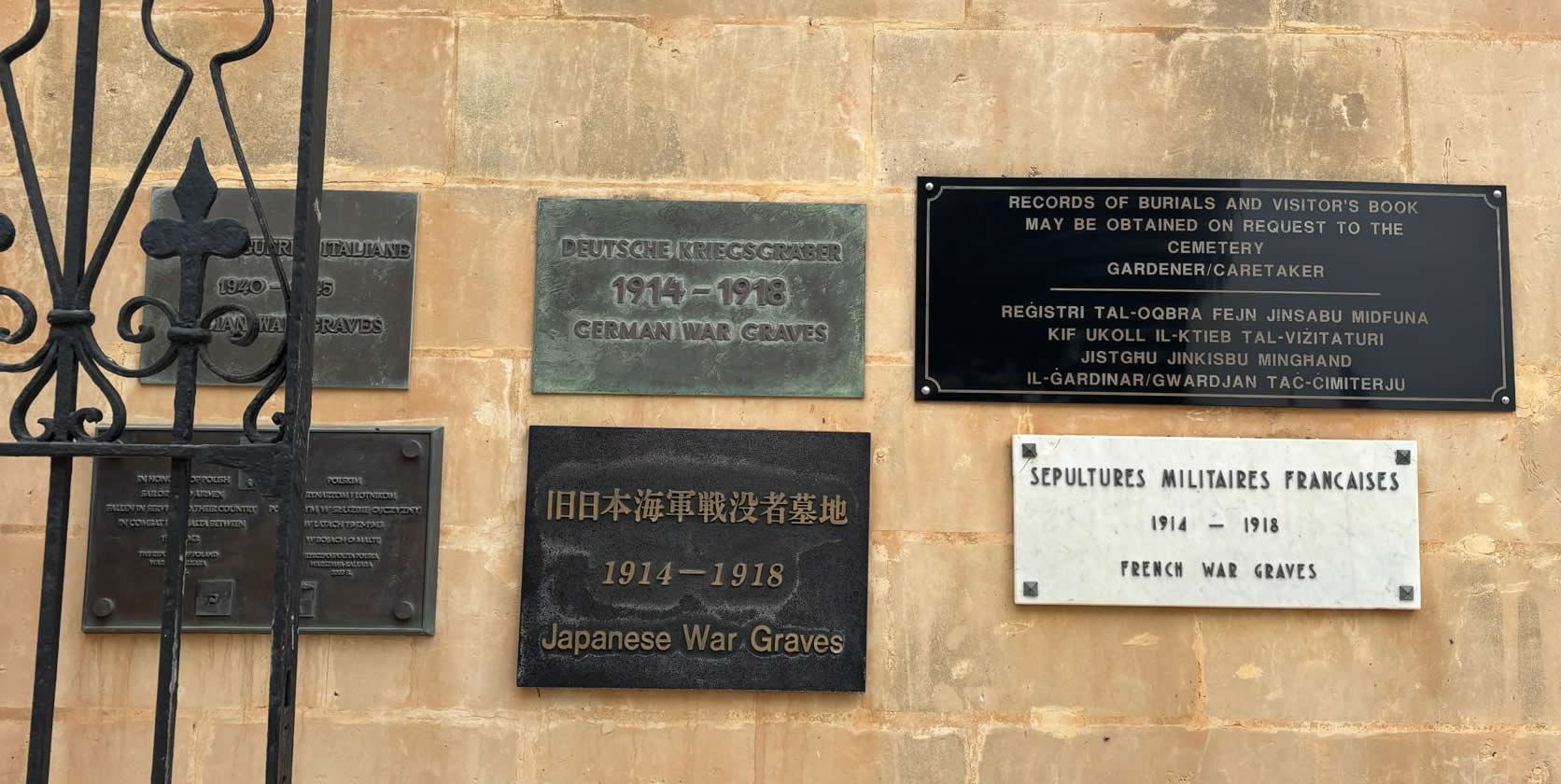
Today, Capuccini Naval Cemetery remains an active Commonwealth War Graves site and a deeply important place of remembrance. The cemetery contains over a thousand Commonwealth military burials from the First and Second World Wars together with numerous civilian and foreign graves. It is also home to the distinctive Japanese Naval Memorial commemorating Japanese sailors who died while assisting Allied naval operations during the First World War.
Location and Setting
Capuccini Naval Cemetery is situated in Kalkara, Malta, at coordinates 35.887227, 14.536781 near Triq San Leonardu and Triq Santa Rokku. The cemetery occupies elevated ground overlooking parts of the Grand Harbour region and lies close to the historic naval infrastructure of Cottonera and Fort Ricasoli.
Its strategic location reflects the close relationship between the cemetery and the British naval establishment. The surrounding harbour region served for generations as one of the most important British naval stations outside the United Kingdom.
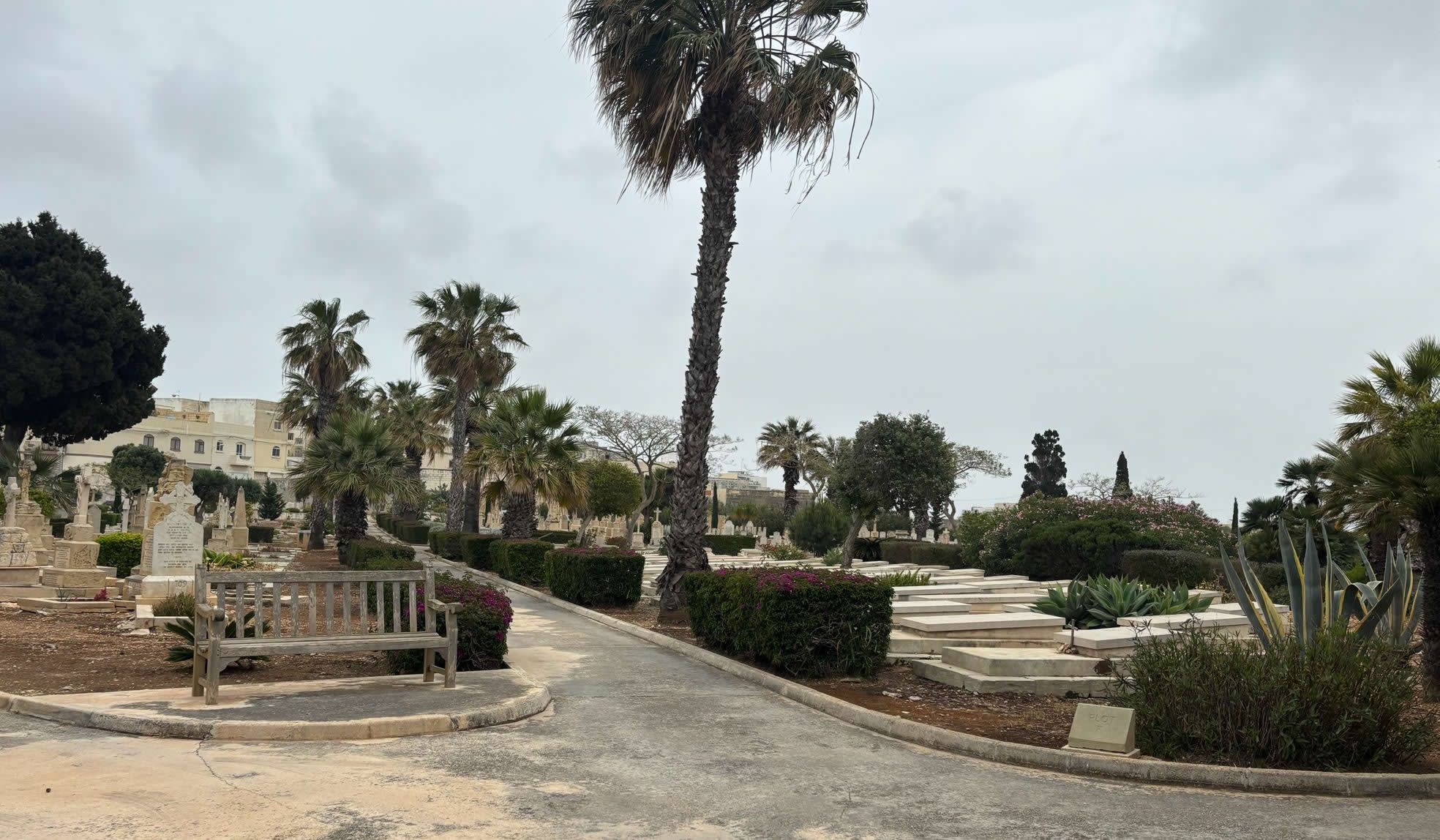
Despite the surrounding urban development of Kalkara, the cemetery retains a quiet and contemplative atmosphere. Mature trees, limestone pathways, memorial crosses, and rows of Commonwealth gravestones create a solemn landscape dedicated to remembrance and military sacrifice.
Origins of the Cemetery
The origins of Capuccini Naval Cemetery date to the British colonial period when Malta increasingly developed into a key Royal Navy base following the departure of the Knights of St John and the establishment of British rule in the early 19th century.
As British naval activity expanded, Malta required dedicated burial grounds for naval personnel, marines, sailors, officers, and their families. Existing churchyards and local cemeteries could no longer adequately serve the growing naval population associated with the dockyards and military establishments around the Grand Harbour.
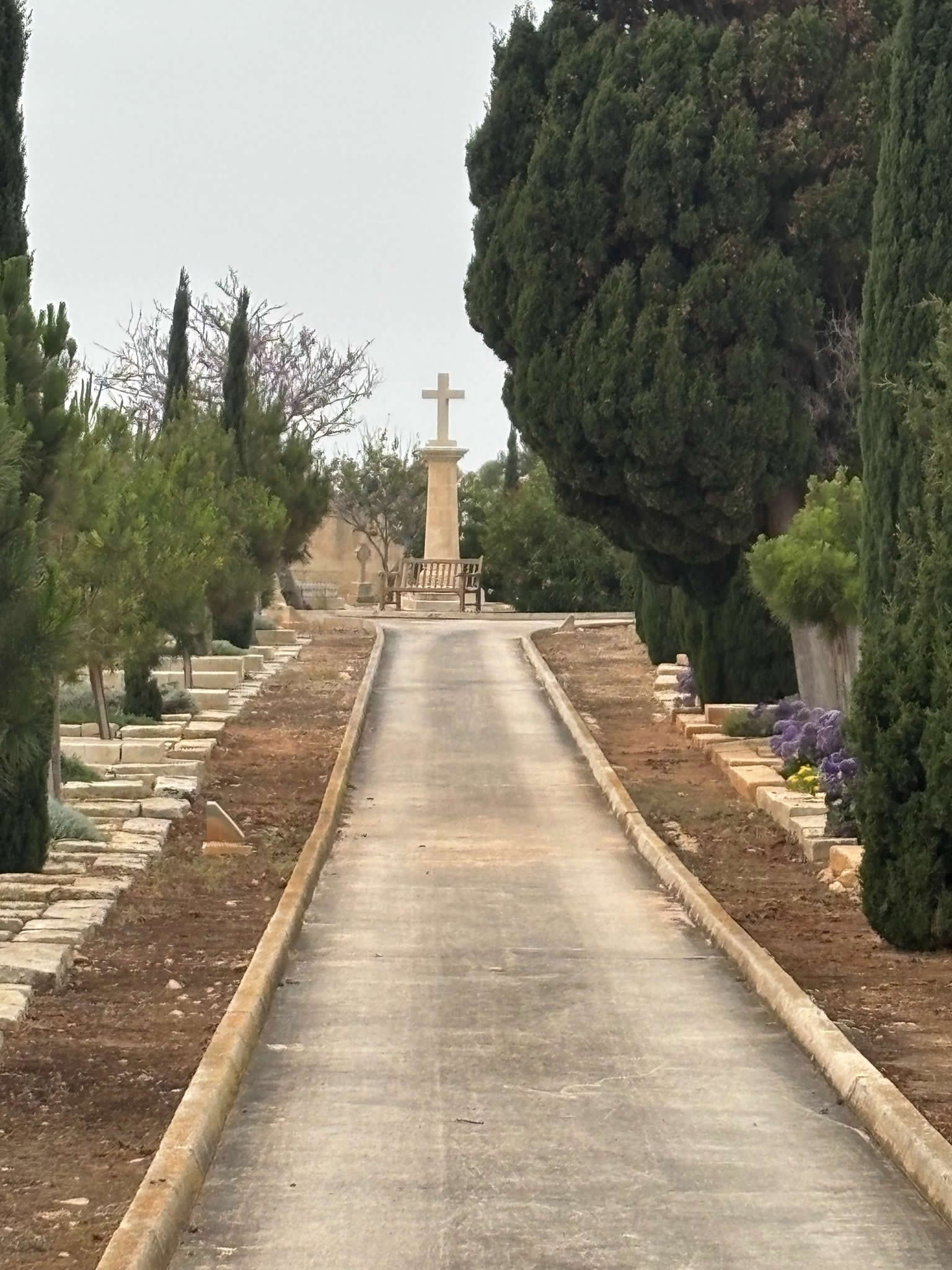
The cemetery gradually evolved into a specialised naval burial ground under British administration. Over time it expanded to include both Protestant and Roman Catholic sections, reflecting the diverse religious backgrounds of those stationed in Malta.
Capuccini Naval Cemetery eventually became one of the principal military cemeteries associated with the Mediterranean Fleet and the naval dockyards of Malta.
Malta and the Royal Navy
During the 19th century Malta became one of the British Empire’s most strategically important naval possessions. Its central Mediterranean location allowed Britain to control maritime trade routes and project naval power across North Africa, the eastern Mediterranean, and the Suez route to India.
Massive dockyard facilities were developed around the Grand Harbour, and thousands of naval personnel were stationed in Malta. Hospitals, barracks, supply depots, and repair facilities transformed the harbour region into a major military-industrial complex.
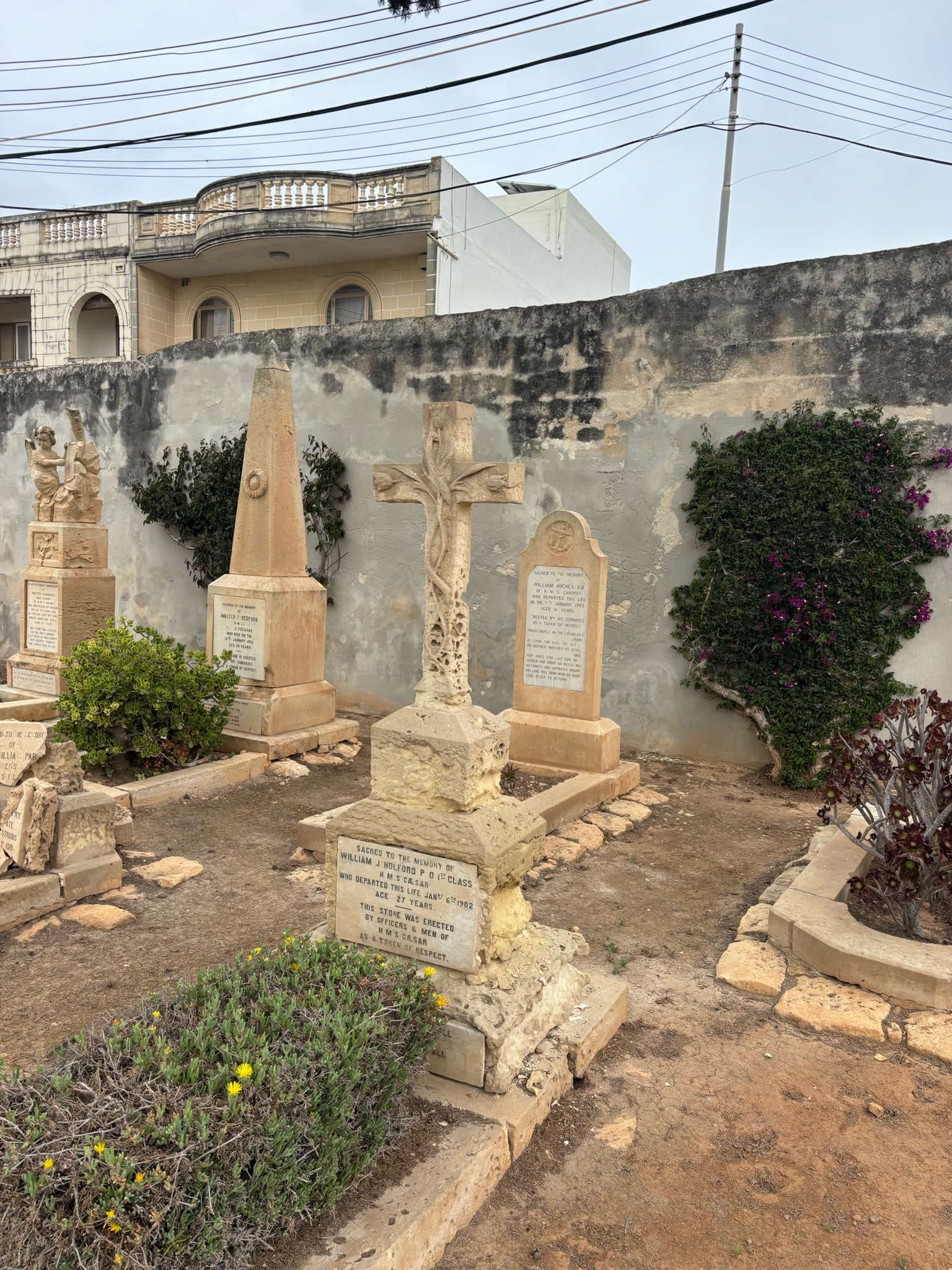
Capuccini Naval Cemetery became closely connected with this military world. Sailors who died from illness, accidents, combat injuries, or maritime disasters were buried here together with naval officers, marines, and civilian workers connected to the dockyard community.
The cemetery therefore preserves an important record of daily life and mortality within the British naval presence in Malta.
First World War Burials
During the First World War Malta became known as the “Nurse of the Mediterranean” because of the enormous number of wounded servicemen treated in military hospitals across the islands. From 1915 onwards, hospitals and convalescent centres in Malta cared for tens of thousands of casualties evacuated from Gallipoli, Salonika, and other Mediterranean campaigns.
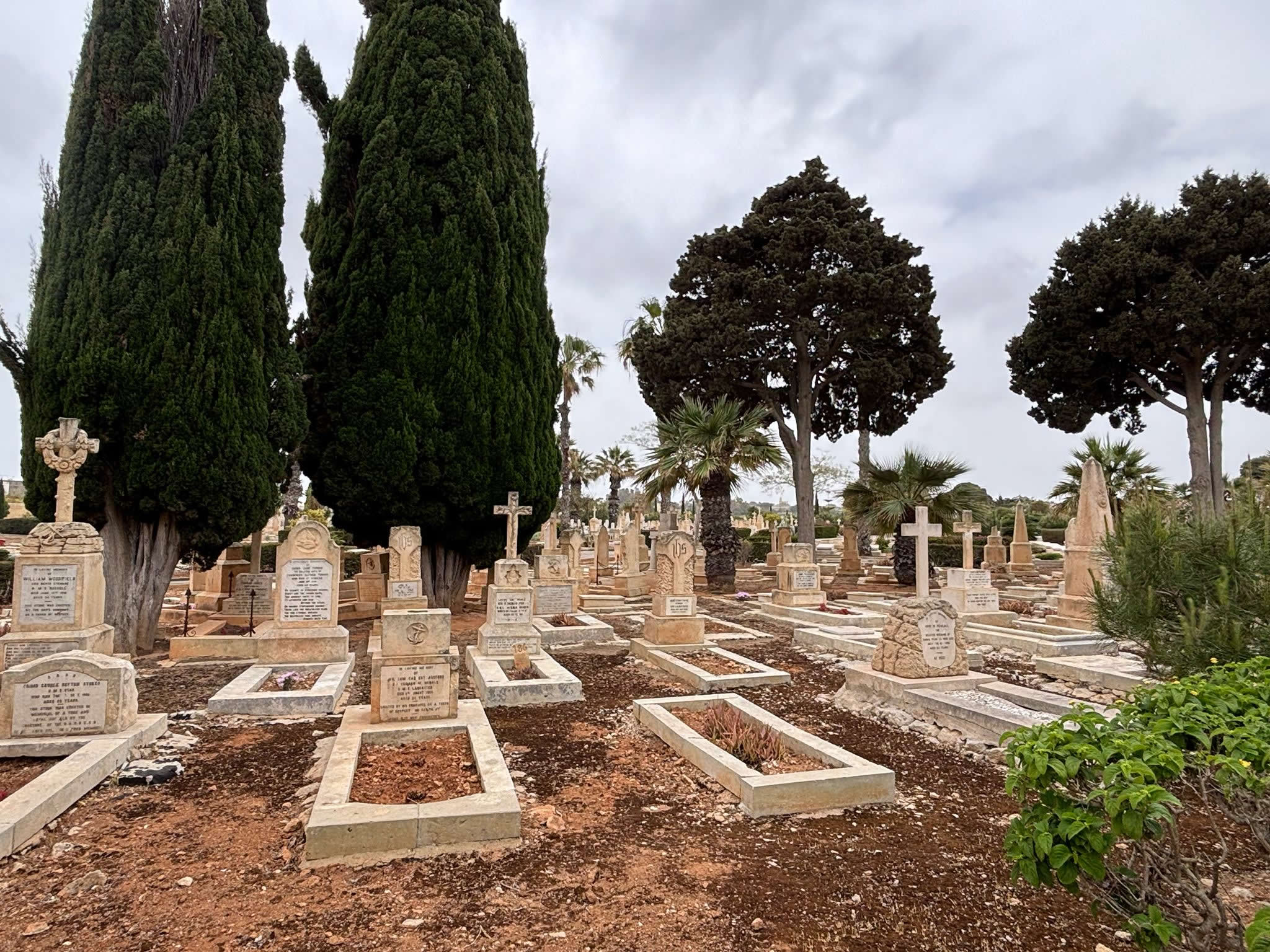
Many servicemen who died from wounds or disease during treatment in Malta were buried at Capuccini Naval Cemetery. The cemetery contains hundreds of Commonwealth burials from the First World War, including Royal Navy personnel and servicemen from across the British Empire.
Several burials are connected to naval disasters and wartime attacks in the Mediterranean. Among the most notable are casualties from HMS Russell, which struck mines near Malta in 1916.
The cemetery therefore provides a direct connection to Malta’s wartime role as both a naval fortress and military hospital centre.
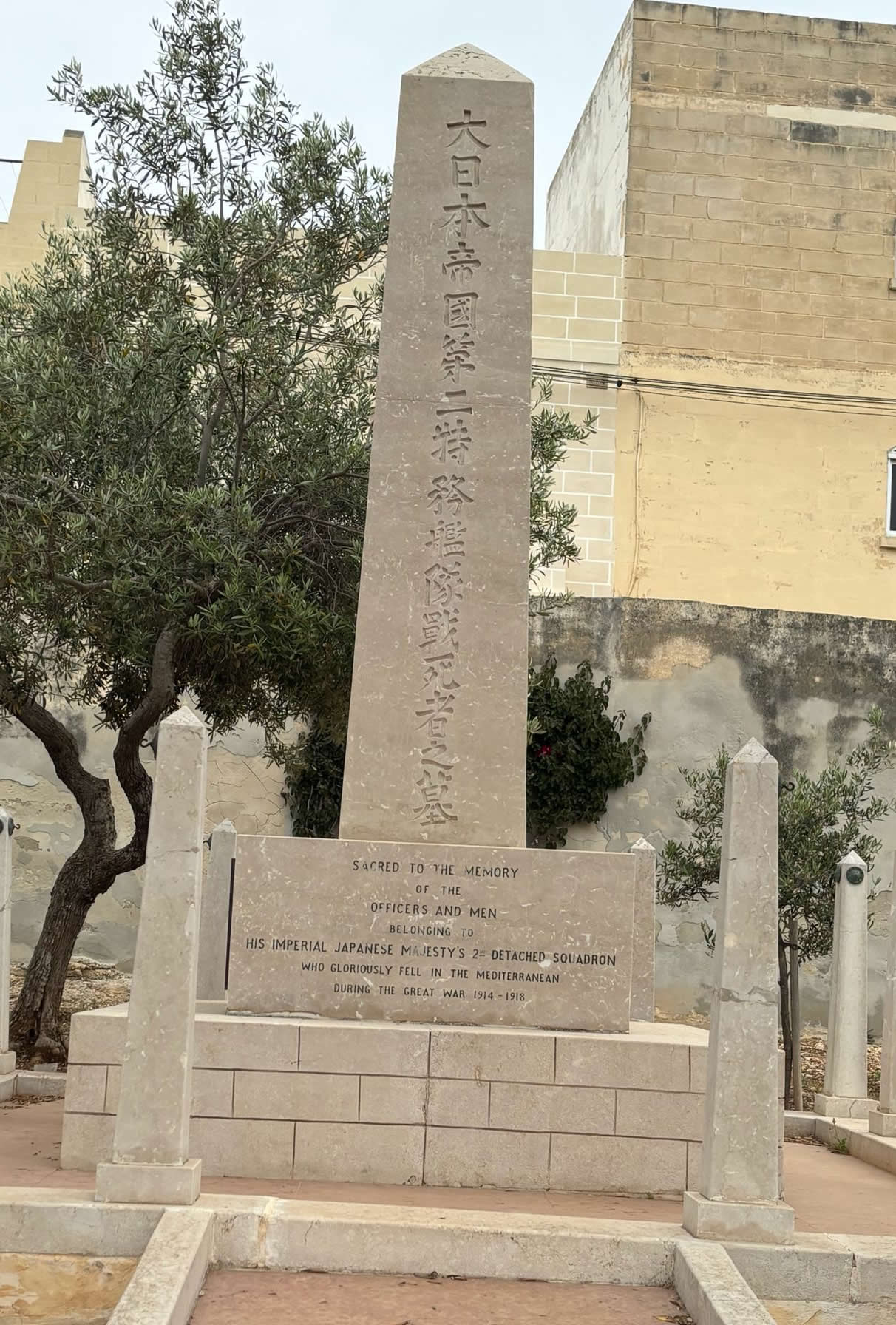
The Japanese Naval Memorial
One of the cemetery’s most distinctive and internationally significant memorials is the Japanese Naval Memorial. This monument commemorates Japanese sailors who died while serving alongside Allied naval forces during the First World War.
In 1917 the Japanese destroyer Sakaki was torpedoed near Crete by an Austrian submarine while escorting Allied convoys in the Mediterranean. Sixty-eight Japanese sailors lost their lives in the attack.
Some of the victims were buried in Malta, and the memorial at Capuccini Naval Cemetery remains an unusual symbol of Japanese-Allied naval cooperation during the war.
The memorial is especially important because it represents one of the few Japanese military memorials in Europe connected with the First World War.
Second World War and the Siege of Malta
During the Second World War Malta endured one of the longest and most intense sieges of the conflict. Between 1940 and 1942 the islands suffered continuous aerial bombardment from Axis forces due to their strategic position in the Mediterranean.
The Grand Harbour and dockyard region became primary targets for enemy attacks. Naval personnel, dockyard workers, merchant seamen, and civilians were killed during air raids, naval operations, and convoy battles.
Capuccini Naval Cemetery received many of these wartime burials. Hundreds of Commonwealth graves from the Second World War are located within the cemetery, reflecting Malta’s enormous sacrifices during the siege years.
The cemetery remains one of the most important surviving physical records of Malta’s wartime experience and the international naval struggle for control of the Mediterranean.
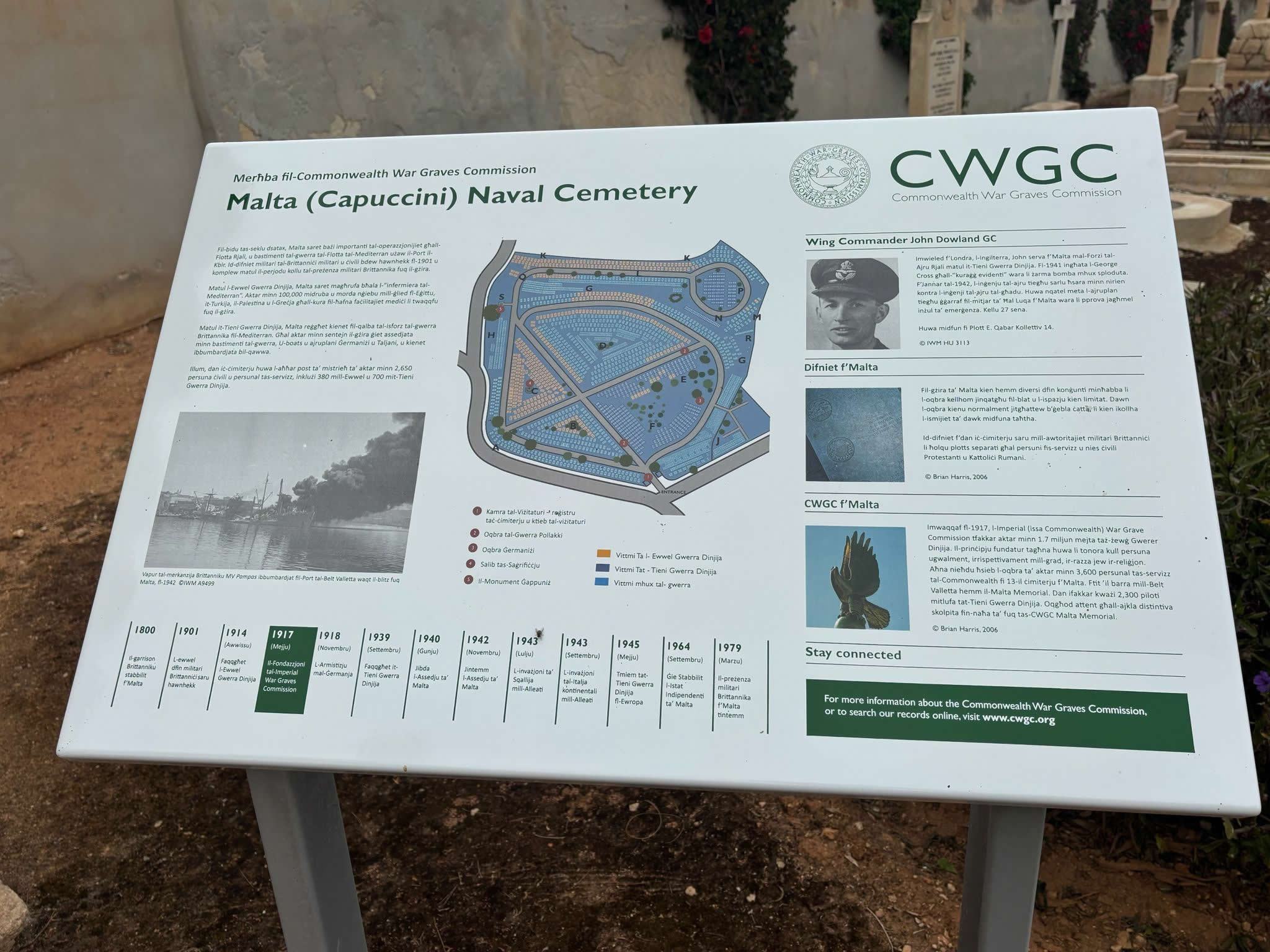
Architecture and Cemetery Layout
The cemetery reflects the formal planning principles commonly associated with British military cemeteries during the late 19th and early 20th centuries.
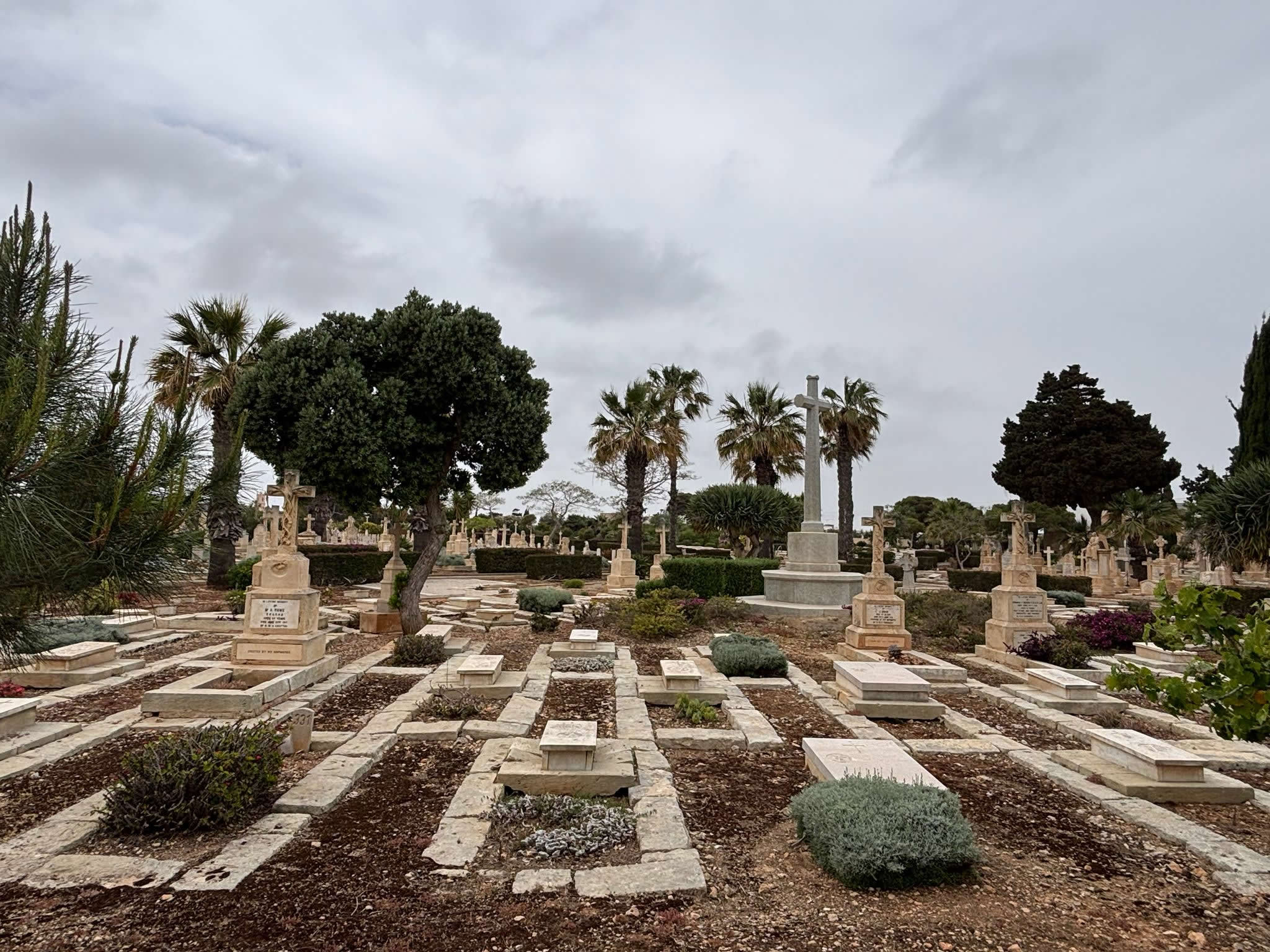
The grounds are divided into Roman Catholic and Protestant sections, illustrating the religious diversity of the naval and military population buried there. Rows of Commonwealth War Graves Commission headstones create an ordered and dignified appearance typical of British military memorial landscapes.
Traditional Maltese limestone walls surround the cemetery, while mature cypress and ornamental trees contribute to the solemn atmosphere. Memorial crosses, obelisks, plaques, and naval insignia appear throughout the site.
The careful arrangement of graves and memorials reflects the military emphasis on discipline, equality, and collective remembrance.
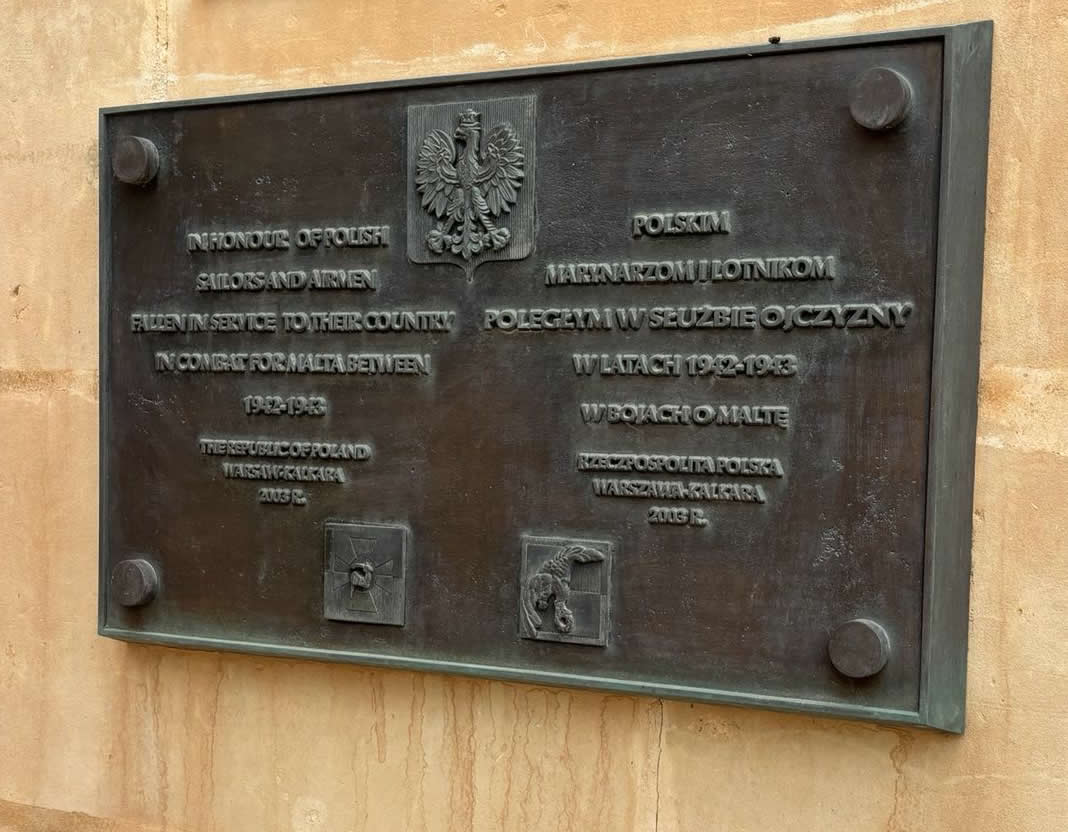
Commonwealth War Graves Commission
Many graves within Capuccini Naval Cemetery are maintained by the Commonwealth War Graves Commission (CWGC), the organisation responsible for commemorating Commonwealth military personnel who died during the world wars.
The cemetery contains more than one thousand Commonwealth war graves in addition to numerous civilian and foreign burials.
CWGC maintenance ensures that the cemetery remains in excellent condition, preserving both the gravestones and the wider commemorative landscape.
Visitors can find graves representing servicemen from Britain, Australia, New Zealand, Canada, India, South Africa, and other Commonwealth nations.
Notable Burials
Among the notable burials and memorials within the cemetery are:
- Japanese sailors from the destroyer Sakaki
- Casualties from HMS Russell
- Royal Navy personnel stationed in Malta
- Merchant Navy casualties
- Servicemen who died during the Siege of Malta
- Members of the dockyard and naval community
The cemetery therefore reflects not only Malta’s military history but also the broader international nature of naval warfare in the Mediterranean.
Floriana relocations 1801-1825
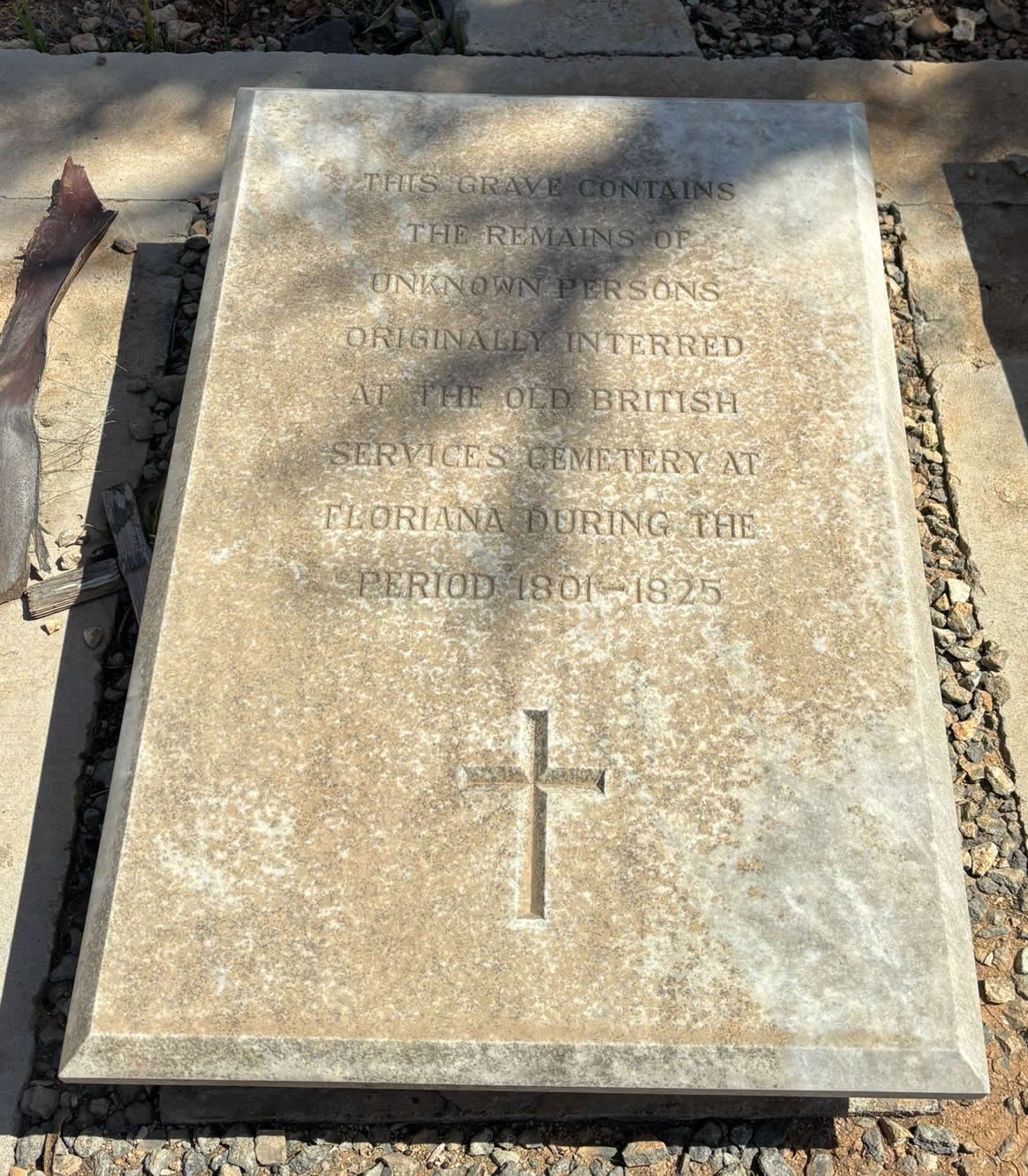
Bighi Royal Naval Hospital relocations
Bighi Royal Naval Hospital had its own cemetery within its boundaries. The cemetery and some of the hospital grounds were redeveloped for a housing project in 1967 and any remains were removed from Bighi in December 1966. A gravestone at the Commonwealth Cemetery states: ‘This stone stands in memory of those originally interred in the cemetery of the Royal Naval Hospital, Bighi, in the years 1846 to 1901. Their names are forever recorded in a memorial book in the church of St. Oswald, Royal Naval Hospital, Malta.’There are a number of gravestones for Bighi relocations from 1801-1825, 14th January 1969 and 25th March 1967, the last two have the names on the gravestone
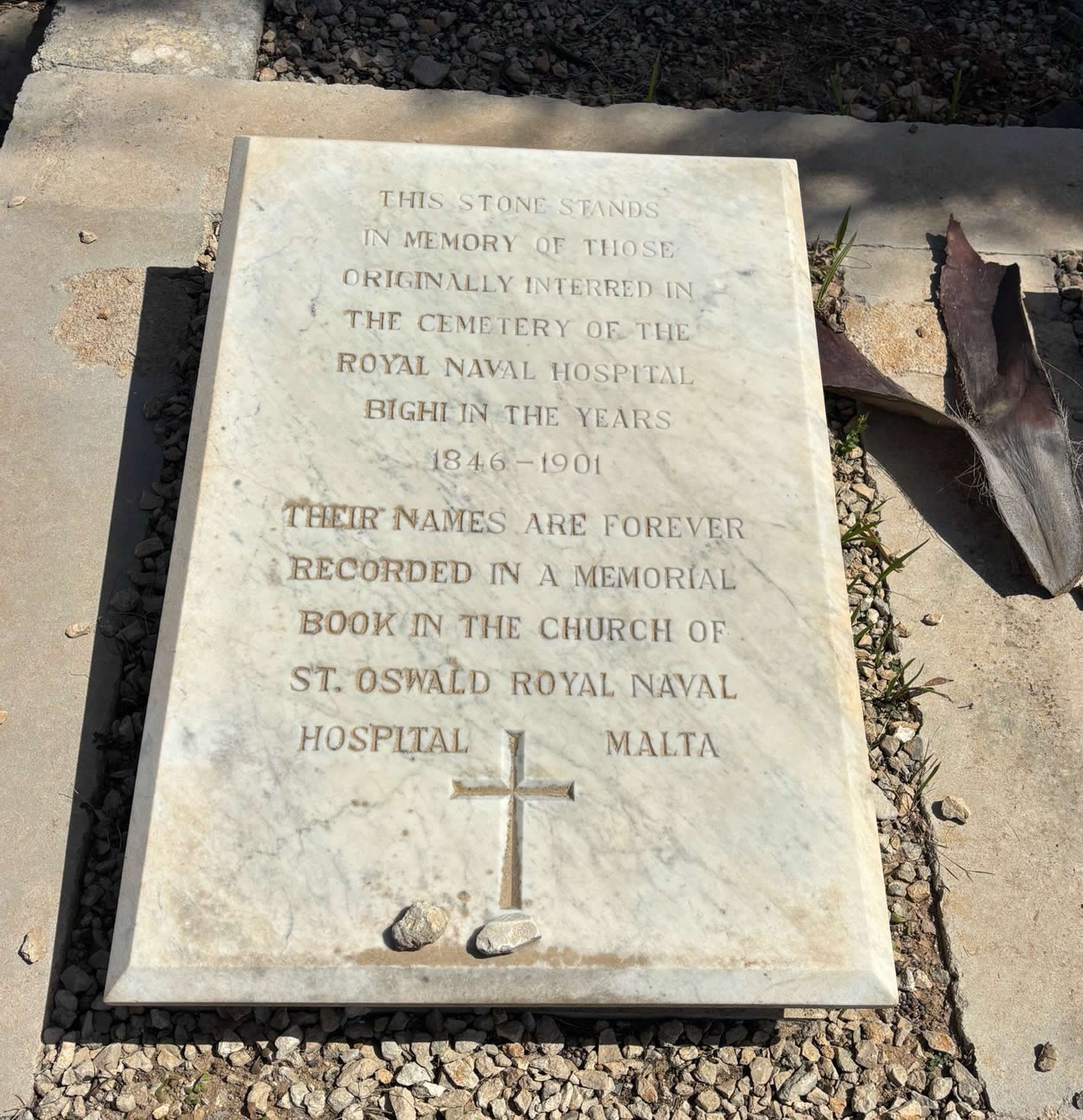
From the dates 1846 to 1901
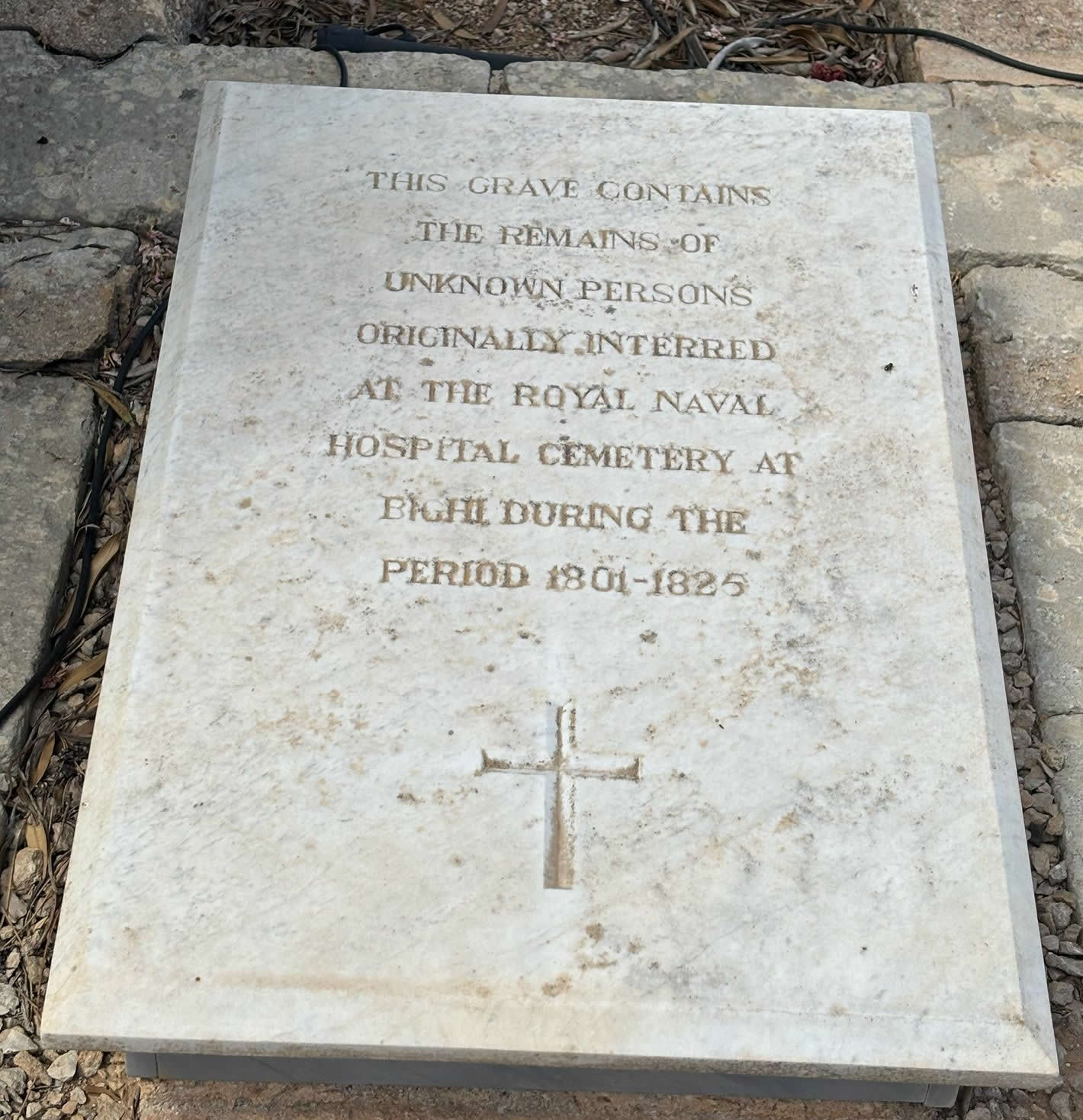
From the dates 1801-1825
Relocated Remains Mass Grave 849
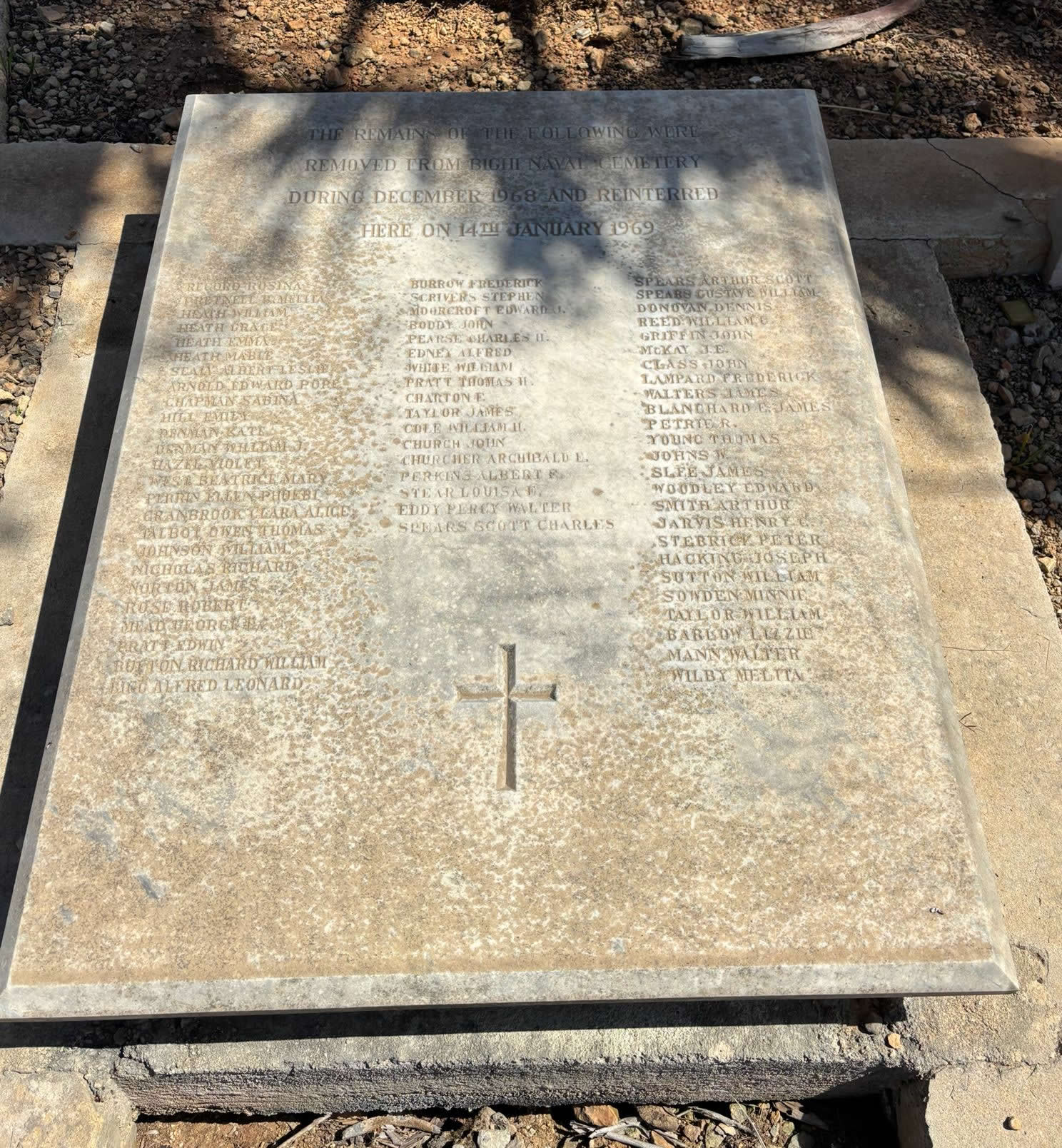
Removed December 1968 and relocated 14th January 1969 - 67 names listed
Relocated Remains Mass Grave 851
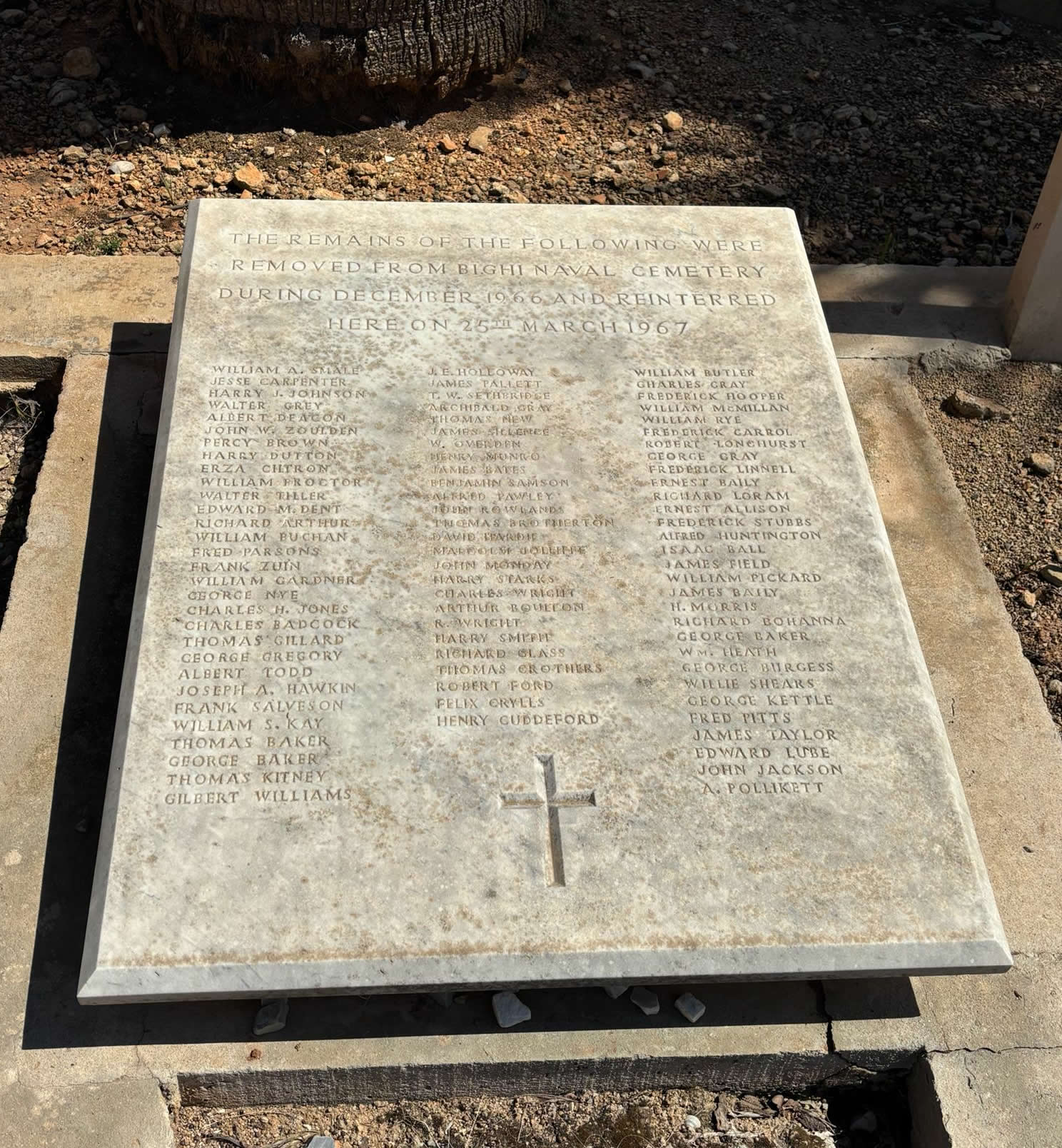
Removed December 1966 and relocated 25th March 1967 - 86 names listed
Rinella Cemetery relocations
Rinella Cemetery was located about halfway between the Commonwealth Cemetery and Bighi Hospital, and was used by British Servicemen and their families from 1865 to 1913. In 1978 any remains were transferred into a mass grave at the Commonwealth Cemetery where a gravestone states: ‘Here buried are those members of the British Services and their families who died between 1865 and 1913 and were formerly interred in Rinella Military cemetery.’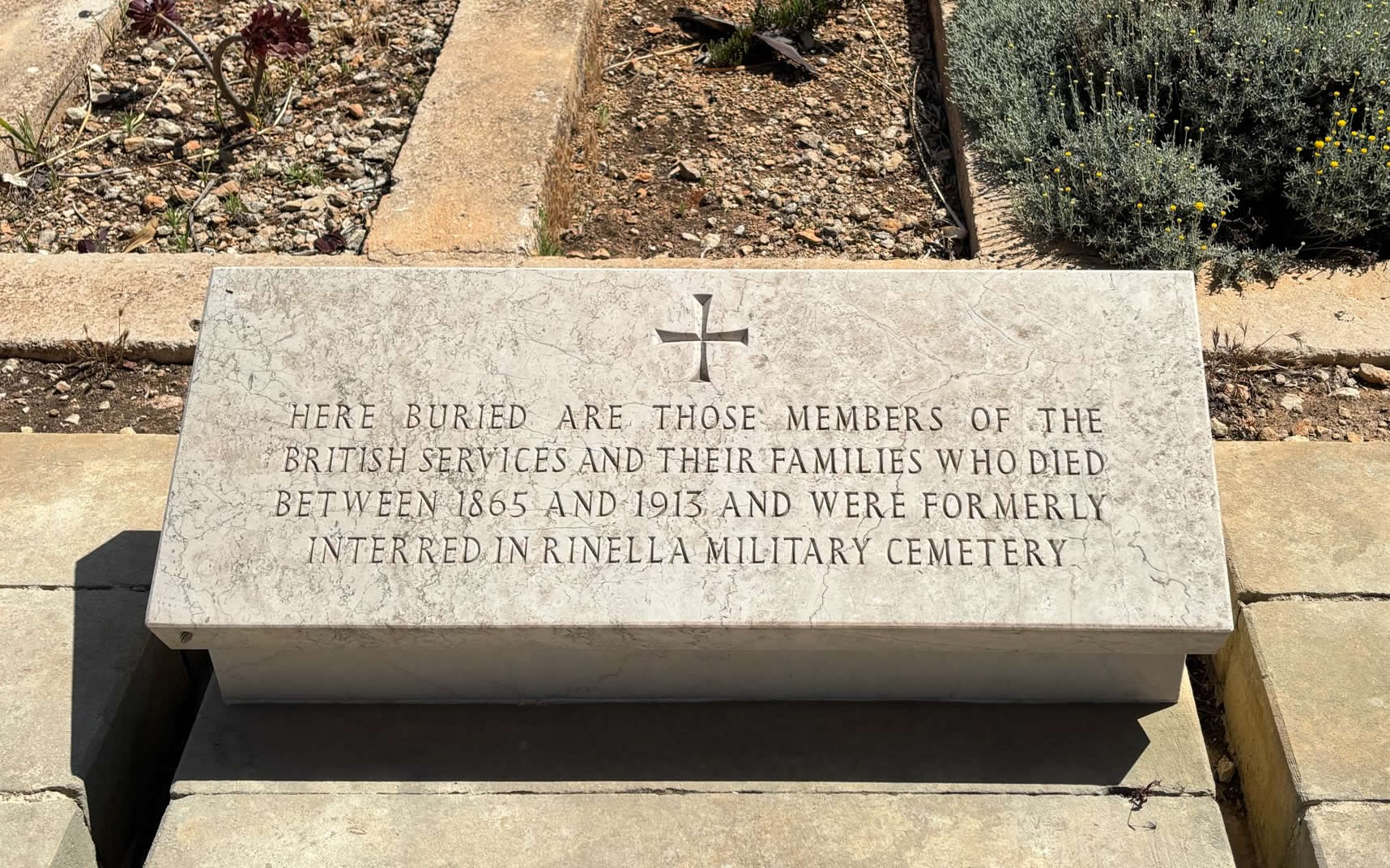
German Memorial
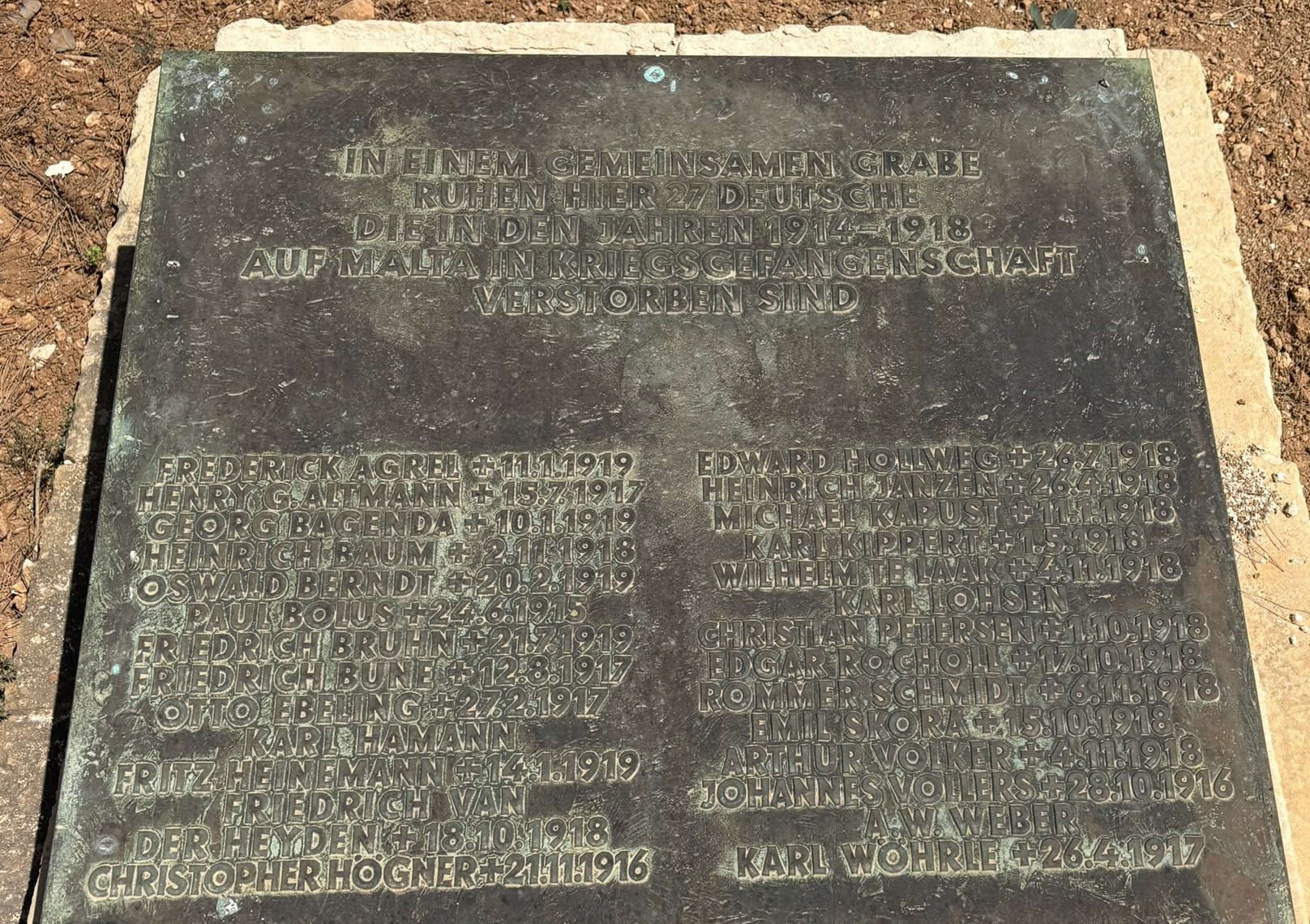
| Name | Date of Death | Notes & Context |
|---|---|---|
| AGREL, Frederick | 11 Jan 1919 | German POW / Internee |
| ALTMANN, Henry G. | 15 Jul 1917 | German POW / Internee |
| BAGENDA, Georg | 10 Jan 1919 | German POW / Internee |
| BAUM, Heinrich | 2 Nov 1918 | German POW / Internee |
| BERNDT, Oswald | 20 Feb 1919 | German POW / Internee |
| BOLUS, Paul | 24 Jun 1915 | German POW / Internee |
| BRUHN, Friedrich | 21 Jul 1919 | German POW / Internee |
| BUNE, Friedrich | 12 Aug 1917 | German POW / Internee |
| EBELING, Otto | 27 Feb 1917 | German POW / Internee |
| HAMANN, Karl | — | German POW / Internee (Date not inscribed) |
| HEINEMANN, Fritz | 14 Jan 1919 | German POW / Internee |
| VAN DER HEYDEN, Friedrich | 18 Oct 1918 | German POW / Internee |
| HÖGNER, Christopher | 21 Nov 1916 | German POW / Internee |
| HOLLWEG, Edward | 26 Jul 1918 | German POW / Internee |
| JANZEN, Heinrich | 26 Apr 1918 | German POW / Internee |
| KAPUST, Michael | 11 Nov 1918 | German POW / Internee |
| KIPPERT, Karl | 1 May 1918 | German POW / Internee |
| TE LAAK, Wilhelm | 4 Nov 1918 | German POW / Internee |
| LOHSEN, Karl | — | German POW / Internee (Date not inscribed) |
| PETERSEN, Christian | 1 Oct 1918 | German POW / Internee |
| ROCHOLL, Edgar | 17 Oct 1918 | German POW / Internee |
| SCHMIDT, Rommer | 6 Nov 1918 | German POW / Internee |
| SKORA, Emil | 15 Oct 1918 | German POW / Internee |
| VÖLKER, Arthur | 4 Nov 1918 | German POW / Internee |
| VOLLERS, Johannes | 28 Oct 1916 | German POW / Internee |
| WEBER, A. W. | — | German POW / Internee (Date not inscribed) |
| WÖHRLE, Karl | 26 Apr 1917 | German POW / Internee |
Protection and Restoration
Capuccini Naval Cemetery is recognised as a site of major national heritage importance and is listed as a Grade 1 protected property on the National Inventory of the Cultural Property of the Maltese Islands.
Conservation work over the years has focused on preserving gravestones, pathways, memorial structures, and boundary walls affected by weathering and environmental exposure.
The continued involvement of the Commonwealth War Graves Commission has played a major role in maintaining the cemetery’s condition and historical integrity.
Visiting Capuccini Naval Cemetery
Today the cemetery attracts military historians, genealogists, descendants of those buried there, photographers, and visitors interested in Malta’s wartime heritage.
The cemetery’s peaceful atmosphere and carefully maintained grounds make it one of the most reflective historic sites in the Grand Harbour region.
Visitors should behave respectfully due to the cemetery’s role as an active memorial landscape and burial ground.
Conclusion
Capuccini Naval Cemetery in Kalkara is one of Malta’s most important military heritage sites. Through its graves, memorials, and carefully preserved landscape, the cemetery tells the story of Malta’s strategic role within the British Empire and the wider Mediterranean conflicts of the 19th and 20th centuries.
From the Royal Navy sailors of the Victorian era to the casualties of the two World Wars and the Japanese naval memorial, the cemetery preserves the memory of thousands connected with Malta’s naval history.
Today it remains not only a cemetery, but also an international monument to sacrifice, remembrance, and Malta’s enduring maritime heritage.
Frequently Asked Questions
Where is Capuccini Naval Cemetery located?
The cemetery is located in Kalkara, Malta at coordinates 35.887227, 14.536781.
Why is the cemetery important?
It is one of Malta’s principal Commonwealth war grave cemeteries and is closely associated with the Royal Navy and the two World Wars.
What is the Japanese Naval Memorial?
The memorial commemorates Japanese sailors killed in 1917 while escorting Allied convoys during the First World War.
Who maintains the cemetery?
Many of the war graves are maintained by the Commonwealth War Graves Commission.