📍 Location
Location Map Coordinates 35.850941, 14.424828
Multi-Epoch Epidemiological Study: Assessing the 1676 Knight-Era Roots, 1813 British Colonial Extensions, and Current Landscape Status

1. Historical Foundations: The Deadliest Outbreak of 1675–1676
The historical significance of Ċimiterju San Teodoro in Siġġiewi lies in its status as a rare multi-epoch epidemic burial ground. While many of Malta's remaining plague sites date exclusively to the 1813 British colonial campaign, your research is entirely accurate: San Teodoro was originally established over a century earlier. It served as a vital containment ground during the catastrophic 1675–1676 bubonic plague epidemic, widely recognized as the deadliest demographic disaster in the documented history of the Maltese islands.
The 1675 outbreak began on Christmas Eve in Valletta within the household of Matteo Bonnici, a prominent textile merchant who had recently imported goods from Tripoli. Due to initial misdiagnoses and delays by the medical board, the highly contagious bacterium Yersinia pestis quickly broke containment. It spread rapidly outward from the fortified harbor cities into the rural agricultural communities, or casali, of the interior hinterlands. By the time the epidemic abated in August 1676, it had claimed approximately 11,300 lives—wiping out nearly 15% to 20% of the island's total population.

During the rule of Grand Master Nicolas Cotoner, the Order of St. John quickly realized that traditional intra-mural burials inside parish church floors were contributing significantly to the spread of the disease. The Grand Master and his public health authorities banned church burials for anyone showing symptoms of the plague. Instead, they mandated that the deceased be taken by night to extra-mural plots quickly established outside the residential limits of the villages. In Siġġiewi, this policy led directly to the consecration of the San Teodoro plot. It provided an emergency repository where victims could be interred in common trenches, far removed from the town's living spaces.
2. The 1813 British Colonial Reactivation and Site Extension
After the 1676 outbreak ended, San Teodoro sat quietly for over a century, preserved as a sacred, non-arable field. However, its isolation and established history as an epidemic cemetery made it highly relevant again in May 1813, when the bubonic plague returned to Malta during the early years of British colonial administration. The 1813 outbreak entered via the infected crew of the merchant brig San Niccolò, which had arrived from Alexandria, Egypt.
When the contagion reached the village of Siġġiewi, the British Civil Commissioner, Sir Thomas Maitland, implemented a strict military quarantine protocol. Rather than seeking out and clearing new agricultural fields, the local health boards chose to reactivate existing, historically isolated burial enclosures. San Teodoro was an ideal choice; its extra-mural position complied with British sanitary regulations, and it already possessed an established perimeter wall.

To handle the new wave of mortalities, British engineers expanded the original boundaries of the old 17th-century plot. They raised the perimeter walls and dug new deep parallel mass trenches to receive the bodies brought in by the town's becchini. This created a layered historical site, with the remains of 19th-century victims interred adjacent to the older graves from the era of the Knights. This combined history makes San Teodoro an important physical document of Malta's evolving public health and quarantine strategies over two distinct colonial periods.
3. Geodetic Profile and Spatial Topography
The placement of Ċimiterju San Teodoro was chosen to ensure absolute distance from the core living spaces of Siġġiewi, following historical quarantine guidelines. The enclosure is located at the precise coordinates of 35.850941, 14.424828. This position is situated deep within the rural landscape outside the modern town limits, far removed from the urban core surrounding the Parish Church of St. Nicholas.
This location offers a distinct strategic advantage for an epidemic cemetery: it sits on a gentle topographical elevation that falls away into nearby valleys, keeping it isolated from major public roads and fresh water routes. This protected position ensured the site remained secure throughout its long period of abandonment. Today, the entire area is classified as an Outside Development Zone (ODZ), protecting the cemetery from surrounding development and preserving its historical rural setting.

| Technical Survey Parameter | Field Inventory Reference Data |
|---|---|
| Primary Structural Name | Ċimiterju San Teodoro (San Teodoro Cemetery) |
| Alternative Topographical Name | Siġġiewi Historic Plague Cemetery / Tal-Brija Area Enclosure |
| WGS84 Coordinate Grid | 35.850941 Latitude, 14.424828 Longitude |
| Original Date of Establishment | Early 1676 (During the Order of St. John Plague Outbreak) |
| Date of Structural Extension | Mid-1813 (Under British Colonial Sanitary Direction) |
| Primary Burial Formats | 1676 Common Trenches & 1813 Layered Mass Graves |
| Modern Legal Zoning Status | Outside Development Zone (ODZ) / Environmentally Protected Status |

4. Architectural Analysis and Structural Layout
From an architectural perspective, San Teodoro Cemetery showcases a robust example of extra-mural defense walling. The exterior is defined by high boundary walls constructed from hand-dressed globigerina limestone blocks. These walls feature a thick profile designed to seal the interior from scavenging wildlife and prevent unauthorized entry, strictly maintaining the quarantine lines during both active epidemics.
The layout includes several distinct elements that reflect its multi-layered history. The original 17th-century core is marked by a simpler, more rustic wall configuration. This sections seamlessly connects to the more uniform, higher ashlar blocks added during the British-led extension in 1813. The main entrance is framed by a simple stone archway, which was later filled and reinforced with limestone block work to secure the abandoned property after its final closure.
The interior layout reflects the urgent nature of the health crises it served. Rather than individual family plots or carved monuments, the majority of the ground contains unmarked common trenches. Over the decades, nature has reclaimed the interior, creating a dense overgrowth of wild flora and a thick canopy of wild sumac trees that blanked the common graves below. This heavy vegetation obscures the multi-epoch trenches, creating a solemn, wild landscape within the limestone walls.

5. The Post-Epidemic Era: 19th-Century Endemics and Modern Status
Following the major plague outbreaks, San Teodoro served an additional role in the mid-to-late 19th century. While its primary use as a mass plague containment field ended, local health records show it was occasionally reactivated to receive victims of other infectious endemics, such as the severe cholera waves that affected the island during the 1850s and 1860s.
During this later period, individual graves were occasionally permitted within designated sections of the old enclosure. While the 1676 and 1813 victims remain in unmarked common trenches, careful exploration of the overgrown interior reveals a few individual stone markers from these later years. For example, field surveys have documented the headstone of a young man named Giuseppe Balzan, who died in 1865 at the age of 24. These individual markers add a personal dimension to the site, transforming it from a mass containment trench into a layered place of family and community remembrance.

Today, Ċimiterju San Teodoro is a well-preserved monument to Malta's public health history. Situated safely within an ODZ area, its outer walls remain structurally intact, protecting it from modern urbanization. The heavy interior growth of sumac trees and wild weeds acts as a natural protective cover, keeping the old graves undisturbed and preserving the site as a quiet monument to the community's past losses.
To see how the San Teodoro site connects with other historical isolation yards, quarantine lazarettos, and plague clearings across the Maltese islands, please consult our master directory at the Plague Cemeteries of Malta and Gozo Master List.
Epigraphical Transcription: The Balzan Gravestone
While the vast majority of the 1676 and 1813 victims rest in unmarked common trenches, our team successfully located and documented an intact, standalone limestone gravestone dating from a later 19th-century epidemic surge. The headstone is carved with classical Roman block capitals in Italian, standard for nineteenth-century Maltese civic and legal records. Despite heavy orange lichen growth and surface scaling, the text remains highly legible.

VERBATIM INSCRIPTION TRANSCRIPTION:
QUI GIACCIONO LE CENERI DEL FU
GIUSEPPE BALZAN MORTO LI X
OTTOBRE DELL'ANNO 1865 D'ANNI 24
English Paleographical Translation: "Here lie the ashes of the late Giuseppe Balzan, who died on the 10th of October in the year 1865, at the age of 24."
The phrasing used on this marker contains classic epigraphical elements from the period. The legal phrase "del fu" indicates the individual is deceased (translating to "the late"), while the specific date is recorded using the Roman numeral X for the tenth day of the month. The reference to "le ceneri" (the ashes) is a poetic, traditional reference to human remains returning to dust, rather than a sign of cremation, which was not practiced in Malta at this time.
Field Survey Discoveries: Farrugia and Recumbent 1878 Slabs
A deeper exploration into the dense wild sumac overgrowth at Ċimiterju San Teodoro reveals a small cluster of late-nineteenth-century individual graves. These burials occurred decades after the 1813 British mass grave expansions. They show that the extra-mural site was reused during later public health challenges, providing an essential resource for tracing ancestral lineages in Siġġiewi.
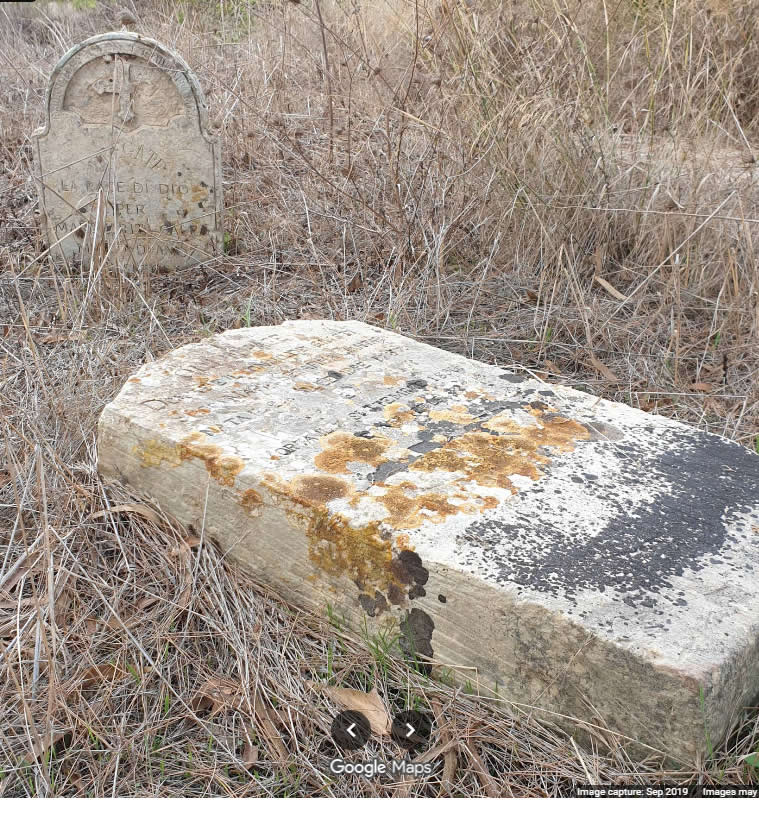
1. THE UPRIGHT BACKGROUND MARKER
[...]GATE
LA PACE DI DIO
PER
MAR[IA] FARRUGIA
M[ORTA IL...] D'ANNI [...]
English Translation: "[...Pray for] the peace of God for Maria Farrugia, who died [on date...], aged [...]"
2. THE RECUMBENT FOREGROUND SLAB
[...]
M[ARIA] [...]
NATA LI 2 [...] 1817
MORTA LI 23 SETTEMBRE 1878
English Translation: "[...] Maria [...], born on the 2nd [...], 1817, died on the 23rd of September, 1878."
The dates on these stones help fill in the timeline of the cemetery's long history. The fallen slab marks the resting place of a woman born in 1817, during the recovery period following the great British-era plague. Her passing in the autumn of 1878 confirms that San Teodoro remained an active alternative burial ground for local families and health officers long after its initial role as an emergency mass grave site.

6. Frequently Asked Questions (FAQ)
❓ Is it true that San Teodoro Cemetery contains victims from the 1600s?
Yes, your information is correct. San Teodoro was originally established in early 1676 during the deadly Order of St. John bubonic plague epidemic to bury victims outside the Siġġiewi village core.
❓ When was the cemetery extended by the British authorities?
The cemetery was reactivated and extended in the summer of 1813. British colonial health boards expanded the original 17th-century walls and dug new trenches to handle the victims of that century's major plague outbreak.
❓ Are there individual gravestones to find inside San Teodoro today?
While the epidemic victims are interred in unmarked mass graves, there are a few individual markers from mid-19th-century infectious outbreaks, including the 1865 gravestone of 24-year-old Giuseppe Balzan.
❓ Can the interior of San Teodoro Cemetery be easily accessed by visitors?
The main archway entrance is secured by a locked gate to protect the historic site and prevent illegal dumping. The interior is heavily overgrown with wild vegetation and a thick forest of wild sumac trees, keeping the old graves undisturbed.