- Home
- Heritage
- Cemeteries in Malta & Gozo
- Msida Bastion Cemetery, Floriana

Introduction
The Msida Bastion Cemetery in Floriana is one of Malta’s most historically significant burial grounds and landscaped heritage sites. Overlooking Marsamxett Harbour, this cemetery represents a unique fusion of funerary architecture, British colonial history, and garden design.

Established in the early 19th century, the cemetery served primarily as a burial ground for Protestants and foreign nationals during a period when Malta was under British rule. Today, it stands as a restored historic garden, offering insight into Malta’s multicultural past and evolving burial traditions.

Historical Background
Following the establishment of Malta as a British protectorate in 1800 and later a formal colony in 1814, the island saw an influx of British military personnel, administrators, and merchants. As a predominantly Roman Catholic country, Malta lacked dedicated burial spaces for non-Catholics.

This led to the creation of Msida Bastion Cemetery, constructed within the Floriana fortifications overlooking the harbour. The cemetery became the principal Protestant burial ground in Malta during the 19th century.

Construction and Layout
The cemetery was built within a bastion of Floriana’s defensive system, originally designed by the Order of St John. Its terraced layout reflects both military engineering and landscaped garden design.

- Multi-level terraces connected by stone staircases
- Decorative monuments, obelisks, and sarcophagi
- Views overlooking Marsamxett Harbour
- Integration into historic fortifications
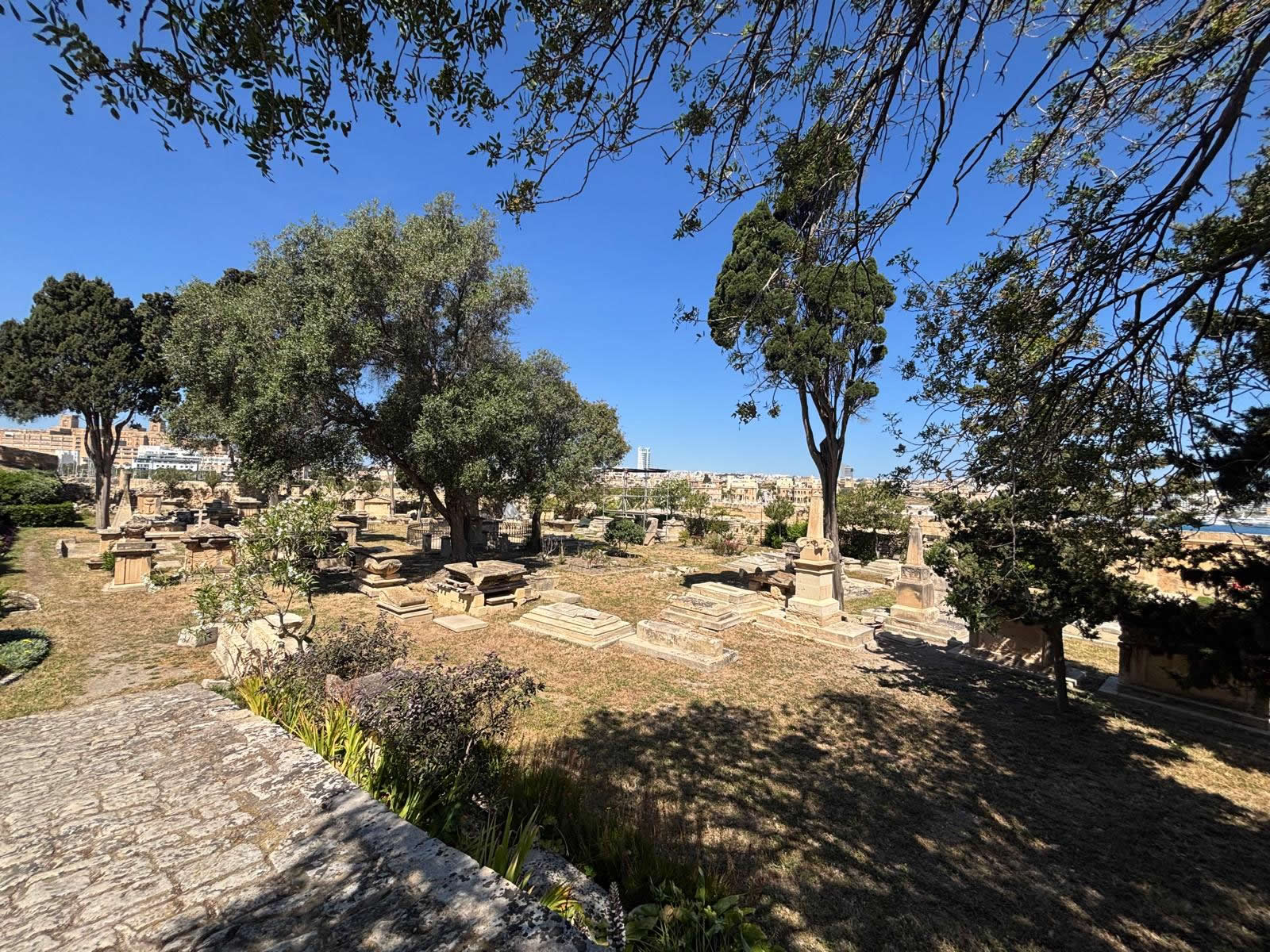
The combination of military architecture and funerary use makes the site unique within Malta’s heritage landscape.
Burials at Msida Bastion Cemetery
The Msida Bastion Cemetery contains the remains of approximately 530 individuals, making it one of the most important early 19th-century burial sites in Malta. The earliest known burial dates to 1806, shortly after the British established control over the islands.

The cemetery primarily served as a Protestant burial ground at a time when Malta, being overwhelmingly Roman Catholic, did not permit non-Catholic burials within church grounds. As a result, the site became the principal resting place for:
- British Army officers and soldiers stationed in Malta
- Royal Navy personnel
- Colonial administrators and civil servants
- Merchants and expatriate communities
- Family members, including women and children
Demographic analysis of the burials reveals striking insights into life in early 19th-century Malta. Nearly half of the recorded individuals died under the age of 20, with a significant number of infant deaths, reflecting the harsh living conditions, disease prevalence, and limited medical knowledge of the time.
The cemetery reached its peak use in the 1840s and was largely filled by 1856–1857, when burial activity shifted to the newly established Ta’ Braxia Cemetery. After this period, only occasional interments took place in existing family graves.

Notable People Buried at Msida Bastion Cemetery
Among the hundreds buried at the cemetery are several historically significant individuals, reflecting Malta’s cultural, linguistic, and colonial history.
Mikiel Anton Vassalli (1764–1829)
The most famous individual associated with the cemetery is Mikiel Anton Vassalli, widely regarded as the “Father of the Maltese Language.” A pioneering linguist and scholar, Vassalli played a crucial role in standardising Maltese and translating important religious texts into the language.
Due to conflicts with the Roman Catholic Church—particularly his translation of the New Testament into Maltese—Vassalli was denied burial in Catholic consecrated ground. As a result, he was interred at Msida Bastion Cemetery, highlighting the religious divisions of the time.
Catherine de Frémeaux (d. 1851)
The wife of Mikiel Anton Vassalli, Catherine de Frémeaux, was also buried in the cemetery. Her burial further reinforces the site’s role as a resting place for individuals connected to Malta’s intellectual and cultural development.
British Military and Naval Officers
While many graves are anonymous or weathered, a significant number belong to British officers who served in Malta during the early decades of colonial rule. Their presence reflects Malta’s strategic importance as a naval base in the Mediterranean.

Colonial Officials and Merchants
Several individuals buried at the site were involved in administration and trade, contributing to Malta’s transformation into a key commercial and military hub under British governance.
Although not all names are fully documented, the cemetery as a whole represents a cross-section of early 19th-century British and international society in Malta.
Connection to the 1813–1814 Plague
Although primarily a Protestant cemetery, the site is closely linked to Malta’s broader public health developments following the devastating 1813–1814 plague outbreak.
The epidemic reinforced the need for structured burial systems outside urban centres, influencing cemetery development across the islands.

Decline and Neglect
By the late 19th and early 20th centuries, the cemetery gradually fell into disuse. Over time, it suffered from neglect, overgrowth, and structural deterioration.
- Vegetation overgrowth obscured monuments
- Stone structures deteriorated
- Limited public access

Restoration and Conservation
In recent decades, significant restoration efforts have been undertaken to preserve the cemetery and transform it into a historic garden.
- Cleaning and conservation of tombstones
- Stabilisation of terraces and walls
- Reintroduction of landscaped gardens
- Improved public access and pathways
Today, Msida Bastion Cemetery is recognised as both a cultural heritage site and a tranquil green space within Floriana.

Modern Use and Cultural Importance
The site now serves multiple roles:
- Historical and educational resource
- Genealogical research site
- Public garden and heritage attraction
- Symbol of Malta’s multicultural past
It is also occasionally used for cultural events and guided heritage tours.
Architectural and Landscape Significance
The cemetery represents an exceptional example of:
- 19th-century funerary architecture
- Integration of landscape design with fortifications
- British colonial influence in Malta
Its elevated position offers panoramic views, reinforcing its importance as both a memorial space and scenic landmark.

Visiting Msida Bastion Cemetery
Visitors can explore the cemetery as part of a broader tour of Floriana’s historic sites.
- Location: Floriana, near Marsamxett Harbour
- Accessible via public pathways
- Best visited during daylight hours
Conclusion
Msida Bastion Cemetery stands as a powerful testament to Malta’s layered history, reflecting the island’s transition into a British colony and the evolution of burial practices. Its restoration ensures that it remains both a place of remembrance and a valuable cultural landmark for future generations.