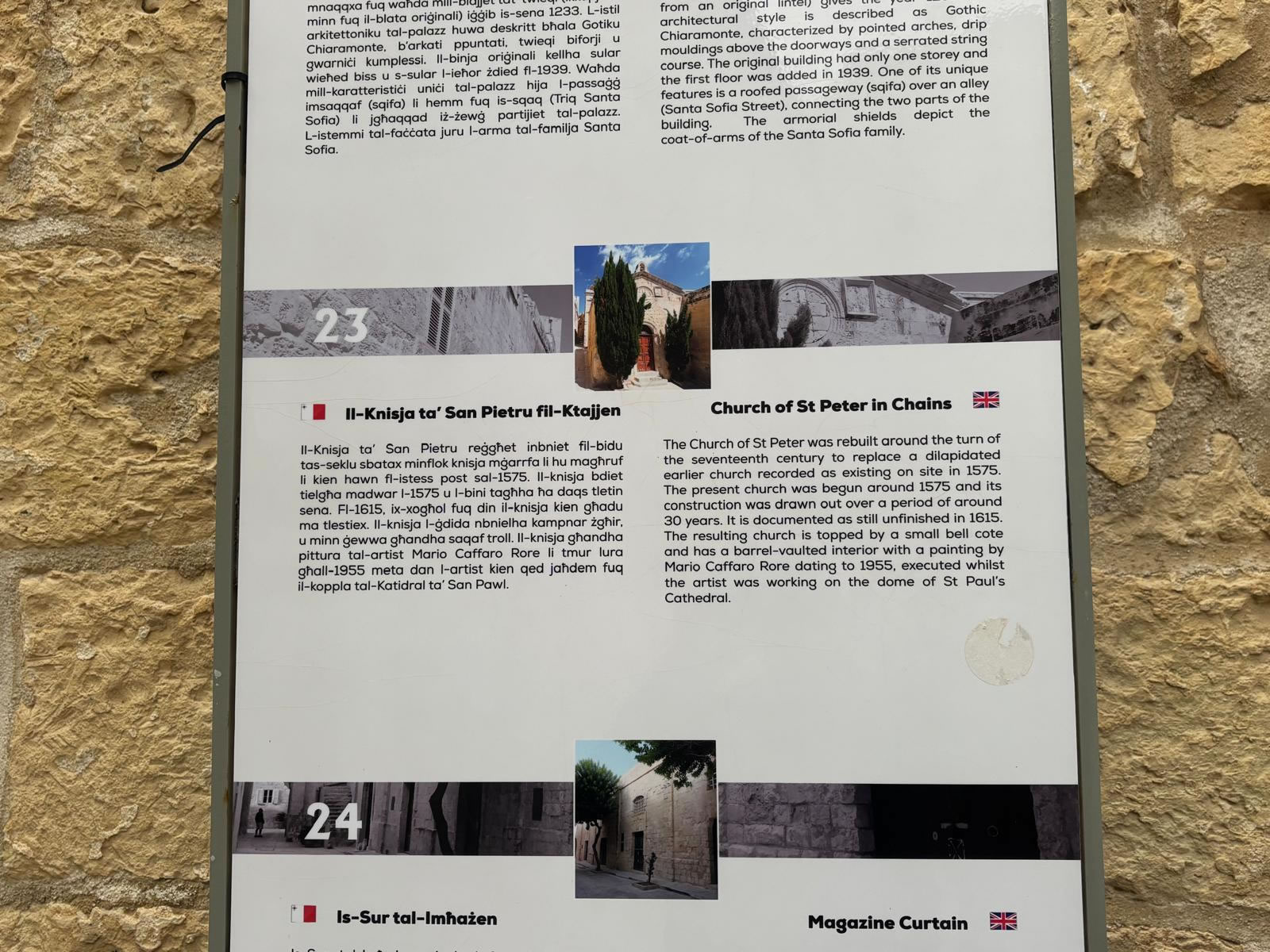
Kappella San Pietru fil-Ktajjen (“St Peter in Chains”) is a small, atmospheric chapel within the fortified city of
Mdina. The original medieval chapel is traditionally dated to the 15th century, reflecting a period when
compact devotional spaces formed part of daily religious life in the islands’ historic capital.
Period: 15th century (traditionally)Setting: Mdina (walled city)Coordinates: 35.8866573, 14.40221857Updated: 18 Dec 2025
A medieval chapel in Mdina dedicated to St Peter “in Chains”, reflecting the city’s layered sacred heritage.Respectful visiting:Mdina is a living historic city. Please keep noise low near places of worship and follow any access or conservation notices.
Dedication: St Peter in Chains (San Pietru fil-Ktajjen)
Location: Mdina, Malta
Date: Medieval; traditionally dated to the 15th century
Coordinates: 35.8866573, 14.40221857
Detailed history
Mdina’s chapels developed within a dense urban fabric where religious life was woven into neighbourhood streets, family patronage,
confraternities, and civic tradition. A chapel dedicated to St Peter in Chains fits well within this context: the dedication
references a long-standing Christian tradition commemorating St Peter’s imprisonment and deliverance, a theme often associated with
protection, steadfastness, and intercession.
A medieval chapel in Mdina dedicated to St Peter “in Chains”, reflecting the city’s layered sacred heritage.
The chapel is commonly described as medieval and is traditionally dated to the 15th century. In that period, small chapels
served practical roles: they offered accessible places for prayer, short services, and private devotion, especially for residents who lived
within the city walls and moved through Mdina’s compact lanes.
Over time, changing parish structures, the concentration of worship in larger churches, and the realities of maintaining small buildings
meant that many chapels shifted toward occasional use. Even when services became less frequent, chapels like San Pietru fil-Ktajjen remained
important as markers of identity—preserving dedications, local memory, and the continuity of sacred space.
Construction and architecture
The chapel reflects the restrained language of Maltese medieval building: local limestone, a compact footprint, and an interior
oriented around the altar. Compared with later Baroque spaces, medieval chapels typically emphasise solidity and simplicity, with modest openings
that control light and contribute to a quiet, enclosed devotional atmosphere.
Materials: Maltese limestone, consistent with Mdina’s historic streetscape.
Plan: compact chapel form centred on altar-focused worship.
Urban context: built to fit within the tight scale of Mdina’s lanes and walled-city parcels.
Restoration and conservation
In Mdina, conservation is typically ongoing and preventive—focused on protecting limestone, controlling damp, and ensuring roof and water run-off
are managed so moisture does not accumulate in historic masonry. Where repairs are undertaken, best practice is to use compatible lime-based materials
rather than hard cement, which can trap moisture and accelerate stone decay.
Restoration work on small chapels often includes careful stone cleaning (where appropriate), re-pointing, repairs to doors and apertures, and protection
of any interior surfaces. The aim is to stabilise the structure while preserving the chapel’s historic character and keeping any interventions as reversible
as possible.
Use over time
Historically, San Pietru fil-Ktajjen would have functioned as a local devotional chapel—supporting prayer, occasional services, and feast-day observance
connected to its dedication. In later centuries, like many small chapels, it likely saw more limited use, depending on caretaking arrangements and community
practice.
Today, the chapel is best appreciated as part of Mdina’s broader sacred heritage: a small structure that adds depth to the city’s story by preserving a
medieval dedication and the continuity of worship space within the walled city.
FAQ
What does “fil-Ktajjen” mean?
It refers to “in chains,” echoing the dedication to St Peter in Chains.
How old is the chapel?
The chapel is generally described as medieval and is traditionally dated to the 15th century.
How do I find it?
Use coordinates 35.8866573, 14.40221857 for map navigation in Mdina.