Collections in St. John’s Co-Cathedral
1. Paintings
The highlight is Caravaggio’s masterpieces:
The Beheading of Saint John the Baptist (1608) – his largest work and the only painting he ever signed.
Saint Jerome Writing – a smaller but equally dramatic canvas.
Works by Mattia Preti, who painted the vaulted ceiling and wall scenes.
Paintings and altarpieces commissioned by the different Langues (national divisions) of the Knights.
2. Sculpture
The cathedral houses numerous Baroque and Renaissance sculptures.
Notable works include funerary monuments of Grand Masters and carved religious statues.
3. Tapestries
A rare and valuable collection of Flemish Baroque tapestries (17th century).
Commissioned in Brussels, these depict biblical and allegorical scenes.
Originally displayed on feast days, they are now carefully preserved.
4. Silverware
The cathedral treasury includes an extensive collection of liturgical silverware: Chalices, monstrances, reliquaries, and candlesticks.
Many were donated by the Knights of the Order of St. John over centuries.
5. Relics and Religious Objects
Sacred relics and devotional objects tied to the Order’s history.
Ornamental vestments used during important liturgies.
6. Marble Tombstones
The cathedral floor itself is part of the collection.
Over 400 elaborately inlaid marble tombstones mark the burial places of knights and grand masters.
Each features heraldic designs, inscriptions, and symbols of knighthood.
7. Manuscripts and Archival Material
The cathedral preserves historical documents and manuscripts related to the Order of St. John and its activities.
In short, St. John’s Co-Cathedral is not just a church — it is a museum of the Knights of Malta, preserving world-class Baroque art, sacred treasures, and historical artifacts.
St John the Baptist Statue by Giuseppe Mazzuoli
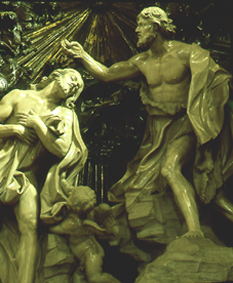
The more-than-life-size marble figures of Christ and St John the Baptist, sculpted by Giuseppe Mazzuoli, replaced an earlier painting by Matteo Pérez d’Aleccio. Pérez d’Aleccio’s Great Siege frieze, located in the Magisterial Palace, remains one of Malta’s most treasured artworks. The original altarpiece survives in the church museum.
The contrast between terracotta and white marble in the chequer-board floor adds depth and perspective to the presbytery. This masterpiece was commissioned by Grand Master Perellos y Roccaful, whose coat of arms appears here alongside that of Grand Master Carafa. The marble arrived in Malta in the sixth year of Perellos’s reign (circa 1703), and after 17 years, Mazzuoli was commissioned to create the monumental Perellos Monument. It’s said the concept may have been sketched by the Maltese sculptor Melchior Gafa (1635–1667), who was admired by Bernini and may have influenced Mazzuoli’s work.