Overview
St John’s is primarily a Baroque interior, redesigned under Mattia Preti after 1661.
Sculpture here was used decoratively and commemoratively, rather than in large freestanding round-sculpture groups.
The most notable works are:
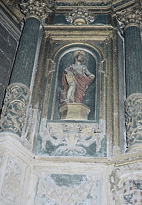
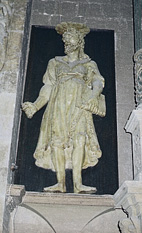
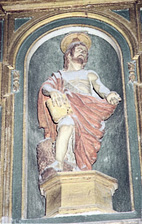
Statues of saints in the oratory and side chapels.
Funerary busts and effigies of Grand Masters.
Marble reliefs and inlaid figures in tombs.
 |
 |
 |
Notable Sculptures & Statues
1. Grand Master Tomb Monuments
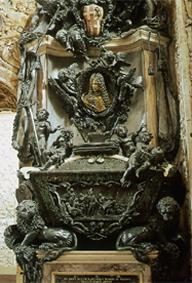
Many chapels (e.g. Provence, Italy, Auvergne) contain wall monuments with sculpted busts or effigies of Grand Masters, often in marble.
Examples:
Grand Master Nicolas Cotoner (Provence Chapel) – sculpted bust within an elaborate marble monument.
Grand Master Annet de Clermont-Gessant (Auvergne Chapel) – commemorative sculptural monument.
Grand Master António Manoel de Vilhena (Castile Chapel) – elaborate Baroque funerary monument with marble statues.
2. Chapel Sculptures
Chapel of Our Lady of Philermos (Blessed Sacrament Chapel):
Contains sculpted angels and a tabernacle richly adorned with gilded reliefs.
Other Langue Chapels:
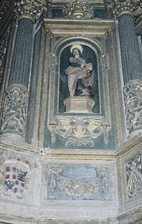
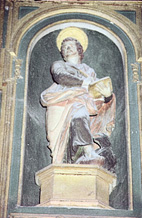
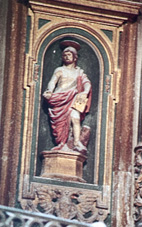
Each has small devotional statues, often angels or saints in gilded stone niches, alongside painted altarpieces.
 |
 |
 |
3. Oratory of St John’s Co-Cathedral
Houses Caravaggio’s “Beheading of St John the Baptist”.
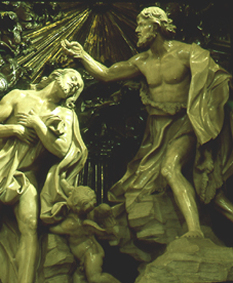
Contains sculptural decoration such as angels, cherubs, and altar statuary framing the masterpiece.
 |
 |
4. St John the Baptist (Patron)
Statues of St John appear in several forms:
Sculpted in marble and gilded stone reliefs.
Included in monuments and decorative panels across the nave and oratory.
5. Marble Inlaid Tomb Slabs
While not statues, the 400+ floor tombs are full of inlaid marble relief work with skeletons, angels, and allegorical figures cut in coloured stone – an extraordinary sculptural art form unique to Malta. Click to see The Tombs
Chapel-by-Chapel Sculptures & Statues
1. Chapel of Our Lady of Philermos (Blessed Sacrament Chapel) – South side, near altar
Statues of angels flanking the tabernacle.
Small sculpted cherubs in gilded niches.
Rich tabernacle sculpture with relief decoration.
2. Chapel of the Langue of Auvergne – South side
Monument with sculpted bust of Grand Master Annet de Clermont-Gessant (d. 1660).
Decorative gilded stone reliefs of putti and angels near the altar.
3. Chapel of the Langue of Aragon, Catalunya & Navarre – South side
Sculpted knightly tomb slabs with heraldic reliefs on the floor.
Wall monument with carved effigies and relief arms of Aragon.
4. Chapel of the Langue of Castile, León & Portugal – South side
Grand Master António Manoel de Vilhena’s tomb monument – includes sculpted bust and allegorical figures in marble.
Sculpted coat of arms of the Langue in high relief.
5. Chapel of the Anglo-Bavarian Langue (Relics Chapel) – North side
Sculpted reliquaries and angel figures around the altar.
Relief carvings framing niches for relic display.
6. Chapel of the Langue of Provence – North side
Bust of Grand Master Antoine de Paule within a marble funerary monument.
Additional knightly tomb slabs with heraldic reliefs.
7. Chapel of the Langue of France – North side
Busts of Grand Master Alof de Wignacourt and later French Grand Masters.
Monumental sculptural frames with angels and cherubs.
8. Chapel of the Langue of Italy – North side
Grand Master Gregorio Carafa’s funerary monument, with full sculpted bust and allegorical figures.
Statues of angels holding coats of arms.
9. Chapel of the Langue of Germany – North side
Monumental marble altar with relief carvings.
Some knightly tomb slabs with sculpted heraldic devices.
Other Sculptural Highlights
Nave & High Altar
Marble group of angels flanking the high altar.
Gilded stone sculptures in niches integrated into Preti’s Baroque decorative scheme.
Oratory of St John
Statues of angels and cherubs framing Caravaggio’s Beheading of St John.
Rich tabernacle with sculpted reliefs.