Ornaments of St. John’s Co-Cathedral
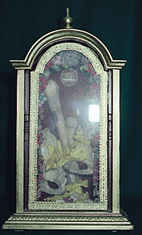
Hodigitria
known as the hodigitria ,this small and yet majistic icon probabely dates back to the 14th centuary . This icon measuring 31 x 24 cms is , according to the usual tradition of the times , both painted and guilded with special highlights for the backgrounds , the haloes and the orb which the infant Jesus holds symbolically in the palm of his hand . The painting , also on gesso ,has been praised by more than one expert in the field . The Madonna and Child once replaced the silver tabernacle door stolen by Napoleon from the church of the Langue of Italy . The icon is now preserved in the churches treasury with the most precious items in the collection .
Present to Vilhena
This reliquary measuring 43 cm in hight is preserved in the treasure of St. John's and dates to a period before napolian ransatked the treasury .Here we have an important example of fine 18'th centenary artistry . Surmounted by an authentic Maltese cross , it can almost be termed a masterpiece as there is little of this quality to compare it with . The subdued flamboyance of this piece leans on baroque inspiration and yet preserves it's delicacy intact . A delightfully silver present to Grand Master de Vilhena by the Inquisitor Monsignor Antonio ruffo , eventually presented to St.John's by de Vilhena in 1726
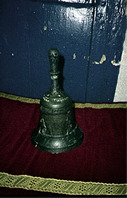
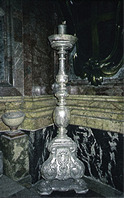
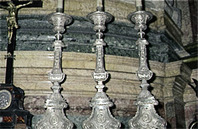
Coral Ornament
The coral monstrance is wonderfully preserved . It can take close scrutiny without loosing quality . The 18th century carving is fine and the southern Italian style with red against gold background . The piece is 75 cms tall and was created out of gilded bronze and ormolu . The crafts man indulged himself in the production of so much intricicy that a carefull examination of this piece is necessary to achive a full apprecation of his work . Amoung the components we can observe four red faced cherubs with intarsio white enamel and brass wings around the recepticle of the host and a magnificent ray of 31 decorated spikes with open flower finals .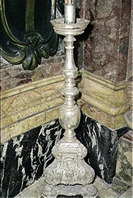
True cross preseved at St.John's
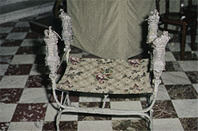
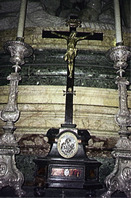
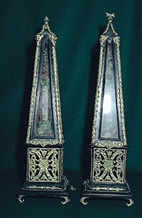
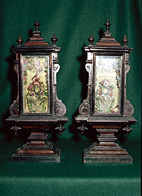
The obverse and reverse view of the most important relic of the True Cross preserved at St. John's . This might be as late as 17th centuary ; However ,the base is interesting for being in the gothic taste with an enclosed effigy of the dead Christ behind the small columns . Experts have disagreed over the period of froduction of the stem and the padistral.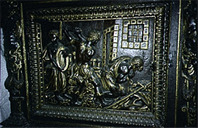
The Sacristy
outside the door from the church
The large white wooden stateus are impressive and deserve further scrutiny . The Crucifixion , Our lady of Sorrows and St.John the Evangelist are fine works and the crucifixion is by Alessandro Algaldi . They once stood on the altar covering up much of Caravaggio's Beheading . Theye are not dwarfed by the magnificence all around and they are important enough , all on their own to warrent more then gust a mention .
Also by Algardi is a fine large bronze alto rilevo depicting San Salvatore . It now graces the Facade of St.John's. Fra Alessandro Zambeccario Prior of England commissioned it in 1639 . It had overlooked GrandHarbour in the primo molo a destra del Gran Potro sulla chiesa del Ssmo. Salvatore . Sailors liked to make there salutations to this image with tenderness when leaveing the harbour. It was moved to it's present location in the 19th century under the governorship of major general Sir William Reid (1851-1858).
Crucifixion
After a faitfull and most successful restoration on behalf of the moseo di Capodimonte by Bruno Arciprete , the large polychrome Crucifixion by polidoro Caldara da Caravaggio (1492-1543) painted around the 1530s is now hung outside the door of the oritary it once hung on the right wall of the chaple of ower lady of Philermos. It's new position is more accessible to the general public and works well withen the dimention of the church. It's Gothic connections add a feeling of antiquity reminding us of earlier day when the order was in Rhodes. The artist is important historically and remembered as one of raphaels assistants as wellas a competent innovator in his own
The Oratory
outside the door from the church
The atrium ouside the oratory today houses the life size crusifix once hang in the chaple of the Our Lady of Philermos. It is not sculpture but a painting effigy. The artist has been identified as Polidoro Caldara da Caravaggio (1490-1535). Polidoro worked under Raffaelo and even produced some frescoes for the Vatican. He was born in Caravaggio in the duchy of Milan but traveled extensively spending time in Rome, Napels and Sicily. His works can be seen in a number of the major european museums from the hermitage to the louvre. his death was tragic like that of his Compatriot Michelangelo Merisi 74 years later. Polidoro Caldara sensitive, gifted and able was murdered for his money by his menservant in Messina. On the opposite wall to the left of the small arch is the benefactor Flaminio Balbiani's appreciation in bronze. To the right is the black Marble Plaque recording the visot of H.H. Pope John Paul II in 1990. A first for St.Johns, but it must be remembered that two inquisitors in Malta who would have known the conventual church well, also become sovereign pomtiffs : first there was Fabio Chigi who became Alexander VII and soon after Antonio Pignatelli who reigned as innocent XII.The 3 lunettes are important 18th century additions by the french courtly painter Antoine de Favray they dipict the descovery of the remains of St.John the Baptist; the presentation of the wright hand of St.John to Grand Master D' Aubusson by Cariati bey on behalf of Bajazet II, And the third picture is of the burning of St.John's bones by order of Julian the Apostate.
Under the larger Arch on the floor leading into the area is the tombstone commemorated a very wealthy Spanish Knight: He was the Bali of Lessa who lived in great style in the building in south street which is now the museum of fine arts. Grand Master pinto was anxious to persuade him to take up residence in Malta as his wealth would be useful to the order. He was sucessful and this is also evident from his tombstone .
inside the oratory
This fine chapel, large enough to described as a church in it's own right, is an important part of the grand priority that is St. John's it' had it's uses and could retain certain amount of privacy without affecting the main church. It was suited for special prayer gatherings ,and was ideal for the instruction of novices and the conferring of knighthoods. On occasions when its doors were shut , the public could somtimes look in through the bronze apertures to see the great relic of the right hand of st John the Baptist on the Altar . After 1689 it was housed in Ciro Ferri's most magnificent reliquary which has survived and can be seen in the Church's Museum .
The Oratory ceiling is decorated like that of a Medici palazzo with thick mouldings some of which frame the fine Preti pictures of Christ's passion . the walls are festooned with lesser works by 'Pretians' and repeat some of the subjects of saints of the Order depicted in the main church . These include St. Nicasius , St Ubaldesca , sir adrian Fortascue , the Blessed Gerard and other . Mounted in the wall on the Epistle side of thew altar is noteworthy 70th century piece : A marble head of St.John on a platter. It has in the past, been attributed to by Pierre Puget (1622-1694). whose bust of Louise XIV is in the louvre. Domnic Cutajar, curator of the museume of fine arts says with conviction.
"...this beautiful, sensuous had has all the marks of the early florentine Mannarist school,
as close to the sensuous idiom of Benvenuto Cellini as one could get."
>It is necessary that one should meantion the great contribution of Knight Fra Stefano Maria Lomellini who personally, paid for much of the beautifully sculpted stonework and also for it;s expensive gilding. He was prior of England and is buried under the pavimento of this chaple.