The Tapestries Collection
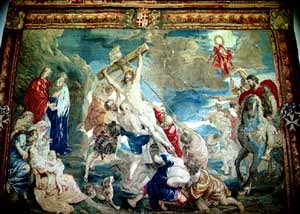
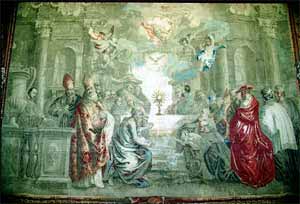
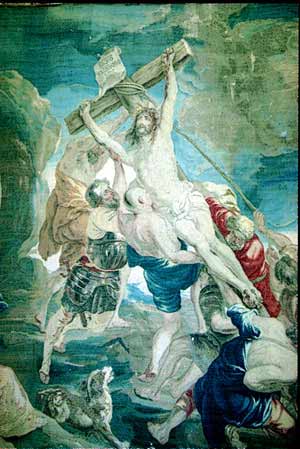
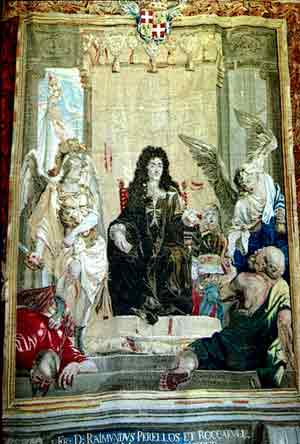
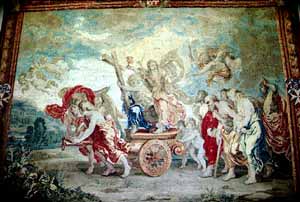
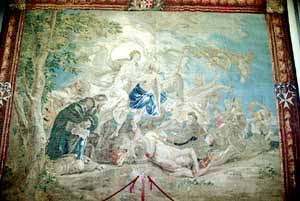
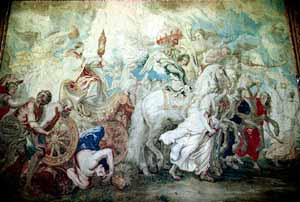
Perellos's offering was exceptional. He ordered a set of twenty-nine tapestries for St.John's from Judocos de Vos in Brussels. There are large horizontal Rubens scenes from the life of Christ including the Adoration of the Magi; the Last Supper; the Crusifixion and the Resurrection; also impressive allegorical scenes to be identified as 'Time Exploring and Unveiling Truth ', 'The Destruction of Idolatry' and 'The Triumph of Faith'; there are depictions of St Peter; St. Paul: the two James's; St. Thomas the Apostle and others on each side of the of the nave. The regal portrait of the Grand Master set imposingly under the Cotoner lunette is flanked by St Simon the Apostle and the four Evangelists to the right and St. Thaddeus the Apostle and the Annunciation to the left.
How sad and thought - provoking that Mattia Preti should have
died not long before the arrival of the tapestries. Hannibal Scicluna, in
his history of St.John's, tells us that Preti did indeed make frequent visits
to the Netherlands while Perellos was a Bali. It seems that some plan may
have been afoot which perellos was able to bring to fruition when he
became Grand Master: One wonders, did he influence the Grand Master in his
choice of subject matter? Had he made the original suggestions to introduce
tapestry? Did he paint the grand Master in those almost two years he survived
into the new reign? These are all questions to which we do not know the answer.
Perellos's grandiose tomb emphasizes Justice and Bounty. Together with his
magnificent tapestries bearing his coat of arms, and his large woven portrait
under the great lunette, he challenges the dominance of the Cotoner presence
in the Conventual Church.
1. Origin and Patronage
The set of tapestries was commissioned in the late 17th century by Grand Master Ramon Perellos y Roccaful (1697–1720), one of the most important patrons of the cathedral.
They were woven in Brussels, one of Europe’s leading tapestry centers, famous for monumental works.
The tapestries were intended both as a devotional offering and as a demonstration of the Knights’ prestige.
2. Themes and Subjects
The series is known as the “Triumph of the Eucharist”.
Central tapestries depict scenes glorifying the Holy Eucharist, emphasizing Catholic devotion during the Counter-Reformation.
Other tapestries show apostles, saints, and allegorical figures, as well as portraits of members of the Order.
One particularly important piece includes a portrait of Grand Master Perellos himself, underlining his role as patron.
3. Artistic Features
They are enormous in size—several meters high and wide—designed to cover the cathedral’s side walls.
The works are richly colored, woven with silk, wool, and gold thread, creating a dazzling effect.
Their scale and quality place them among the finest sets of Baroque tapestries in Europe.
4. Function and Use
The tapestries were not permanently displayed.
Instead, they were hung on special feast days (especially the feast of Corpus Christi and St. John the Baptist’s day) to transform the cathedral into a spectacular ceremonial space.
When displayed, they created a powerful visual dialogue with the painted vault by Mattia Preti, turning the entire church into a unified work of art.
5. Preservation and Legacy
The collection has survived relatively intact, though it has required careful conservation due to its age and delicate materials.
Today, the tapestries are exhibited periodically, often in the Cathedral Museum, rather than permanently in the church, to protect them from light and humidity.
They are considered one of the most important European tapestry ensembles outside France and Belgium.
Visitor Information
Location: St. John’s Square, Valletta, Malta. Easily accessible by foot from Valletta’s main entrance.
Opening Hours:
Monday to Friday: 09:30 – 16:30
Saturday: 09:30 – 12:30
Closed on Sundays and public holidays (for worship only).
(Check official site for updates)
Tickets: Entry fees apply (discounts for students/seniors; children under 12 free). Includes access to the Oratory, Museum, and audiovisual introduction.
Dress Code: Modest clothing (shoulders and knees covered). Scarves are available at the entrance if needed.
Guided Tours: Audio guides available in multiple languages. Private and group tours can be booked.
Accessibility: Wheelchair accessible, with lifts available.
Why Visit?
To admire world-class Baroque art and architecture.
To see Caravaggio’s masterpieces in their original setting.
To walk on the ornate marble tombstone floor — a unique funerary monument.
To experience the grandeur of the Knights Hospitaller’s spiritual heart in Malta.