📍 Location
Location Map Coordinates 35.892624, 14.504671
War Memorial to the people of Floriana killed during the Second World War at the Knisja ta’ San Publiju (St Publius Parish Church), Floriana, Malta.
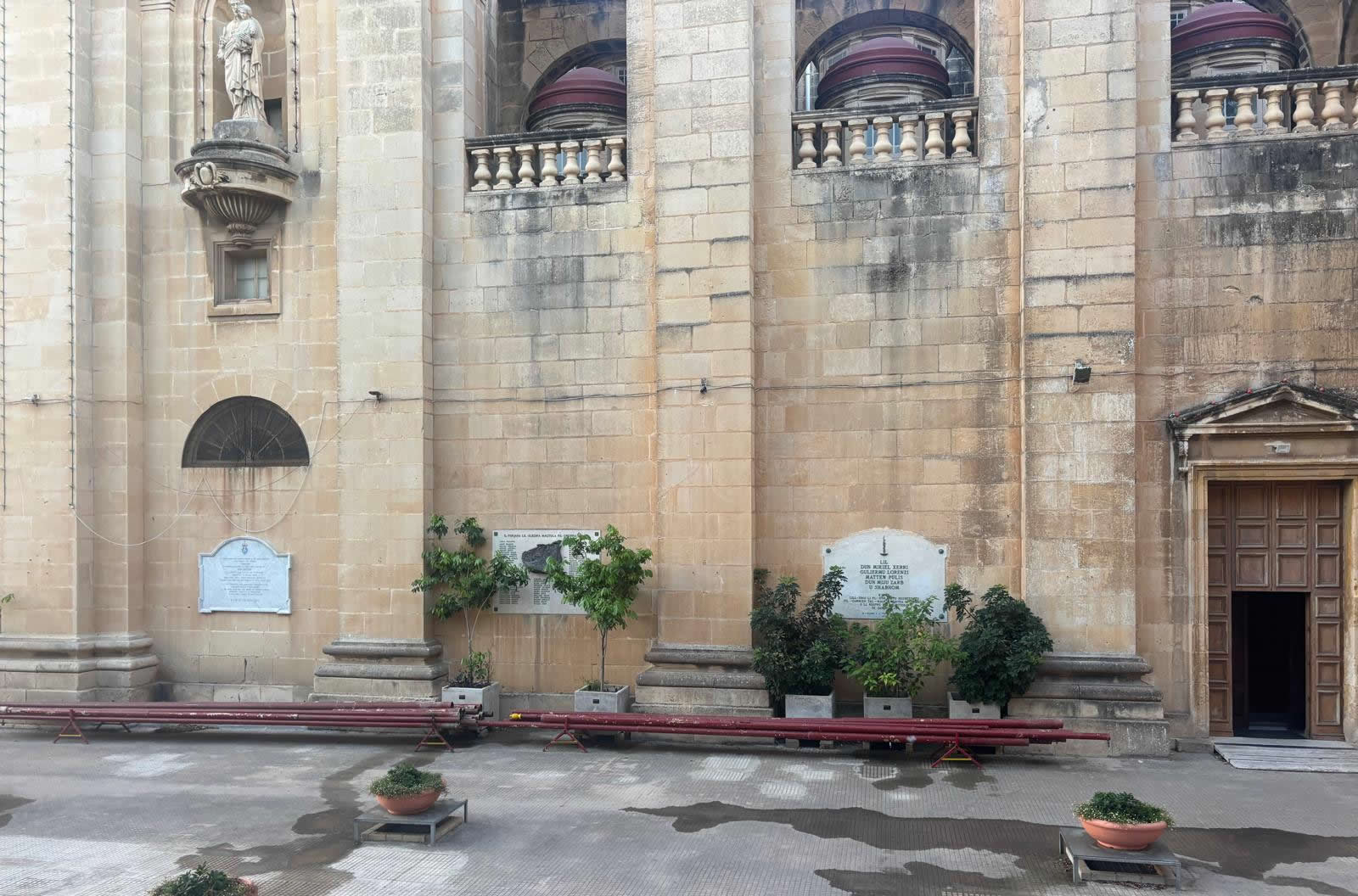
Coordinates: 35.892624, 14.504671
Memorial: Floriana War Memorial 1939-1945
Site: St Publius Parish Church, Floriana
About the Floriana War Memorial
The Floriana War Memorial at the Parish Church of St Publius is a poignant local memorial to the people of Floriana who were killed during the Second World War.
Unlike the large national war memorials found elsewhere in Floriana, this memorial is closely associated with the parish and the local community. Its long roll of names records the human cost of the war among the people of Floriana and preserves the names of men and women who died during the years 1939-1945.
The memorial is particularly significant because the parish church itself became one of the most important locations in Floriana's wartime history. St Publius Church suffered devastating bombing during the Malta Blitz, including the destruction of its dome and crypt.
The memorial therefore forms part of a wider landscape of remembrance surrounding the church: the building itself bears the physical memory of the bombing, while the memorial records the names of members of the Floriana community who lost their lives during the war.
The Memorial Inscription
The principal inscription is in Maltese and reads:
“Floriana to her children killed in the war, 1939–45.”
The wording “lil uliedha”, literally “to her children”, gives the memorial a strongly local and personal character. The people commemorated are presented not simply as casualties of a war, but as members of the Floriana community.
Floriana and the Second World War
Floriana occupied a strategically important position immediately outside Valletta and beside the Grand Harbour. During the Second World War the locality contained important military, transport, harbour and administrative facilities and was consequently exposed to repeated enemy attacks.
One of the darkest episodes in the history of Floriana came on 28 April 1942. Shortly before 8.00am, German aircraft attacked the harbour area and Floriana. The Parish Church of St Publius was struck by bombs, causing catastrophic damage to the building.
The University of Malta's archival record of Mark Anthony Vella's study Floriana's Darkest Day records that the bombing destroyed the church's dome and crypt. The collapse of the crypt killed thirteen people sheltering there and seriously injured another five.
Other bombs fell around the Granaries and the surrounding streets, causing further destruction to homes and buildings. The attack became one of the defining tragedies in the wartime history of Floriana.
The church was subsequently reconstructed. The Floriana Local Council records reconstruction work beginning in 1944 under the supervision of architect Gustav Vincenti.
The surviving war memorial on the church wall provides another historical record of the period, complementing the physical evidence of wartime damage preserved in and around St Publius Church.
Memorial Specifications
| Memorial Name | Floriana War Memorial 1939-1945 |
|---|---|
| Alternative Name | Floriana War Dead Memorial |
| Locality | Floriana, Malta |
| Location | Knisja ta’ San Publiju (St Publius Parish Church) |
| Type | Church wall war memorial and roll of honour |
| Conflict | Second World War |
| Period Commemorated | 1939-1945 |
| Inscription Language | Maltese |
| Coordinates | 35.892624, 14.504671 |
| Memorial Subject | People of Floriana killed during the war |
| Associated Historic Event | Bombing of St Publius Parish Church on 28 April 1942 |
The Roll of Honour
The following is a complete transcription of the names visible on the memorial. The spelling has been retained as it appears on the photographed plaque, including Maltese forms, traditional spellings and unusual forms of given names.
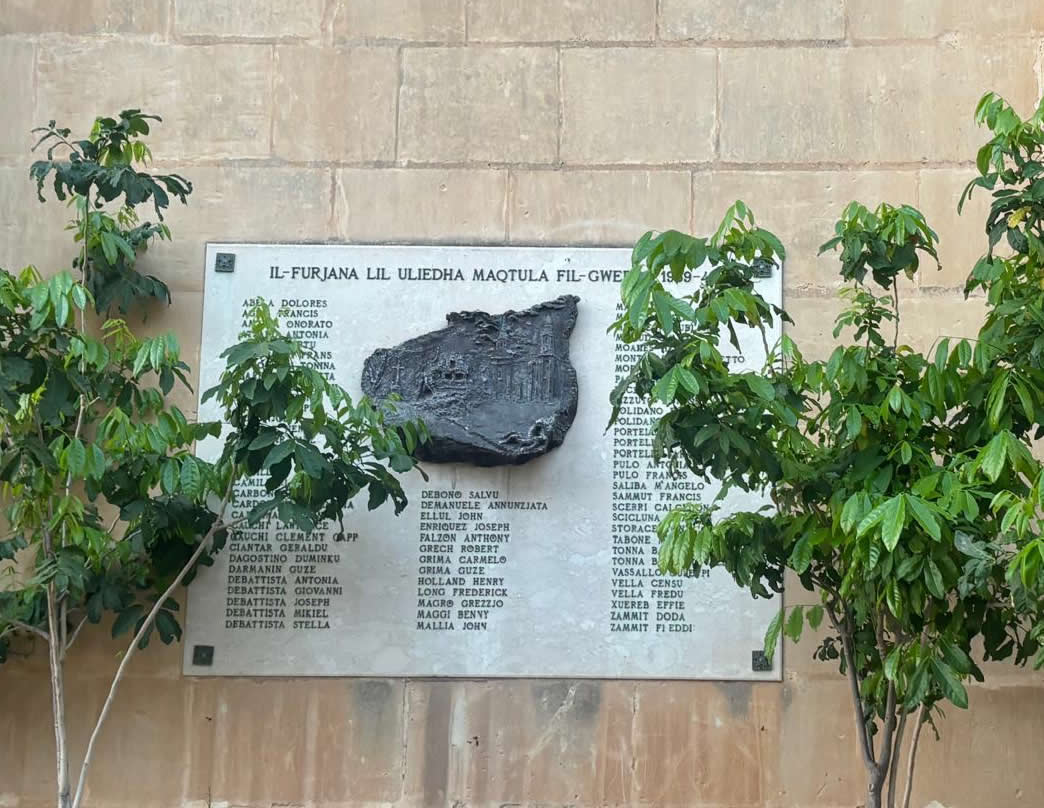
Names as recorded on the memorial
| ABELA DOLORES | DEBONO SALVU | MAMO FRANK |
| AGIUS FRANCIS | EMANUELE ANNUNZJATA | MANGION MARY |
| AMAIRA ONORATO | ELLUL JOHN | MERCIECA PUBLIUS |
| ATTARD ANTONIA | ENRIQUEZ JOSEPH | MIFSUD GULIO |
| ATTARD BERTU | FALZON ANTHONY | MOAKES HENRY |
| AZZOPARDI FRANS | GRECH ROBERT | MONTANARO DR. ANNETTO |
| AZZOPARDI TONINA | GRIMA CARMELO | MORANA SALVU |
| BARBARA ANNETTA | GRIMA GUZE | PACE EMMANUELE |
| BERTUELLO JOSEPH | HOLLAND HENRY | PACE GIOVANNA |
| BORG ANTHONY | LONG FREDERICK | PIZZUTO ANTHONY |
| BORG GUSEPPI | MAGRO GREZZJO | POLIDANO FRANK |
| BORG JOE | MAGGI BENNY | POLIDANO MARY |
| BRINCAT NENU | MALLIA JOHN | PORTELLI CARMELA |
| BUHAGIAR PAUL | PORTELLI DUN PAWL | |
| CAMERON UNA | PORTELLI SARA | |
| CAMILLERI GIGI | PULO ANTONIA | |
| CAMILLERI JOE | PULO FRANCIS | |
| CAMILLERI PINU | SALIBA M'ANGELO | |
| CARBONE TERESA | SAMMUT FRANCIS | |
| CARDONA CALCEDONIA | SCERRI CALCEDON | |
| CARUANA GIOVANNA | SCICLUNA CHARLES | |
| CAUCHI LAWRENCE | STORACE TONY | |
| CAUCHI CLEMENT CAPP | TABONE M'ASSUNTA | |
| CIANTAR GERALDU | TONNA BARTHET EMILIA | |
| D'AGOSTINO DUMINKU | TONNA BARTHET VALENTINO | |
| DARMANIN GUZE | VASSALLO GUSEPPI | |
| DEBATTISTA ANTONIA | VELLA CENSU | |
| DEBATTISTA GIOVANNI | VELLA FREDU | |
| DEBATTISTA JOSEPH | XUEREB EFFIE | |
| DEBATTISTA MIKIEL | ZAMMIT DODA | |
| DEBATTISTA STELLA | ZAMMIT FI EDDI |
St Publius Church and the War Memorial
The memorial should be viewed together with the historic parish church beside which it stands. The church is dedicated to St Publius (San Publiju), the patron saint of Floriana.
The first stone of the church was laid on 2 August 1733. The building developed through several stages during the eighteenth and nineteenth centuries and became the parish church of Floriana in the nineteenth century.
During the Second World War the church suffered major damage. The bombing of 28 April 1942 destroyed the dome and crypt and caused considerable damage to the surrounding area. Reconstruction began in April 1944 and the church was subsequently restored.
The relationship between the church and the memorial is therefore especially significant. The church was itself a victim of the bombardment, while the memorial records the people of the surrounding community who died during the war.
28 April 1942 – The Bombing of St Publius Church
The bombing of St Publius Church was one of the most devastating episodes suffered by Floriana during the Malta Blitz.
On the morning of 28 April 1942, German aircraft attacked Malta. Several aircraft concentrated on the Floriana and Grand Harbour area. St Publius Parish Church was struck and the building suffered catastrophic damage.
The crypt, which was being used as a shelter, collapsed. Historical research held by the University of Malta records that thirteen people were killed in the crypt and another five were seriously injured.
The attack also damaged the surrounding streets and buildings. The destruction of such an important parish church had a profound psychological effect on the local population as well as causing the immediate loss of life.
The surviving memorial and the reconstructed church together provide an unusually powerful physical record of the experience of Floriana during the Second World War.
Related eMalta Pages
Continue exploring the history of Floriana and Malta's wartime heritage:
Historical Sources
The historical information on this page has been cross-referenced against published and archival material relating to Floriana, St Publius Parish Church and Malta during the Second World War.
A particularly useful source is Mark Anthony Vella's Floriana's Darkest Day, deposited in the University of Malta's OAR archive. The study documents the bombing of 28 April 1942, including the destruction of the church's dome and crypt and the deaths of thirteen people sheltering in the crypt.
The Floriana Local Council's historical information on St Publius Church also records the severe wartime damage and subsequent reconstruction.
Research & Documentation
- Researcher: Paul Berman
- Last Updated: 2026
This page forms part of eMalta's ongoing documentation of the historical, cultural and religious heritage of Malta and Gozo.
Information has been compiled through site visits, field research, historical publications, archival records, maps, plans and other reference sources.
All locations that currently exist featured on eMalta have been personally visited and documented. Where historic sites no longer exist, information has been researched from archival sources and contemporary records.
Images used on eMalta include original photography as well as historical illustrations, maps and photographs reproduced with permission from archives, institutions and copyright holders where applicable. Individual image credits and archive reference numbers are provided where available.
© 2026 eMalta Heritage. Documenting the architectural and historical identity of the Maltese Islands.