📍 Lija World War II War Memorial
Location Map Coordinates 35.901524, 14.446909
Civilian victims of the Second World War, 1939–1945
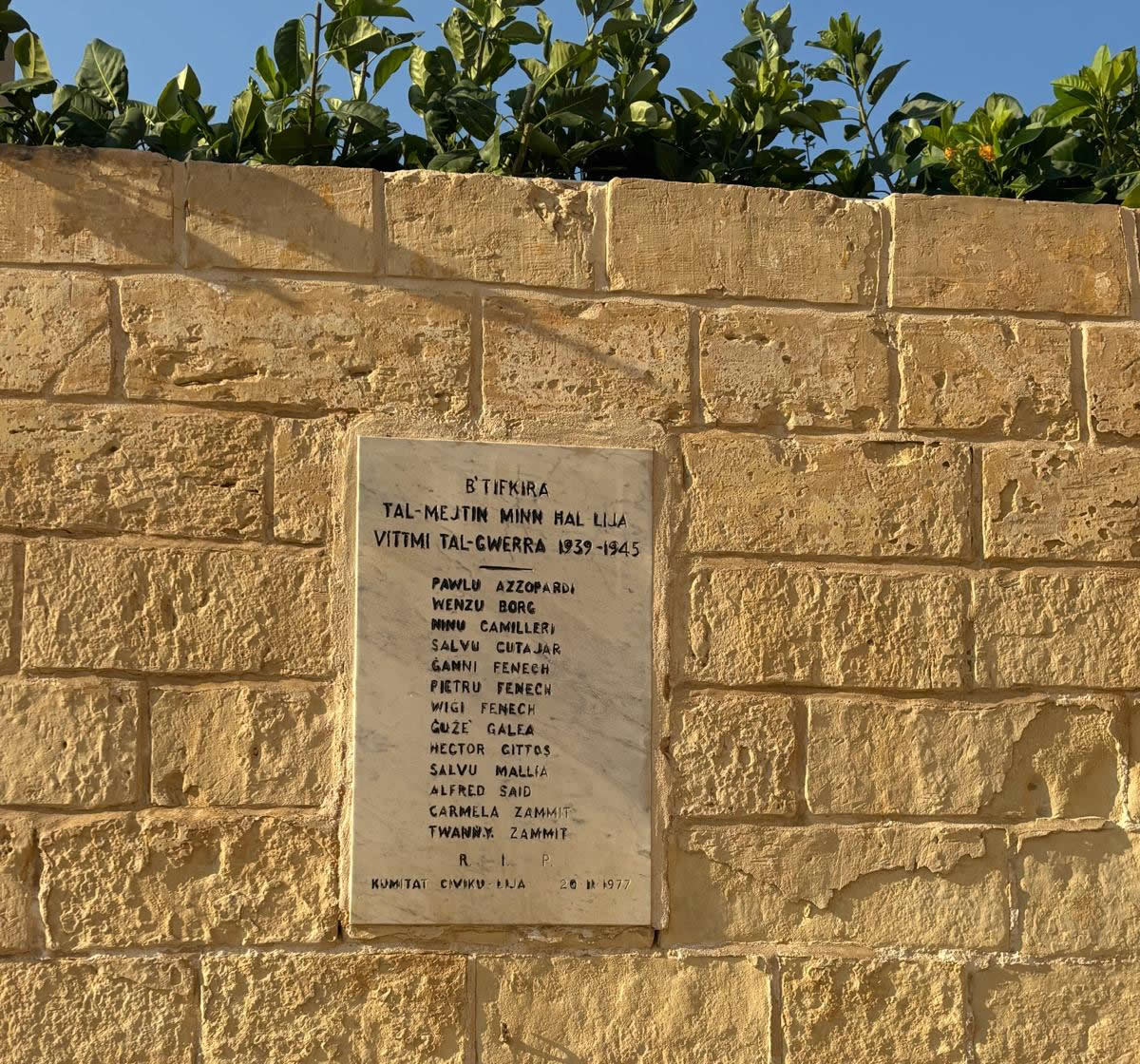
The Lija World War II Memorial
This marble plaque in Lija commemorates people from the locality who lost their lives as victims of the Second World War between 1939 and 1945. The memorial was erected on 20 November 1977 by the Kumitat Ċiviku – Lija.
The plaque is mounted on the historic limestone boundary wall of the parish church precinct, overlooking Misraħ it-Trasfigurazzjoni in the centre of Lija. The present location is clearly documented by contemporary photographs of the memorial in situ.
Lija's parish church, commonly known as the Church of the Transfiguration or Our Saviour's Church, stands immediately beside the memorial site. The parish church is located on Misraħ it-Trasfigurazzjoni and is one of the principal historic landmarks of the village.
Commemorative Inscription
TAL-MEJTIN MINN ĦAL LIJA
VITTMI TAL-GWERPA 1939–1945
PAWLU AZZOPARDI
WENZU BORG
NINU CAMILLERI
SALVU CUTAJAR
ĠANNI FENECH
PIETRU FENECH
WIGI FENECH
GUŻE GALEA
HECTOR GITTOS
SALVU MALLIA
ALFRED SAID
CARMELA ZAMMIT
TWANNY ZAMMIT
R. I. P.
KUMITAT ĊIVIKU – LIJA 20-11-1977
The inscription commemorates the dead from Lija who were victims of the war, 1939–1945.
Roll of Honour
The following names and details are recorded in the historical casualty record associated with the Lija memorial:
| Name | Date of death | Age |
|---|---|---|
| John FENECH | 19 January 1942 | 27 |
| Louis FENECH | 20 January 1942 | 47 |
| Charles LANZON | 17 March 1942 | 36 |
| Paul AZZOPARDI | 19 March 1942 | 39 |
| Saviour MALLIA | 20 March 1942 | 45 |
| Anthony CAMILLERI | 3 November 1942 | 56 |
| Saviour CUTAJAR | 3 November 1942 | 48 |
| Joseph GALEA | 3 November 1942 | 55 |
| Anthony ZAMMIT | 3 November 1942 | 10 |
| Carmela ZAMMIT | 3 November 1942 | 24 |
| Peter FENECH | 4 November 1942 | 82 |
Other persons remembered on the Lija memorial
- Wenzu BORG
- Hector GITTOS
- Alfred SAID
The historical casualty record distinguishes these three additional names from the individuals for whom a date of death and age are given above.
Historical Context
Malta was a major Allied base during the Second World War and experienced sustained aerial bombardment, particularly during the years 1940–1942. Civilian casualties occurred throughout the island, and many Maltese localities subsequently created their own memorials to residents who died during the conflict.
The Lija plaque represents this local tradition of remembrance. Rather than being a national military memorial, it records the names of people from the locality remembered by the Lija community. Its installation in 1977, more than three decades after the end of the war, demonstrates the continuing importance of local remembrance.
The memorial remains in its original commemorative setting beside the parish church and provides a permanent record of Lija's wartime civilian losses.
Photographs


Sources & Documentation
The memorial's present location and inscription have been documented from current photographs of the plaque in situ. Geographic information for Misraħ it-Trasfigurazzjoni and the Lija parish church has also been cross-checked against available mapping and heritage references.
- Lija Parish Church / Parish of the Transfiguration — location and geographic reference.
- Misraħ it-Trasfigurazzjoni — Lija locality and postal area.
- Contemporary photographic documentation of the memorial plaque.
Research & Documentation
- Researcher: Paul Berman
- Last Updated: 2026
This page forms part of eMalta's ongoing documentation of the historical, cultural and religious heritage of Malta and Gozo.
Information has been compiled through site visits, field research, historical publications, archival records, maps, plans and other reference sources.
All locations that currently exist featured on eMalta have been personally visited and documented. Where historic sites no longer exist, information has been researched from archival sources and contemporary records.
Images used on eMalta include original photography as well as historical illustrations, maps and photographs reproduced with permission from archives, institutions and copyright holders where applicable. Individual image credits and archive reference numbers are provided where available.