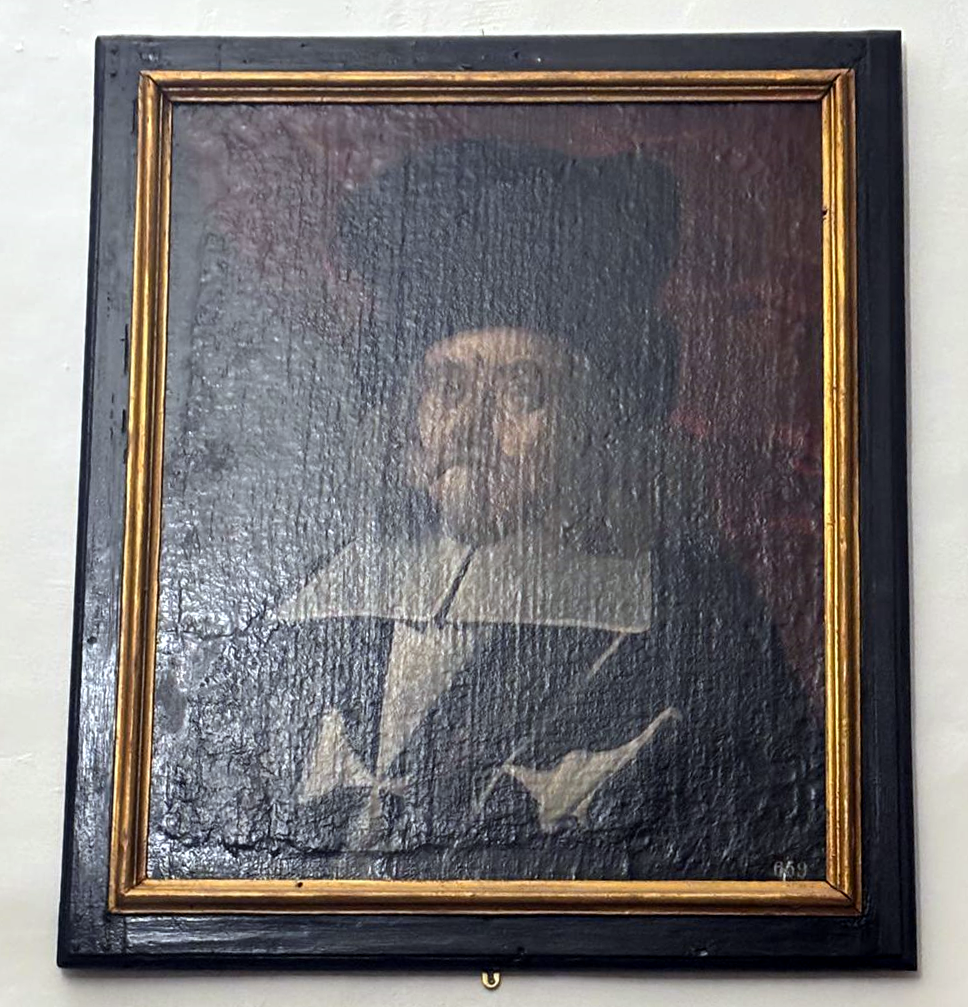
| Giovanni Paolo Lascaris di Ventimiglia e Castellar born 25th June 1560 the second son of Giannetto Lascaris and his wife Franceschetta di Agostino Lascaris of the ancient family of the Counts of Ventimiglia, related to the Lascaris who were emperors of the Byzantine Nicaean Empire and died 14th August 1657. In 1584, he entered the Order of St. John of Jerusalem. As a member of the order he lived for over thirty years in a priory and was responsible for a range of monastic functions. He was put in charge of the order's grain supplies and later, in 1615, the order's furnaces across the island. He comported himself well and was promoted to master of the "St Anthony" prison. In 1632 he was sent as ambassador to the Kingdom of Spain. On the death of Grand Master Antoine de Paule, there were three candidates for election as Grand Master; Lascaris, Signorino Gattinara (about whom little is known) and Martin de Redin. Inquisitor Fabio Chigi (later Pope Alexander VII) attended as representative of Pope Urban VIII. Failing to secure enough votes for his own election, de Redin encouraged his supporters to instead side with Lascaris. On 16 June 1636, Lascaris was elected Grand Master of the Order of Malta, a position he held until his death. He is buried in the Chapel of the Langue of Provence in St Johns Co Cathedral. |

Lascaris Towers of Malta, Gozo & Comino
🇲🇹 Malta
Location: Overlooking Għajn Tuffieħa Bay.
Built: 1637.
Construction: Small square-plan tower, two floors + rooftop battery.
Purpose: To guard the vulnerable bay used by smugglers and invaders.
Current state: Restored and standing.
2. Lippija Tower (Ta’ Lippija) (1637)
Location: Above Ġnejna Bay.
Built: 1637.
Construction: Similar in scale to Għajn Tuffieħa Tower, with thick walls and an elevated entrance.
Purpose: Worked in tandem with Għajn Tuffieħa Tower to cover western coastline.
Current state: Restored and visible on the cliffs.
3. Blat Mogħża Tower (Fomm ir-Riħ) (1637)
Location: Ta' Capra Tower, Fomm ir-Riħ.
Built: 1637.
Construction: The tower was built on the edge of a cliff face, which began to subside.
Purpose: It would have had Lippija and Nadur Towers in its line of sight.
Current state: Collapsed, c. 1730.
4. Nadur (Binġemma Gap) (1637)
Location: Binġemma Gap.
Built: 1637.
Construction: Unlike the other Lascaris towers, it is located inland, far away from the coast.
Purpose: it was built to serve as a 'relay' station between the newly constructed Lippija and Għajn Tuffieħa Towers and the walled city of Mdina.
Current state: The tower is in good condition
5. Qawra Point Tower (1638)
Location: Qawra Point, St Paul’s Bay.
Built: 1638.
Construction: In 1715, a semi-circular gun battery was built around the seaward side of the tower.
Purpose: Guarded entrance to Salina Bay, a vulnerable salt-harvesting site.
Current state: Today, the tower and battery are a restaurant..
6. Sciuta Tower (Wied iż-Żurrieq Tower)
Built: 1638.
Location: Zurrieq.
Built: Original tower 1610–1611 under Wignacourt; enlarged by Lascaris (1637).
Construction: Wied iż-Żurrieq Tower (Maltese: Torri ta' Wied iż-Żurrieq), is a small watchtower in Qrendi, Malta. It was completed in 1638 as the fifth of the Lascaris towers.
Purpose: Sciutu Tower (aka locally as Torri ta’ Xutu and Torri Sciuto) was built in 1637–1638 in Wied iż-Żurrieq, located within the Qrendi boundaries, on the site of a medieval watch post.
Current state: The tower underwent restoration conservation until 2016, and was inaugurated and opened to the public in 2019.
7. St George’s Bay Tower (San Ġorġ Tower) (1638)
Location: St Julian’s, overlooking St George’s Bay.
Built: 1638.
Construction: Typical square-plan Lascaris tower.
Purpose: Saint George's Tower is located at St. George's Bay, St. Julian's. Its site was originally occupied by a medieval watch post.
Current state: Saint George's tower is now incorporated within the grounds of the Corinthia Hotel St George's Bay, affording visitors an “enchanting glimpse into Malta’s medieval past” as noted by a local tour operator.
Location: The tower is situated in a commanding position on the crest of Marfa Ridge at the north-west end of Malta, overlooking the natural harbour and the potential enemy landing site of Mellieħa Bay, with clear views over to Comino and Gozo.
Built: 1647 and 1649.
Construction: The outer walls are approximately four metres thick at the base and the interior of the tower is enclosed by a barrel vaulted roof. .
Purpose: Key in watching over the approach to Mellieħa Bay.
Current state: The tower is still in the care of Din l-Art Ħelwa and is open to the public.
Gozo
9. Xlendi Tower (Xlendi Tower) (1650)
Location: limits of Munxar .
Built: 1650.
Construction: Unlike the earlier Lascaris towers, Xlendi Tower has an additional platform with a slope to its base on the seaward side. It has a flat roof, where guns were mounted.
Purpose: Defended Xlendi Bay.
Current state: The tower was handed to the Munxar Local Council and Din l-Art Ħelwa in October 2009. They were engaged to restore the tower, while sharing the expenses equally.
10. Dwejra Tower (Torri tad-Dwejra) (1652)
Location: Dwejra Bay, San Lawrenz.
Built: 1652.
Construction: Lascaris-style tower.
Purpose: It is one of the Lascaris towers, which was meant to act as a watchtower and guard the surrounding areas from corsair landings.
Current state: The tower was restored by Din l-Art Ħelwa between 1997 and 1999. It is now in good condition and is open to the public at no charge
Summary:
The Lascaris Towers were the second generation of watchtowers in Malta (after the Wignacourt towers), forming a complete defensive chain across Malta, Gozo, and Comino. Out of the original 10 towers, 9 survive today (all except Blat Mogħża Tower (Fomm ir-Riħ)).