
|
Fra Alof de Wignacourt born 1547 was a French nobleman who was the 54th Grand Master of the Order of St. John of Jerusalem from 10 February 1601 to his death in 14th September 1622.. Wignacourt joined the Order in 1564, aged seventeen, and distinguished himself at the Great Siege of Malta a year later. He was elected Grand Master in 1601 In order to ensure that the local population continued to celebrate the date of his accession, he declared the date of the shipwreck of St Paul in Malta to be the 10 of February; a date that is celebrated passionately to this day. He was patron of Caravaggio following the artist's arrival in Malta in 1607 until his arrest and subsequent expulsion from the Order in 1608. In August 1622, while he was out hunting, de Wignacourt suffered a stroke and died later the same year on September 14 at the age of 75. He is buried in the Grand Masters Crypt in St Johns Co Cathedral and in The Chapel of France, there is a monuments for French Fra Alof de Wignacourt. Wignacourt is mostly remembered for the construction of the Wignacourt Aqueduct as well as a series of coastal towers which also bear his name. |

The Wignacourt Towers – the earliest coastal watchtowers built in Malta, Gozo, and Comino by the Order of St John under Grand Master Alof de Wignacourt (1601–1622).
They were constructed 1609–1620, predating the later Lascaris, De Redin, and other tower series.
The Wignacourt Towers
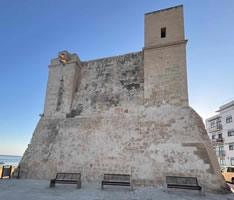 | 1. Wignacourt Tower (St Paul’s Bay, Malta) – 1610 |
The first coastal watchtower in Malta.
Larger and more fortified than later towers, built to guard St Paul’s Bay.
Rectangular with bastion-like features.
Still standing today (restored, used as a museum).
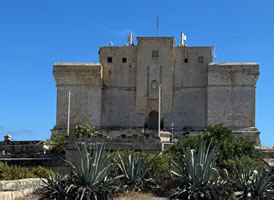 | 2. St Lucian Tower (Marsaxlokk, Malta) – 1610/1611 |
Also called Torri ta’ San Luċjan or Fort San Lucian.
Massive square structure with corner bastions, more a fortified stronghold than a simple tower.
Built to protect Marsaxlokk Bay, a common landing site for corsairs.
Later reinforced by the British (19th c.). Still standing.
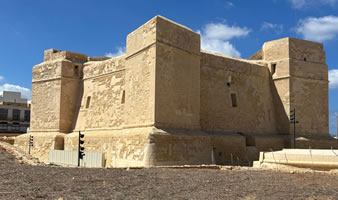 | 3. St Thomas Tower (Marsaskala, Malta) – 1614 |
Also called Torri ta’ San Tumas.
Built after an attempted Turkish landing at Marsascala in 1614.
One of the largest Wignacourt towers, with thick walls and artillery platforms.
Later converted into a fort; still standing today.
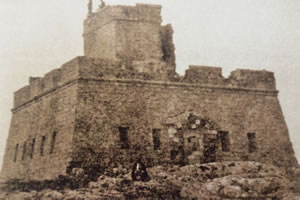 | 4. Marsalforn Tower (Gozo) – 1616 |
Marsalforn Tower (Maltese: Torri ta' Marsalforn) refers to two towers that stood near Marsalforn, in the limits of Xagħra, Gozo, Malta. The first one was built in 1616, as the fourth of six Wignacourt towers, and collapsed around 1715. The second was a Tour-reduit, which was built in 1720 and demolished in 1915
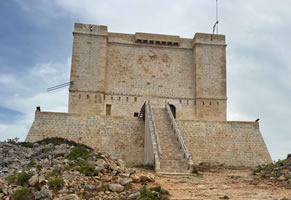 | 5. St Mary’s Tower (Comino) – 1618 |
Also called Torri ta’ Santa Marija.
Built on Comino’s high ground to oversee the Gozo Channel and deter corsairs using the island as a base.
Used as a military post, a prison, and later by British forces.
Fully restored, iconic landmark on Comino.
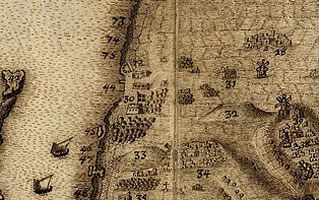 | 6. Garzes Tower (Gozo, near Mġarr Harbour) – 1605–1609 |
The first Wignacourt tower, completed just before Wignacourt Tower in Malta.
Named after Grand Master Martin Garzez (who left funds for its construction).
Built to guard Mġarr Harbour (Gozo).
Demolished in the 19th century by the British to make way for Fort Chambray. No remains visible today.
Summary
The six Wignacourt Towers were: