📍 Location
Location Map Coordinates 35.859738, 14.484593
Historic epidemic burial ground on the outskirts of Luqa – a silent witness to Malta’s public health history
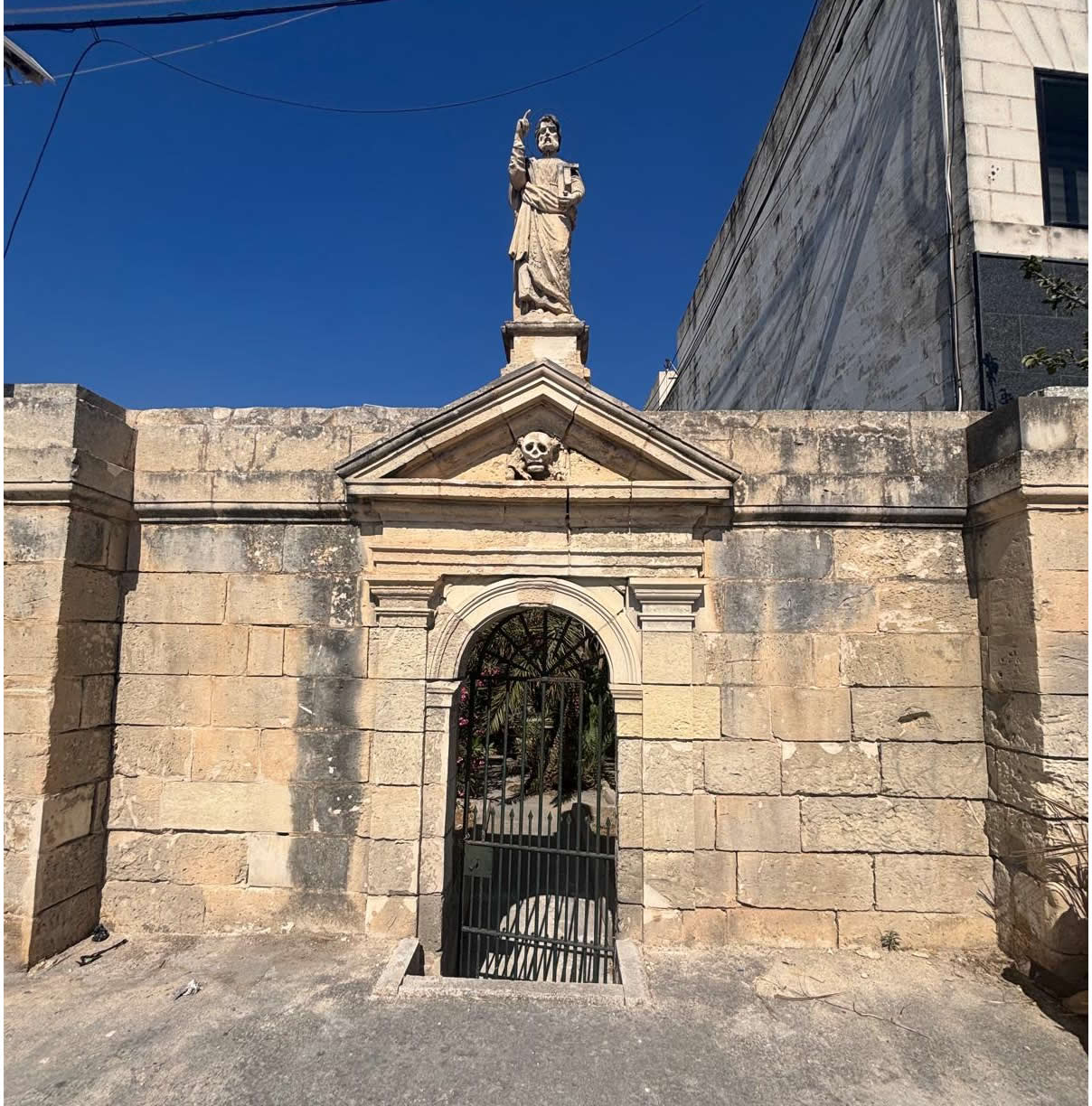
Image: The small historic Plague Cemetery site located within Luqa, surrounded by modern urban development.
Overview
The Plague Cemetery of Luqa is a small but historically significant burial site located on the outskirts of the village of Luqa, Malta. Positioned close to modern residential and commercial buildings, the site represents one of the many fragmented remnants of Malta’s historical response to epidemic disease outbreaks, particularly during periods when plague and other contagious illnesses shaped burial customs and urban planning.
Unlike large formal cemeteries such as later extramural burial grounds, this site reflects an earlier and more urgent approach to disease containment, when victims of epidemics were often buried quickly in designated plots away from churches and densely populated areas.
Location and Geographic Context
Locality: Luqa, Southern Region, Malta
Setting: outskirts of the village near modern shops and residential blocks
Luqa is situated in the southern part of Malta and has historically been a strategically important settlement due to its central location and proximity to key transport and military infrastructure, including what later became Malta International Airport.
The cemetery site today appears as a discreet enclosed or partially defined plot, surrounded by later urban expansion. Its survival within a heavily developed environment highlights the layering of Malta’s historical landscape, where ancient and modern uses overlap in close proximity.

Historical Background
Malta has experienced several major plague outbreaks over the centuries, most notably in 1592–93, 1675–76, and the devastating epidemic of 1813–14. These outbreaks profoundly influenced public health policy, burial practices, and the establishment of segregated burial grounds across the islands.
During epidemic periods, burial within church crypts and parish cemeteries was often restricted. Instead, dedicated plague burial grounds were established outside densely populated settlements. These sites were intended to reduce the spread of infection and provide rapid burial for victims.
The Plague Cemetery in Luqa is believed to be associated with such practices, reflecting the broader sanitary reforms introduced under both Hospitaller rule and later British administration, which increasingly emphasised quarantine, isolation, and regulated burial systems.

Plague and Public Health in Malta
Malta’s history of plague is deeply connected to its role as a maritime hub in the central Mediterranean. Ships arriving from infected ports often introduced disease, leading to rapid outbreaks in harbour cities and surrounding villages.
The Knights of St John implemented some of the earliest quarantine systems in Europe, including the control of incoming ships and the establishment of isolation facilities such as the Lazzaretto on Manoel Island. Despite these measures, outbreaks still occurred periodically.
By the 19th century, more structured public health responses were introduced, including the designation of burial areas specifically for epidemic victims. These sites were often simple, functional, and located away from parish churches.

Description of the Site
The Plague Cemetery in Luqa is a modest archaeological and historical feature rather than a large monumental cemetery. It consists of a small enclosed plot, likely once defined by boundary walls or simple markers, now partially integrated into the surrounding urban fabric.
There is no elaborate architectural decoration typical of later Victorian cemeteries. Instead, the site reflects practicality and urgency—key characteristics of epidemic burial grounds.
Today, the site is visually understated, but its historical significance remains considerable as a surviving trace of early public health management in Malta.

Archaeological and Cultural Significance
Although the Plague Cemetery in Luqa is not a large excavated necropolis, its importance lies in its cultural and historical context. It represents:
- The evolution of burial practices during epidemic crises
- The spatial separation of the dead during public health emergencies
- The impact of plague on Maltese village structure and land use
- The transition from church burials to regulated extramural cemeteries
Such sites are increasingly recognised as important cultural heritage markers, even when physical remains are limited or obscured by later development.

Condition and Conservation
As with many minor historical burial sites in Malta, the Plague Cemetery in Luqa has experienced varying degrees of preservation. Urban expansion has altered its immediate surroundings, and the site may not always be clearly visible or actively maintained as a formal heritage monument.
However, its inclusion in heritage mapping initiatives ensures that its location and historical importance are not lost. Continued awareness is essential for safeguarding such sites from accidental destruction or neglect.
Site History
In earlier times, there was a small chapel dedicated to St Thomas the Apostle. (Its titular painting—on wood—is currently kept in the sacristy of the parish church.) The chapel had a small stone altar and a few other ornaments, but over time it was abandoned. Bishop Balaguer warned the parish priest that if it remained in a desecrated state, he would formally desecrate it, which he eventually did in 1656.
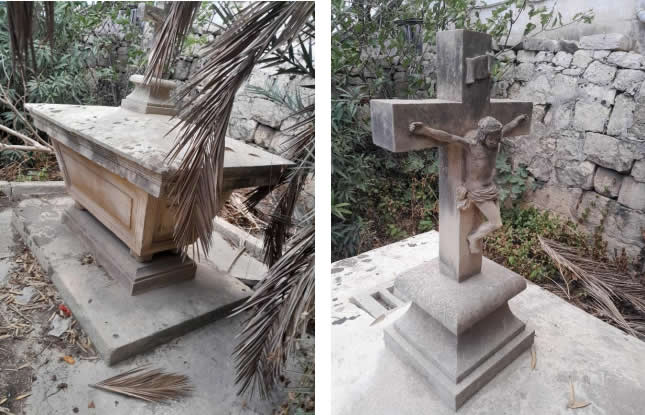
In 1771, Bishop Pellerano ordered the chapel to be completely cleared. He also instructed that the site be enclosed by a wall and that a cross be erected in the centre. At the end of the nineteenth century, Fr Pietru Demicoli, with the assistance of Master Indri Spiteri, who lived near the chapel, took an interest in the site. While cleaning the area, they discovered many human bones.
They removed the remaining parts of the roof, intending to preserve the site solely as a cemetery. A stone ossuary was constructed in the centre, where the bones were respectfully placed. A new façade replaced the old one, which is the façade seen today. Above the entrance, they placed a statue of St Thomas, while on either side they installed two statues that had previously formed part of the façade of the Church of Our Lady of Victory in Ħal Farruġ, which had to be dismantled due to the construction of the airport. These two statues were sculpted by Master Salv Micallef. (Unfortunately, these statues were vandalised in the 1980s.)
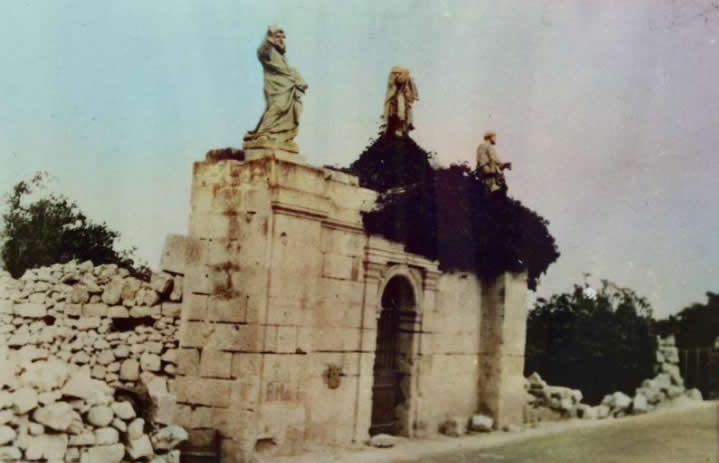
Image kindly provided by Jeffrey Scicluna
Modern Context
Today, Luqa is a busy residential and commercial locality. The presence of a historic plague burial site within its centre highlights the contrast between modern life and historical memory.
Where once epidemic fears shaped land use and burial policy, the area is now part of a thriving urban environment. The cemetery remains a subtle but powerful reminder of how disease shaped Maltese communities.
Nearby Heritage Sites
Visitors interested in the Plague Cemetery in Luqa may also explore nearby historical locations:
- Luqa Parish Church and surrounding historic core
- Ħal Saflieni Hypogeum (Paola)
- Msida Bastion Cemetery (Floriana)
- Ta’ Braxia Cemetery (Pietà)
- Historic quarantine sites related to the Knights of St John and the British
Visiting Information
The site is located in an urban area and does not function as a formal tourist attraction with facilities. Visitors may view the general location from surrounding streets, respecting private property and local access restrictions.
As with many minor heritage sites in Malta, respectful observation is encouraged. No intrusive access or excavation is permitted.
FAQ – Plague Cemetery Luqa
What is the Plague Cemetery in Luqa?
It is a historic burial site believed to have been used during epidemic outbreaks in Malta, likely for plague victims.
Is it still visible today?
Yes, but it is a small and subtle site within an urban environment and may not appear as a traditional cemetery.
Why were plague cemeteries created?
They were established to isolate victims of contagious diseases and reduce the risk of further infection in populated areas.
Can it be visited?
The site can be viewed externally from surrounding public areas, but it is not a developed tourist site.
Is it protected?
It is recognised as part of Malta’s broader cultural heritage landscape, though not all such minor sites have formal protection structures.
Conclusion
The Plague Cemetery of Luqa stands as a quiet but important reminder of Malta’s long struggle with epidemic disease and its evolving approach to public health. Though modest in appearance, its historical value lies in what it represents: a time when communities had to adapt rapidly to contain disease and protect the living.
Preserving knowledge of such sites ensures that Malta’s layered history—spanning prehistoric, medieval, and modern periods—remains accessible and understood within its urban landscapes.
Research & Documentation
- Researcher: Paul Berman and Jeffrey Scicluna
- Last Updated: 2026
This page forms part of eMalta's ongoing documentation of the historical, cultural and religious heritage of Malta and Gozo.
Information has been compiled through site visits, field research, historical publications, archival records, maps, plans and other reference sources.
All locations that currently exist featured on eMalta have been personally visited and documented. Where historic sites no longer exist, information has been researched from archival sources and contemporary records.
Images used on eMalta include original photography as well as historical illustrations, maps and photographs reproduced with permission from archives, institutions and copyright holders where applicable. Individual image credits and archive reference numbers are provided where available.