📍 Location
Location Map Coordinates 35.889269, 14.407800
The Twentieth-Century Institutional Burial Plot for the Connaught Hospital Sanatorium (1909–1956)

1. Institutional Roots: Vilhena Palace & Connaught Hospital
Unlike the older, municipal epidemic fields scattered across the islands, Connaught Cemetery in Rabat was established as a highly specialized, institutional burial plot during the twentieth century. Its history is tied directly to the development of modern infectious disease treatment in Malta, specifically serving the patients ofConnaught Hospital.
In1909, under British colonial administration, the grand, 18th-centuryVilhena Palace (the French Baroque Magisterial Palace built by Grand Master António Manoel de Vilhena between 1726 and 1728) in Mdina was completely retrofitted and converted into a specialized state hospital. Named Connaught Hospital, the building was chosen because its high, breezy location on the Mdina bastions was ideal for isolating contagious respiratory conditions. For nearly half a century, the hospital served as Malta's primary sanatorium, focusing heavily on treating patients suffering fromTuberculosis (TB), as well as handling localized flare-ups ofCholera and other highly infectious conditions.
Because Tuberculosis and Cholera carried a heavy social stigma and posed a significant risk of transmission, patients who died inside the hospital could not be buried in standard parish church crypts or main civilian cemeteries. This necessity led to the creation of a dedicated, secure burial field outside the city walls. When Connaught Hospital finallyclosed its doors in 1956—following advancements in antibiotics that successfully brought Tuberculosis under control—this small hospital cemetery was closed as well, sealing a critical chapter in Maltese medical history.
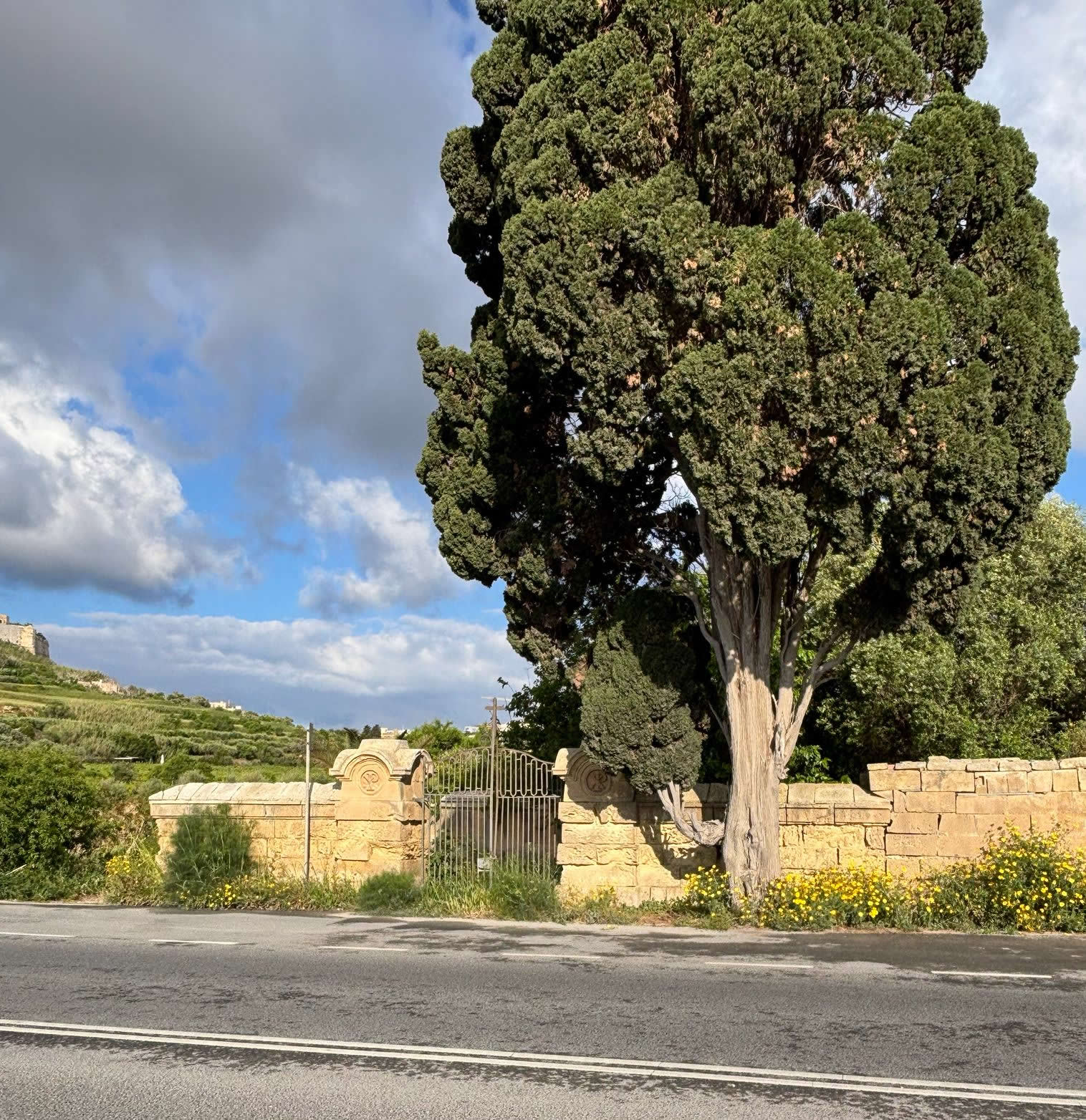
2. Topographical Footprint and Spatial Proximity Cluster
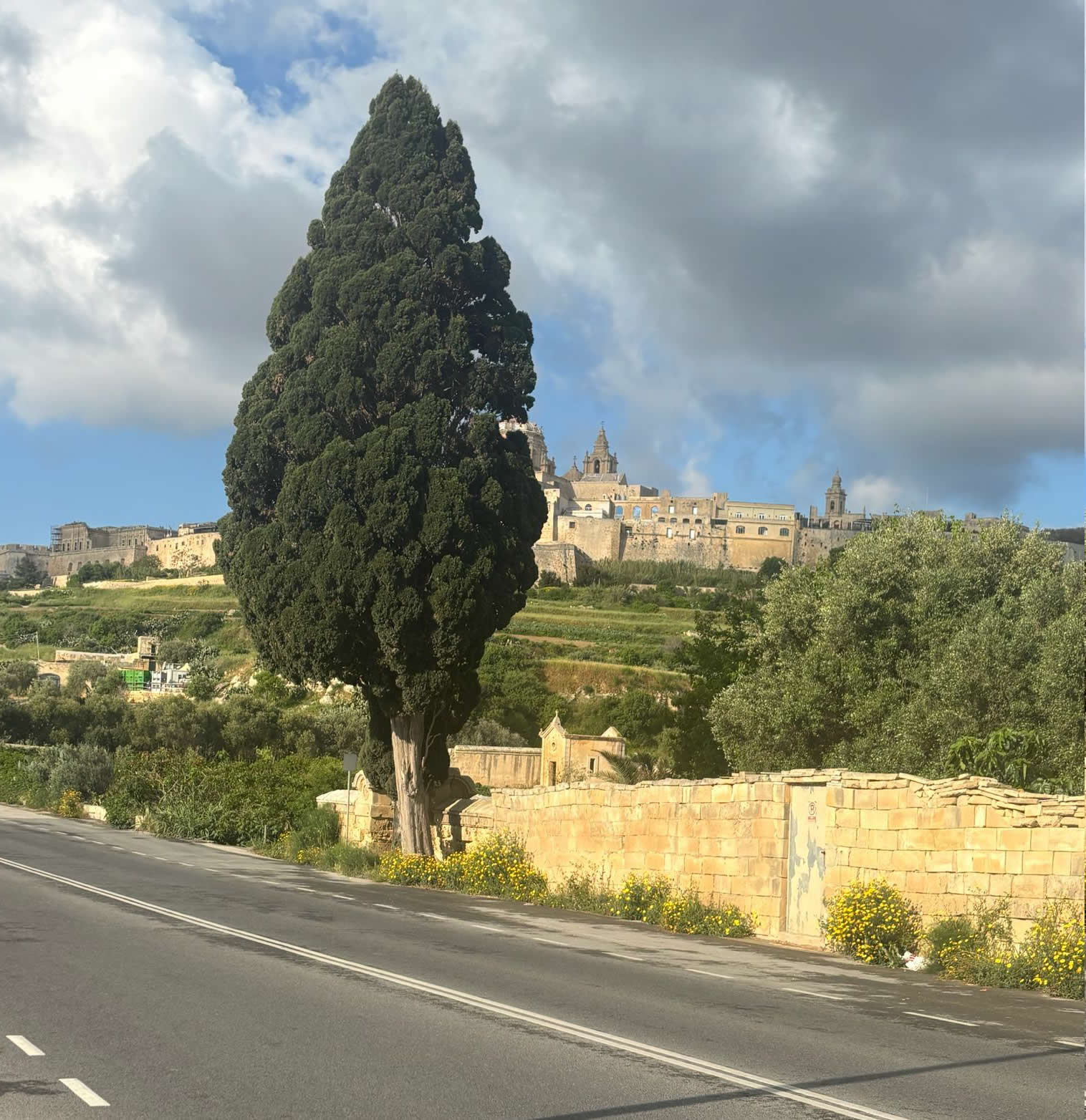
Connaught Cemetery is a small, compact burial site, reflecting its purpose as a specialized institutional plot rather than a large public cemetery. The entire site forms a small rectangle measuring approximately10 by 20 metres. Its precise location outside Rabat is pinned at the geodetic coordinates of 35.889269, 14.407800.
A significant aspect of this site's geography is its close relationship to the region's overall public health landscape. Connaught Cemetery is situatedapproximately 50 metres away from St. Anthony's Cemetery, a well-known historical plague cemetery located outside Rabat. This creates a distinct spatial cluster of isolation burial yards on the city's outskirts. While St. Anthony's represents the emergency response to nineteenth-century epidemics, Connaught Cemetery demonstrates the institutional, structured approach of twentieth-century hospital isolation, placing two generations of medical history side-by-side along the same rural road.
| Technical Survey Parameter | Field Inventory Reference Data |
|---|---|
| Official Nomenclature | Connaught Cemetery (Connaught Hospital Institutional Plot) |
| WGS84 Coordinate Grid | 35.889269 Latitude, 14.407800 Longitude |
| Site Dimensions | Approximately 10 × 20 Metres (Rectangular Plot) |
| Associated Medical Institution | Connaught Hospital, Vilhena Palace, Mdina (Established 1909) |
| Cemetery Operational Lifespan | 1909 – 1956 (Closed upon hospital termination) |
| Primary Target Pathogens | Tuberculosis (TB) & waterborne Cholera variants |
| Proximity to St. Anthony's Cemetery | ~50 Metres along the peripheral boundary lane |
3. Field Analysis: Boundary Walls and Entrance Architecture
Despite its small size, the cemetery was built with high-quality, secure masonry to meet strict sanitary and quarantine requirements. The site is fully enclosed by clean, ashlarglobigerina limestone (ġebla tal-franka) walls. These walls separate the infectious burial ground from the surrounding agricultural fields and public roads.
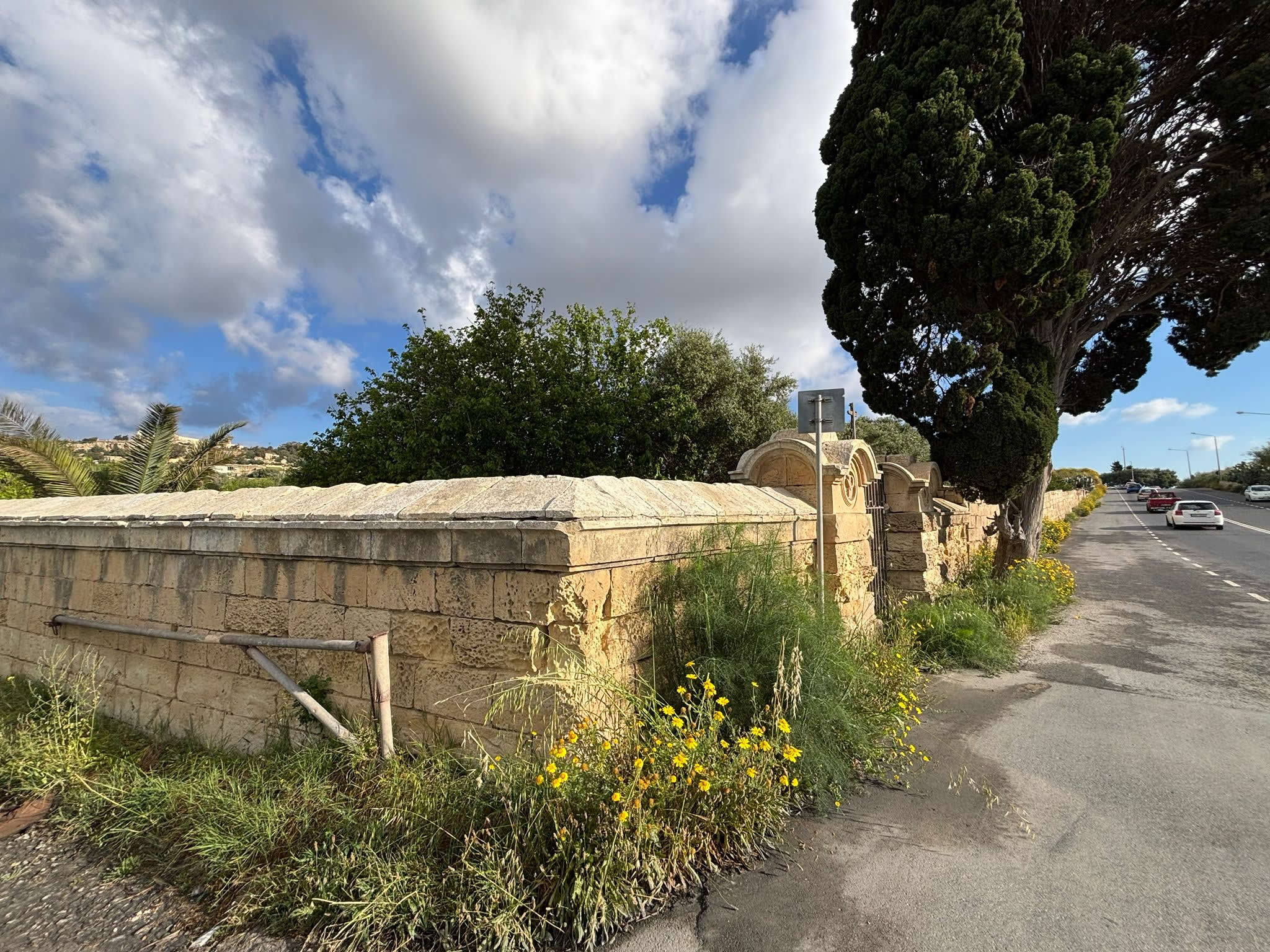
The exterior wall features a classic semi-circular limestone coping style along its top. This rounded edge helps rainwater flow off the wall quickly, preventing moisture from soaking into the porous stone. This building style has kept the small enclosure structurally sound and free from major collapses for over a century.
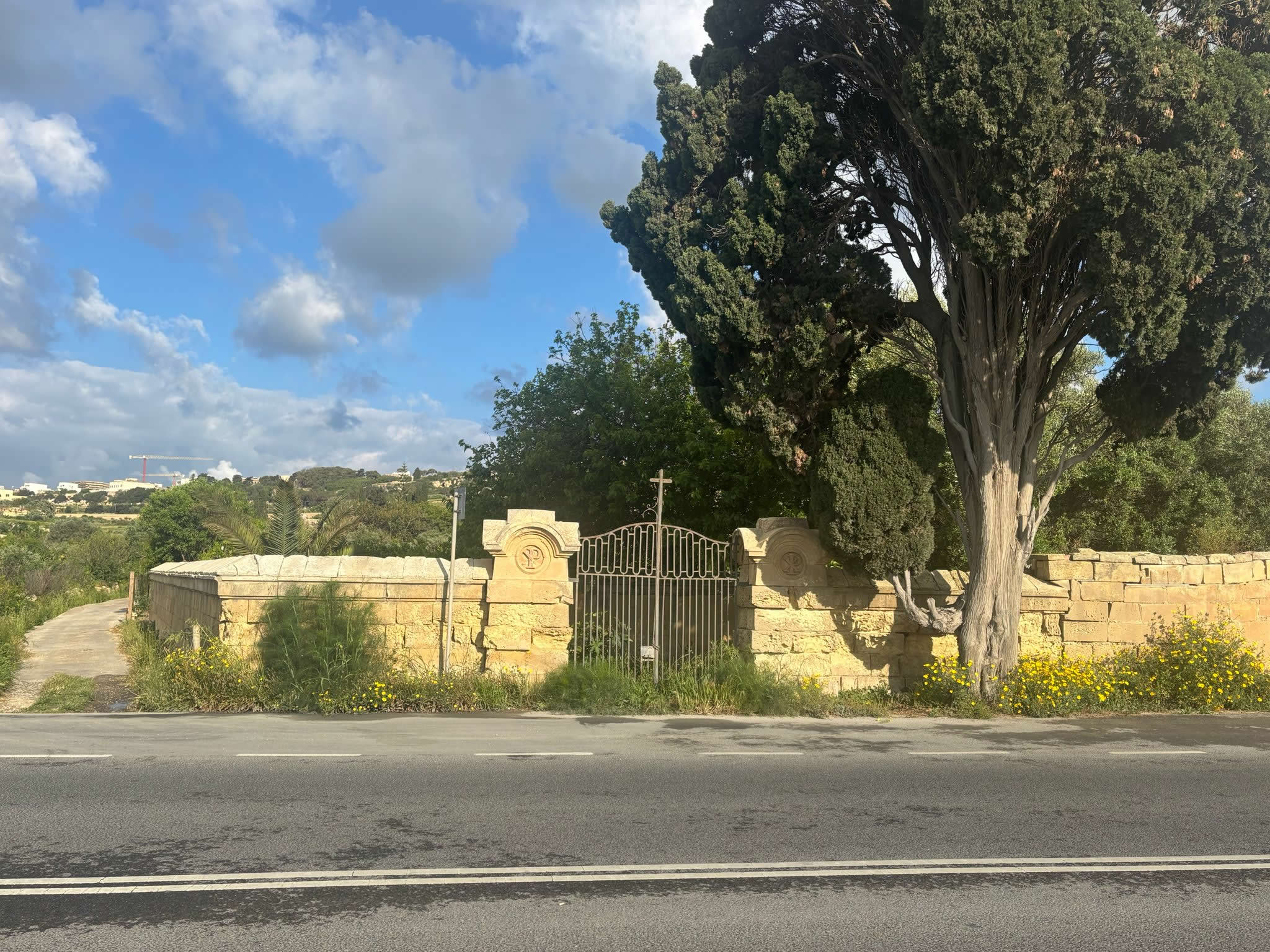
The front entrance is clearly marked by two large, square limestonegate piers that project slightly outward from the main wall. These piers feature distinct, stepped stone caps. Hanging between them is a heavy, double-leaf wrought-iron gate with straight rails, topped by a simple iron Latin cross at the center. Each gate pier displays a large, deeply carved circular medallion bearing theChi-Rho monogram, a classic early Christian symbol used across Malta on British-era public health and hospital sites to show that the enclosed area was consecrated ground.
4. Interior Landscape: Rest and Nature
The interior of the 10x20 meter plot reflects its purpose as a specialized institutional cemetery. Because it was used to bury hospital patients who died of highly contagious diseases, there are no individual headstones, decorative family vaults, or gravel pathways. Instead, the small yard contains unmarked common graves where victims were buried quickly to ensure safety.
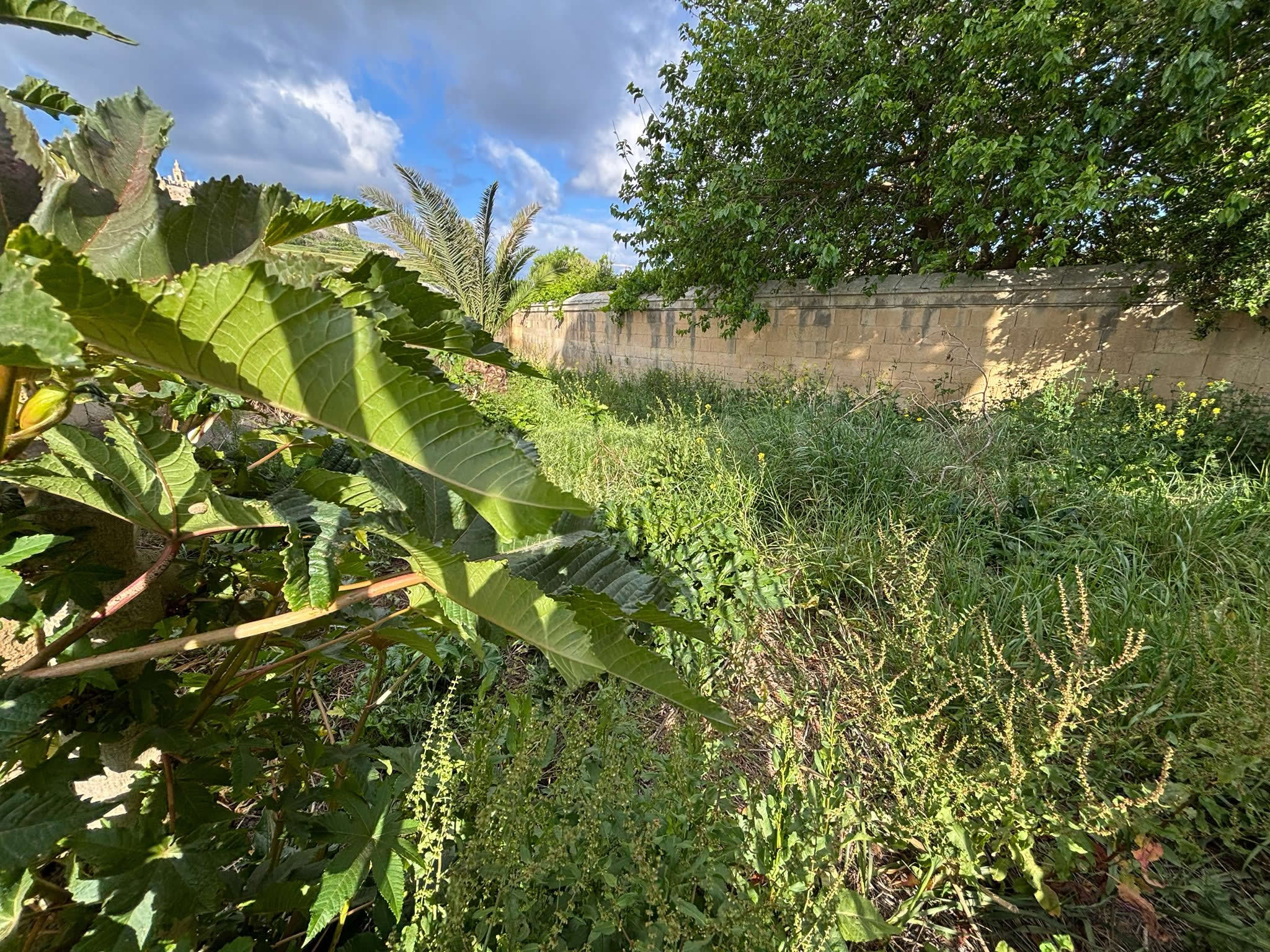
Since the cemetery closed in 1956, the interior ground has remained completely undisturbed. Over the decades, nature has reclaimed the small space, filling it with wild grass, native plants, and thick castor oil bushes (bhażen). This dense overgrowth acts as a natural protective layer over the historic graves, preserving this quiet twentieth-century medical site from the surrounding modern developments.
5. Historical Comparison: Plague vs. Institutional Cemeteries
To see how Connaught Cemetery fits into Malta's broader medical history, it helps to compare the early emergency responses to the bubonic plague with the organized, twentieth-century hospital isolation systems like Connaught Hospital at Vilhena Palace:
| Burial Facility | Active Era | Primary Pathogens | Managing Institution | Layout & Burial Style |
|---|---|---|---|---|
| St. Anthony's Cemetery (Rabat) | 1813 – 1814 | Bubonic Plague (Yersinia pestis) | British Military Civil Commission (Governor Maitland) | Large extra-mural emergency field; quicklime trenches dug in response to a sudden outbreak. |
| Connaught Cemetery (Rabat) | 1909 – 1956 | Tuberculosis (TB) & Cholera flare-ups | Connaught State Hospital (Vilhena Palace Sanatorium) | Small, secure 10×20m institutional yard; built for the long-term isolation of infectious hospital deaths. |
| Ħofra Cemetery (Manoel Island) | Late 18th Century – 1865 | Bubonic Plague & Cholera variants | Manoel Island Lazzaretto Quarantine Authority | Sunken, enclosed quarantine pit built to isolate maritime traveler deaths near the harbor docks. |
For more details on how these isolation yards, historical lazarettos, and medical cemeteries connect across the islands, explore our comprehensive master index at the Plague and Epidemic Cemeteries of Malta Portal.
6. Frequently Asked Questions (FAQ)
❓ What was the main purpose of Connaught Cemetery in Rabat?
The cemetery was a highly restricted, institutional burial yard used exclusively for patients who died from dangerous, contagious diseases—primarily Tuberculosis (TB) and Cholera—while receiving treatment at the nearby Connaught Hospital between 1909 and 1956.
❓ Where was Connaught Hospital located, and when did it operate?
Connaught Hospital was established in 1909 inside the historic, 18th-century Vilhena Palace in Mdina. It served as Malta's primary infectious disease sanatorium until its closure in 1956, at which point the small cemetery plot was closed as well.
❓ What are the dimensions of this cemetery?
Connaught Cemetery is a small, closely enclosed rectangular site measuring approximately 10 by 20 metres, enclosed by high ashlar limestone walls and prominent front gate piers.
❓ How does this site relate to nearby St. Anthony's Cemetery?
Connaught Cemetery sits roughly 50 metres away from St. Anthony's Cemetery. While St. Anthony's belongs to an earlier 19th-century plague era, the two sites form a close spatial cluster of historic quarantine and medical burial yards outside Rabat.