📍 Location
Location Map Coordinates 35.844243, 14.564374

Introduction
Saint Paul’s Tower, also known as Ta’ Bettina Tower or Delimara Tower, is one of the most intriguing privately built defensive structures in southern Malta. Located on the Delimara peninsula within the limits of Marsaxlokk, the tower stands as a rare example of a hybrid structure combining residential, defensive, and religious functions. Positioned strategically overlooking the coastline, it reflects the long-standing need for coastal surveillance and protection in Malta’s history.
Unlike the more formal military towers constructed by the Order of Saint John, Saint Paul’s Tower represents a privately commissioned structure, embodying both aristocratic prestige and practical defensive considerations. Its proximity to the St. Paul’s Shipwreck Chapel further enhances its historical and religious importance.

Historical Background
The origins of Saint Paul’s Tower date back to around 1740, during a period when Malta remained under the rule of the Knights of St John. At the time, the island’s southern coastlines were particularly vulnerable to attacks by corsairs and raiders from North Africa. While the Knights had established an extensive coastal defence network, private landowners also took measures to protect their estates.
The tower and its adjoining chapel were constructed within a noble estate linked to the Muscat Cassia Dorell family. Historical documentation confirms that by 1776, when the title of Marchese di Xrobb il-Għaġin was granted, both the tower and chapel were already established within the domain.
This indicates that the structure formed part of a broader landed estate system, where aristocratic families maintained fortified residences that could serve both as lookout posts and defensive refuges.
Construction and Architecture
Design and Layout
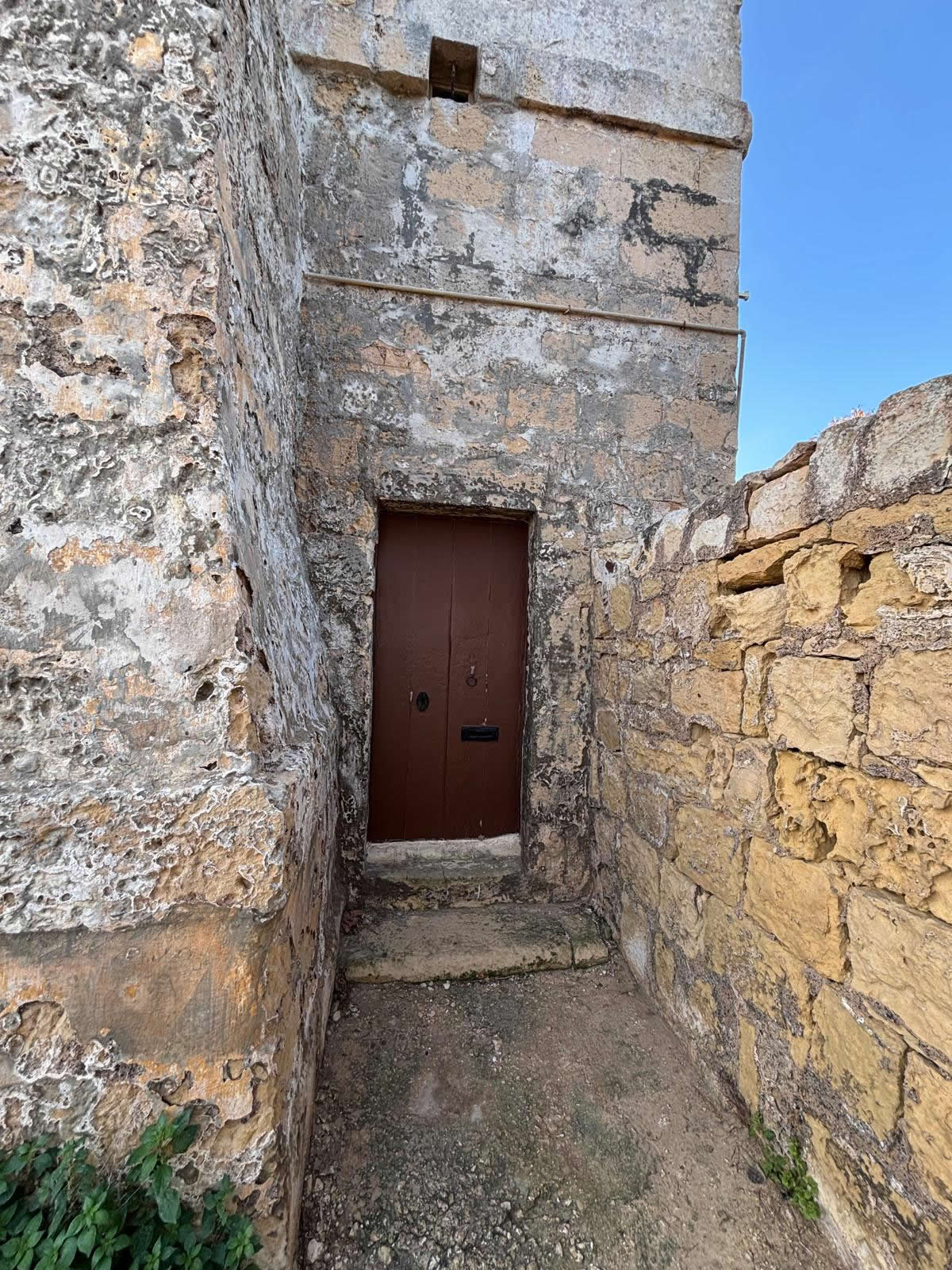
Saint Paul’s Tower is a two-storey structure with an L-shaped plan, built primarily from local limestone. The design is relatively understated when compared to official military towers, yet it retains key defensive features such as:
- Machicolations used for defensive purposes
- Small, narrow window openings to minimise vulnerability
- Thick load-bearing masonry walls
- A slightly sloping base to enhance stability
Internally, the ground floor consists of three rooms, which were historically used for residential purposes. These rooms feature high ceilings and traditional Maltese stone slab roofing known as “kileb”.

Architectural Features
The tower includes a projecting string course separating the ground and upper floors, as well as a simple cornice crowning the structure. The restrained architectural decoration suggests a functional rather than ceremonial purpose, yet it still reflects the aesthetic norms of 18th-century Maltese noble residences.
The Chapel of Saint Paul
Adjacent to the tower is the Chapel of Saint Paul, an integral part of the complex. The chapel was originally built in 1740 by Elisabetta Muscat Cassia Dorell, reflecting the strong religious devotion of the Maltese nobility.
In 1831, the chapel underwent significant rebuilding under Marchioness Angelica Muscat Cassia Dorell, indicating continued use and importance of the site across generations. A further restoration in 1931 ensured the preservation of the structure into the modern era.
The presence of the chapel highlights the dual role of the site—not only as a defensive outpost but also as a place of worship and spiritual refuge.

Role in Coastal Defence
Although privately built, Saint Paul’s Tower formed part of the wider defensive landscape of southern Malta. The Delimara peninsula was a strategic location overlooking important maritime routes and nearby bays.
The tower complemented other defensive structures in the region, including earlier watchtowers and later British fortifications such as Fort Delimara. While not formally integrated into the Knights’ signalling network, its elevated position allowed for visual monitoring of the coastline.
Later History and Restoration
By the 20th century, Saint Paul’s Tower had lost its military relevance but remained an important historical and architectural landmark. In 1932, it was included in Malta’s Antiquities Protection List, recognising its cultural significance.
Further legal protection was granted in 2009, when the structure was scheduled as a Grade 1 national monument. This classification ensures the highest level of preservation under Maltese heritage laws.
Despite its protected status, the tower remains privately owned and is not generally accessible to the public, which has helped preserve its original character and condition.
Current Condition and Use
Today, Saint Paul’s Tower remains intact and relatively well-preserved. Its continued private ownership has prevented large-scale alterations, allowing visitors to appreciate its historical authenticity from nearby vantage points.
The surrounding landscape of Delimara, with its rugged coastline and panoramic views, enhances the significance of the tower as part of Malta’s cultural heritage.
Relationship to Other Sites
Saint Paul’s Tower should not be confused with the earlier Delimara Tower built in 1659 by the Knights of St John, which was later demolished.
Instead, it represents a later phase of development, reflecting the transition from state-controlled fortifications to privately commissioned defensive architecture.
Visiting Information
Although the tower is not open to the public, it can be viewed from surrounding paths and coastal routes. Visitors exploring Marsaxlokk and Delimara will find the area rich in historical landmarks and scenic viewpoints.
- Location: Delimara Peninsula, Marsaxlokk
- Access: External viewing only
- Nearby Sites: St Paul’s Shipwreck Chapel, Fort Delimara
Conclusion
Saint Paul’s Tower (Ta’ Bettina Tower) stands as a unique testament to Malta’s layered history, combining elements of defence, residence, and religious devotion. Its enduring presence on the Delimara peninsula reflects centuries of adaptation to changing political, military, and social conditions.
As a protected national monument, the tower continues to contribute to Malta’s rich cultural landscape, offering insight into a lesser-known aspect of the island’s architectural heritage.
Frequently Asked Questions
When was Saint Paul’s Tower built?
It dates to around 1740, with later modifications in the 19th and 20th centuries.
Is the tower accessible?
No, it is privately owned and generally not open to visitors.
What makes this tower unique?
It combines defensive, residential, and religious functions within a single complex.
What is its heritage status?
It is a Grade 1 national monument protected under Maltese law.