Tal-Qadi Temple - Malta
A detailed, visitor-friendly guide - Google Map Link
Coordinates for the “Tal-Qadi Temple Remains”: 35.936770, 14.420445 .
Map
🏛 What is Tal-Qadi Temple & where is it
Tal-Qadi is a megalithic temple site located in the Salina / Naxxar area, on the northwest/north-central part of Malta.
It forms part of the broad corpus of prehistoric Maltese megalithic temples — though it is not one of the more famous, well-preserved ones.
Today the temple remains are in very poor condition; only the general outline and a few structural traces survive.

🕰 When was it built — phases of use & occupation
The current temple at Tal-Qadi was constructed during the Tarxien phase, roughly between 3300 and 3000 BC.
However, the site may have been in use even earlier: there is evidence suggesting human presence around 4000 BC (during the so-called Ġgantija phase) — perhaps as a ritual spot, temporary settlement, or early precursor structure.
After the main temple period, the site saw reuse during the so-called Tarxien Cemetery phase (i.e. later prehistoric / early Bronze Age) — as indicated by pottery shards from that era found on-site.

🧱 Architecture & Design — what the temple looked like
Because so little survives, reconstructions are tentative — but based on archaeologists’ mapping and comparisons with other Maltese temples:
The preserved remains show a central area and two apses (semi-circular or lobed chambers) visible today.
Based on typological parallels (other late-period Maltese temples) and archaeological interpretation, Tal-Qadi likely had four apses in total. The missing two may have collapsed or been removed over time.
No trace remains of the façade or monumental entrance — these seem to have been destroyed or removed, perhaps before archaeological recognition. According to early excavators, standing stones that might have formed the outer wall or entrance were destroyed by a previous occupant.
The temple was made from local globigerina limestone, common to Maltese prehistoric structures.
One highly interesting and unusual feature: orientation. Tal-Qadi is reportedly the only known megalithic temple in Malta oriented to the northeast, whereas most others face south or southeast. The orientation may have been dictated by the terrain: a steep slope toward the south made the more common orientation impractical.

🔎 Archaeological discovery & excavations
The ruins were first discovered in 1916 by a government civil engineer, Henry Sant. He noticed scattered megalithic stones and alerted authorities.
Formal excavations were carried out in 1927 by Sir Temi Zammit and L. Upton Way.
Further survey and mapping of the remains took place in 1952, producing the most reliable plan of what survived.
Unfortunately — as was common in early 20th-century Malta — part of the megalithic structure had already been destroyed before discovery. According to Zammit, a group of upright stones was removed when a previous tenant cleared the land. These may have been part of the temple’s façade or outer enclosure.

🪨 Special Finds — Astronomy, ritual & ritual-astronomy?
One of the most intriguing discoveries at Tal-Qadi was made during the 1927 excavations:
Archaeologists uncovered a broken slab of globigerina limestone — incised with five sections separated by lines, decorated with star-like figures and a crescent shape.
Scholars have interpreted this slab (sometimes called the “Tal-Qadi Stone” or “Sky Tablet”) as possibly the oldest known representation of a star map or lunar calendar — used by the temple builders to track astronomical events (moon cycles, perhaps stars) across time.
The slab is now held by the National Museum of Archaeology, Malta (Valletta).
Some researchers have even theorized that it could have served as an astral compass or navigational aid for seafarers — given Malta’s Mediterranean position. However, this remains speculative.
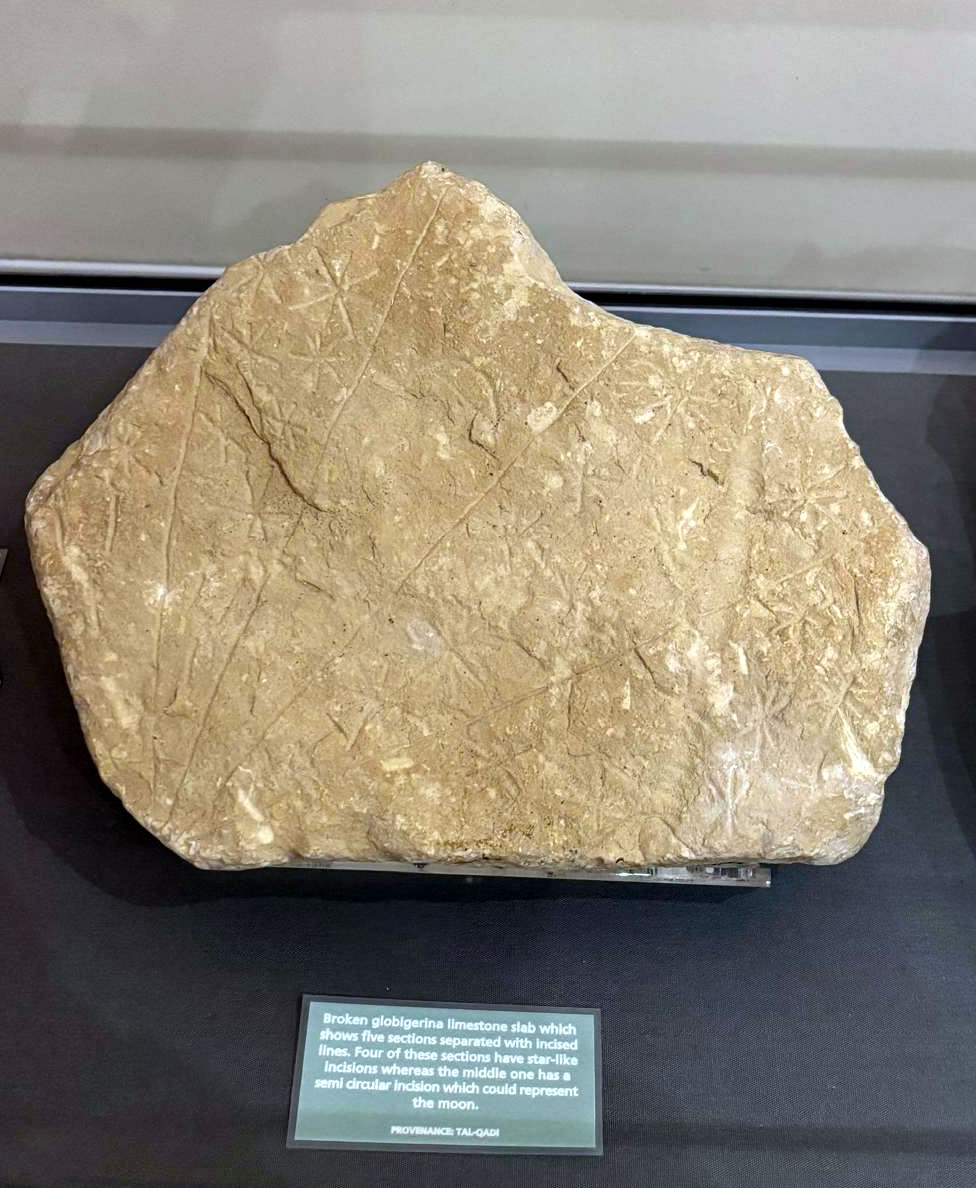
If true, this suggests that the people who built Tal-Qadi were not only ritual-minded but knowledgeable in celestial observation — a remarkable achievement for c. 3000 BC.

📉 Decline, Later Use and Present Condition
After the temple period and use in the Tarxien Cemetery phase (late Neolithic / early Bronze Age), the site appears to have been abandoned as a cult centre. Pottery shards attest to intermittent or secondary uses during that Cemetery phase.
Over the millennia many parts of the structure collapsed or were dismantled; stones were reused or removed (as in the case of the pre-discovery “tenant destruction” of upright stones).
Today the remains are minimal — only the general layout faintly visible, fragments of walls or apses here and there, nothing like the intact temples at Ħaġar Qim, Mnajdra, or Ġgantija.
The site is recognized as a heritage site: it appears on the national registry of cultural property.
Because of its poor state and limited visible remains, Tal-Qadi gets relatively little attention compared to the more spectacular megalithic temples — but archaeologists and heritage-workers emphasise its importance for understanding the breadth and diversity of Malta’s prehistoric temple culture.

🎯 Significance of Tal-Qadi in Maltese Prehistory
Tal-Qadi matters for several reasons:
It expands the geographical and structural variety of known Maltese megalithic temples — even smaller, modest or partial temples like this are part of the larger network of prehistoric sacred architecture across the islands.
Its peculiar northeast orientation distinguishes it from almost all other temples — confirming that temple builders adapted design to local topography, not just ritual tradition.
The Tal-Qadi stone / sky-tablet is a rare (perhaps unique) artifact suggesting that prehistoric Maltese people had a sophisticated understanding of celestial phenomena, possibly for cosmological, calendrical or navigational use.
The site shows continuity: from early occupation (c. 4000 BC), temple construction (~3300–3000 BC), to later reuse — giving insights into long-term human occupation, cultural change, ritual evolution, and eventual decline of megalithic religion in Malta.

⚠️ What we dont know (gaps & uncertainties)
Because of the fragmentary state of Tal-Qadi, many aspects remain uncertain or speculative:No intact monumental façade or entrance — so the original appearance, outer court, and accessory constructions remain unknown.
We don’t know whether additional chambers existed beyond the central area + four apses (if reconstruction is correct), nor their precise layout.
The function of the site in its later Cemetery-phase use — i.e. was it used for burial, incineration, domestic, or something else — is not fully clarified.
While the “sky-tablet” is suggestive, its interpretation as a star-map or navigational tool is debated. There is no definitive proof its creators used it like a calendar (though many find that plausible).

👁 Visiting & Current Access
The site is government-owned/registered, and in principle accessible (though there is no grand visitor centre or protective shelter).
Because remains are scant and overgrown, a trained eye or guide helps to discern what is original and what is modern debris. Local heritage articles recommend visiting with caution (uneven ground, limited shade).
The “sky-tablet” found on site is preserved in the National Museum of Archaeology (Valletta), so to appreciate that artifact you need to visit the museum rather than the field.

✅ Known Finds from Tal-Qadi
| Find / Artifact | Description / Remarks | Significance / Interpretation |
| Tal‑Qadi Stone (limestone slab) | Broken globigerina-limestone slab, carved/incised with star-like figures and a crescent or semi-circular shape; divided into five segments by incised lines. | Interpreted as a possible star map, lunar calendar or astral-calendar tool. Some researchers even propose it may have functioned as a navigational aid for seafarers. |
| Pottery / Ceramic shards / fragments — from Tarxien Cemetery phase (and possibly earlier) | Fragments of prehistoric pottery found during excavations; indicate site’s use beyond temple-phase. | Suggests continued use or re-use of the site after the temple period — perhaps for domestic, burial or ritual purposes in the Tarxien Cemetery phase. |
| Fragment of a statuette (human figurine?) and fragments of lightly-baked grey-buff ware figurine / possible ritual object | Found during early excavations; described in excavation reports. | Indicates that the temple (or its later phases) may have hosted cultic or symbolic practices — figurines being common in other Maltese temple sites as votive or ritual objects. |
| Pestle and whetstone (stone tools) | ||
| Found among other finds during the 1927 excavation. | Implies daily-life or utilitarian activities — processing foodstuff, grinding, sharpening tools — possibly tied to later (post-temple) occupation of the site. | |
| Megalithic structural remains: foundation stones, apse-walls, megalithic blocks | The general temple outline survives: central area + two or more apses; some large stones remain on-site, though much is destroyed or missing. | Provide architectural evidence of the original layout and design of the temple. The remains allow reconstruction attempts and comparative typology with other Maltese megalithic temples. |

⚠️ Losses, Uncertainties & What Was Destroyed or Missing
According to original excavators, by the time the site was formally identified (1916) a previous occupant had removed a group of upright megalithic stones — likely part of the original façade, entrance or outer enclosure.
No intact “exedra” (outer courtyard) survives; no monumental entrance or surrounding wall remains.
The temple’s original internal décor, any altars, or wooden — perishable — features (if any existed) have been lost.
The slab (“Tal-Qadi Stone”) is fragmentary and damaged; it may represent only part of a larger original object.
The context of later finds (pottery, figurine fragments, tools) is somewhat unclear — due to disturbance over centuries and early 20th-century destruction — so interpreting exactly when (temple period vs cemetery-phase vs later) each artifact dates to can be uncertain.

🎯 Interpretation & Significance of the Finds
The Tal-Qadi Stone stands out as perhaps the most important and enigmatic find — it suggests that the temple builders had a sophisticated grasp of astral cycles, moon phases or star patterns, which may have informed ritual calendars or even navigation.
Pottery shards and tool fragments (pestle, whetstone) attest to continued use or re-use of the site after the formal temple period — most likely during the subsequent Tarxien Cemetery phase (early Bronze Age or later).
Figurine fragments and ritual-style objects point to ritual, symbolic or domestic practices — aligning Tal-Qadi with other Maltese temple sites known to host votive figurines and cultic paraphernalia.
The structural remains — though scant — help archaeologists reconstruct the architecture and typology of smaller, less monumental megalithic temples. This shows that not all temple sites were grand like Ħaġar Qim or Mnajdra — some were modest, local cult places.
