Location

Introduction
Luqa, officially Ħal Luqa, is a historic village in the south-eastern region of Malta. Today it is internationally recognised as the location of Malta International Airport, but behind the modern aviation infrastructure lies a village with centuries of history, religious traditions and archaeological importance.
The village retains a traditional Maltese character with narrow streets, limestone houses, chapels, niches and a strong parish identity. The historic core remains centred around the impressive Parish Church dedicated to Saint Andrew.
Early History of Luqa
The area around Luqa has been inhabited since prehistoric times. Malta's fertile southern plains provided ideal conditions for early farming communities, and archaeological evidence indicates human activity in the region thousands of years ago.
One of the most important prehistoric sites associated with Luqa was Id-Debdieba, a Neolithic temple site dating to approximately 3000–2500 BC. The remains were investigated during early twentieth-century archaeological work, but much of the site was later lost beneath modern development and airport expansion.
Punic and Roman Period
Like much of Malta, the Luqa region was influenced by the Phoenician, Punic and Roman civilisations. The surrounding landscape contained agricultural areas, burial sites and rural settlements connected with Malta's wider Mediterranean role.
Roman Malta was an important crossroads between Sicily, North Africa and southern Europe, and the lands around Luqa formed part of this agricultural network.
Medieval Luqa
During the medieval period Luqa formed part of the larger ecclesiastical territory of Gudja. Villages in southern Malta developed around agriculture, wells, farms and religious landmarks.
The village name "Luqa" is believed to derive from a personal name of Arabic origin, reflecting Malta's medieval Arab influence.
Luqa Becomes a Parish
A major turning point came in the seventeenth century when Luqa became an independent parish in 1634. This allowed the community to develop its own religious institutions and identity.
The construction of a major parish church dedicated to Saint Andrew followed, reflecting the prosperity and importance of the growing village.
St Andrew's Parish Church
The Parish Church of Saint Andrew dominates the centre of Luqa and is one of the village's most important landmarks. The original church was built after Luqa gained parish status and was later enlarged.
The church contains important works of art and religious treasures, including the famous titular painting associated with the Maltese artist Mattia Preti.
During the Second World War the church suffered severe damage from bombing and was later rebuilt. The reconstructed church was completed during the post-war period and consecrated in 1962.
Key Features:
Features striking twin bell towers and an imposing facade dominating the main square.Artistic Value:
Houses fine historic titular statuary and reconstructed ecclesiastical art celebrating the town’s patron saint.The Dejma Cross (Salib tad-Dejma)
Located directly within the main square (Misraħ tal-Knisja), the Dejma Cross is an exceptionally rare and important piece of civic-military heritage dating back to the period of the Knights of St. John. These stone crosses historically served as muster points for the local "Dejma"—the localized militia forces responsible for defending Maltese villages and keeping watch for Ottoman raiders or corsairs.Historical Significance:
It represents the centuries of localized civilian defense and vigilance essential to Maltese history.Design:
A classic stone cross elevated on a stepped stone plinth, surviving as a prominent feature of the historic core.Chapel of St. Mary (Tal-Ftajjar)
Situated on Triq il-Karmnu, this small, historical chapel is one of the older surviving religious buildings in the village, tracing its origins back to the early 17th century. It is affectionately known by locals as the chapel “tal-Ftajjar” (associated historically with traditional bread bakers or bakers’ guilds).Architecture:
Exhibits a simple, traditional Maltese vernacular chapel architecture with a clean stone facade and a modest bell cot.Heritage Status:
Formally listed on the National Inventory of the Cultural Property of the Maltese Islands (NICPMI) as a protected structure.Chapel of the Madonna of Mount Carmel
Located at the intersection of Triq il-Ġdida and Triq id-Dokkiena, this chapel serves as another beautiful example of early-to-mid modern religious devotion embedded deep within Luqa’s street grid.Context:
Features an elegant internal space and has stood for generations as a center of neighborhood piety, surviving the heavy wartime devastation of the surrounding harbor area.Historic Street Shrines and Niches
The historic streets of old Luqa are populated by street-facing stone niches (niċċa) and statues, which are protected by law as intrinsic cultural monuments. Key historical markers include:Statue of the Immaculate Conception:
A prominent historical public monument located in the church square (Misraħ tal-Knisja).Niche of St. Andrew:
Embedded into the facade of the historic "Palazz Bethsaida" overlooking the square.Niche of the Madonna of Mount Carmel:
Located on Triq Pawlu Magri, retaining classic limestone Baroque scrollwork framing the religious icon.Niche of St. Roque:
Found along Sqaq tal-Karmnu, historically erected to invoke the protection of St. Roque against plagues and contagious diseases.Ħal-Farruġ Outskirts Heritage
On the periphery of Luqa, in the old hamlet of Ħal-Farruġ (now closely associated with industrial and airport developments), lies the Chapel of Our Lady of Victory (Triq ir-Russett Abjad). The contemporary Tal-Vitorja chapel and pastoral center standing today was formally constructed, fitted out, and blessed in September 1992. It sits on its own completely independent chronological timeline, serving as a late-20th-century addition to the parish’s assets rather than a direct architectural renovation of an antique building.The Corner Monument of St. Andrew (1877–1878)
Location: Triq il-Karmnu / Sqaq tal-Karmnu, Luqa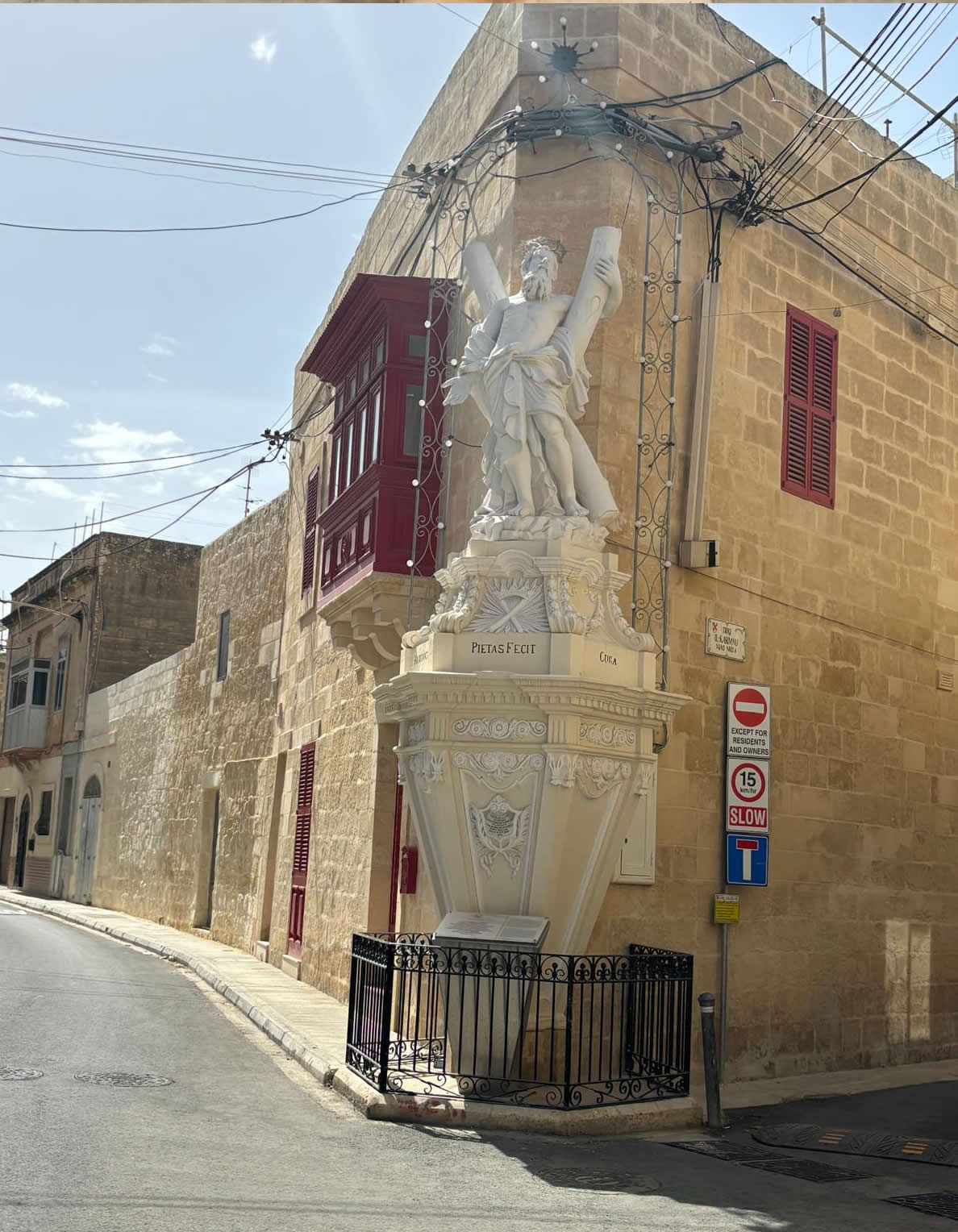
Figure 1: The grand street-corner statue of St. Andrew, sculpted over an elaborate pedestal inscribed with "Pietas Fecit".
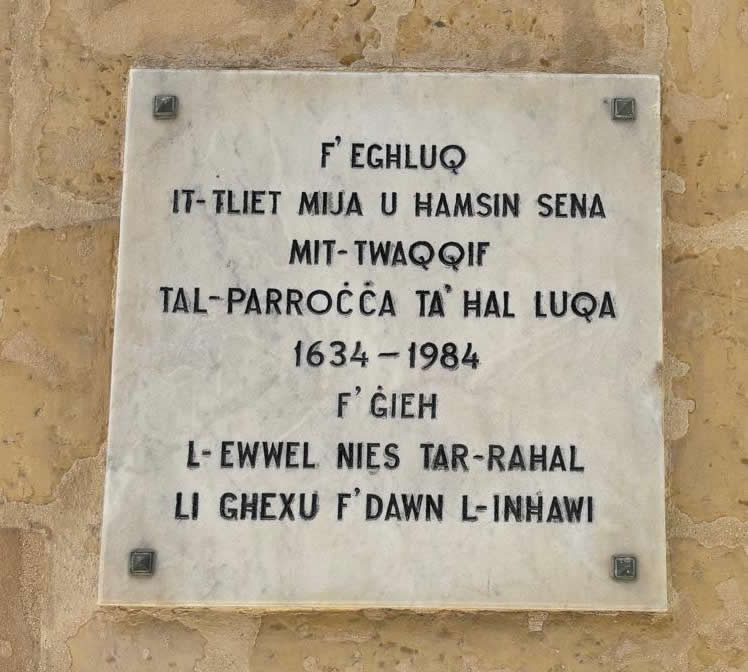
Figure 2: The adjacent commemorative marble tablet mounted on the limestone wall next to the monument.
Historical Context & Urban Architecture
Standing at the sharp architectural intersection where Triq il-Karmnu meets Sqaq tal-Karmnu, this monumental street shrine is one of Luqa's finest remaining expressions of late 19th-century public devotion. Erected between 1877 and 1878, the feature scales a massive decorated pedestal wrapped in classical scrollwork, ironwork guards, and a bold Latin programmatic statement: "Pietas Fecit" (Piety Built This). The larger-than-life stone statue captures the town's patron saint, St. Andrew, clasping his iconic saltire (X-shaped) cross.
Directly beside this towering monument on the traditional limestone fabric of the house is a commemorative marble slab unveiled in 1984. The plaque marks a key milestone in the town's history, celebrating exactly 350 years since Luqa was formally dismembered from Birżebbuġa / Gudja and established as an independent parish back in 1634 under Bishop Baldassare Cagliares.
Pedestal Inscription
Original Latin
PIETAS FECIT
English Translation
Piety Made [It] /
Erected out of Devotion.
Wall Plaque Inscription
Original Maltese
F'EGHLUQ
IT-TLIET MIJA U ĦAMSIN SENA
MIT-TWAQQIF
TAL-PARROĊĊA TA' ĦAL LUQA
1634 – 1984
F'ĠIEĦ
L-EWWEL NIES TAR-RAĦAL
LI GĦEXU F'DAWN L-INĦAWI
English Translation
On the completion of
the three hundred and fiftieth year
from the founding
of the Parish of Luqa
1634 – 1984;
in honor of
the first people of the village
who lived in these parts.
Luqa and World War II
The twentieth century transformed Luqa because of aviation. The airfield became strategically important during British rule and later played a central role during World War II.
Because of the military installations nearby, Luqa became a major target for enemy bombing. The village suffered extensive damage, and many residents experienced displacement and hardship.
Luqa Airport
The modern identity of Luqa is closely connected with aviation. The airfield developed from military origins and later became Malta's main civilian airport.
The airport brought major economic change, transforming Luqa from an agricultural village into a location of international importance.
Plague History of Luqa
Luqa experienced several historical epidemics that affected Malta. During the 1592–1593 plague epidemic, Malta suffered heavy losses and plague burial sites were established in several localities. A historic plague burial ground is associated with Luqa.
The village also has later burial sites connected with nineteenth-century outbreaks, including cholera and plague periods.
Historic Sites in Luqa
| Site | Description |
|---|---|
| St Andrew's Parish Church | Main village church and religious centre. |
| Luqa Cemetery | Traditional Maltese burial ground serving the community. |
| 1592 Plague Cemetery | Historic burial site linked to epidemic history. |
| 1813-1814 Plague Cemetery | Historic burial site linked to epidemic history. |
| Old Cholera Cemetery | Historic burial site linked to Cholera outbreak and used afterwards . |
| Id-Debdieba | Lost prehistoric temple site near Luqa. |
| Traditional Village Core | Limestone streets, houses and historic niches. |
| Luqa Naval Reservoir | Historic water infrastructure connected with Malta's military history. |
Chapels and Religious Heritage
Like many Maltese villages, Luqa contains numerous religious features including roadside niches, small chapels and devotional monuments.
These reflect the importance of Catholic faith in Maltese village life and the close relationship between community identity and religious tradition.
Traditional Culture
Luqa maintains traditional Maltese customs including village feasts, band clubs, religious processions and community celebrations.
The annual feast of Saint Andrew remains one of the most important events in the local calendar.
Timeline of Luqa
| Date | Event |
|---|---|
| 3000–2500 BC | Neolithic activity including the Id-Debdieba temple site. |
| Punic & Roman Period | Settlement and agricultural activity. |
| Medieval Period | Luqa forms part of Gudja parish territory. |
| 1634 | Luqa becomes an independent parish. |
| 17th Century | Development of St Andrew's Parish Church. |
| 1940 | Luqa airfield becomes operational as an all-weather airfield. |
| 1940–1945 | World War II bombing damages the village. |
| 1962 | Rebuilt parish church consecrated. |
| Modern Era | Luqa develops around Malta International Airport. |
Visiting Luqa
Visitors interested in Malta's history can explore Luqa as a place where prehistoric archaeology, medieval village traditions, religious architecture and twentieth-century aviation history meet.
Conclusion
Luqa is far more than the location of Malta's airport. It is a village with deep historical roots, from prehistoric communities and medieval farming traditions to the development of a major parish and its transformation during the aviation age. Its churches, cemeteries, historic streets and archaeological remains provide an important record of Malta's changing history.
List of Churches and Chapels in Luqa
| Name | Location | First Built | Google Map |
| St Andrew's Parish Church | Misrah il-Knisja, Ħal Luqa | 17th century rebuilt after WW2 | Google Map |
| Malta Armed Forces | Luqa Barracks, Ħal Luqa | Google Map | |
| Sacred Heart of Jesus | Residenza San Vincenz de Paul, Ħal Luqa | Google Map | |
| St Bartholomew | Residenza San Vincenz de Paul, Ħal Luqa | Google Map | |
| Victory (Hal Farrug) | Triq tal-Vitorja, Ħal Luqa | 1992 | Google Map |
| Old Cemetery | Triq Valletta, Ħal Luqa | 19th century | Google Map |
| San Tumas Chapel - Luqa Cemetery | Triq il-Gudja, Luqa | 19th century | Google Map |
| St James | Triq Ħal Luqa , Ħal Luqa | circa 1550 | Google Map |
| St Mary (Tal-Ftajjar) | Triq il-Karmnu , Ħal Luqa | 15th century | Google Map |
| Chapel of the Nativity of the Blessed Virgin Mary | Triq il-Karmnu , Ħal Luqa | 16th century | Google Map |
| Our Lady of Mount Carmel | Triq il-Gdida , Ħal Luqa | Google Map |