Location: St John’s Co-Cathedral, Valletta, Malta
Coordinates: 35.897883, 14.512519
Back to the Tomb map
Introduction
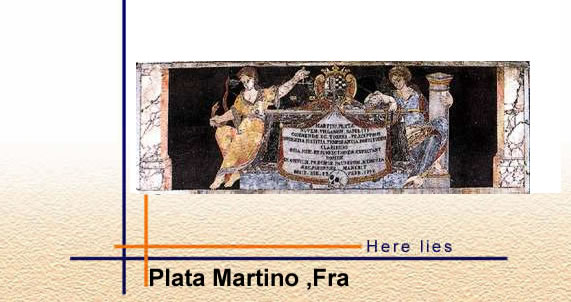
The tomb of Frà Martino Plata is one of the richly decorated marble slabs forming the remarkable funerary pavement of St John’s Co-Cathedral in Valletta. The cathedral floor is composed of hundreds of such tombstones commemorating knights, officers, and notable members of the Order of St John, each uniquely designed with inscriptions and symbolic imagery. :contentReference[oaicite:0]{index=0}
This tomb is distinguished by its elegant Latin inscription and classical Baroque composition, reflecting both the virtues of the deceased and the artistic traditions of the late 18th century.
Who was Frà Martino Plata?
Frà Martino Plata was a member of the Order of St John and held important administrative responsibilities within the Order. The inscription refers to him as a bajulus (bailiff), a senior rank within the Order’s hierarchy, and also as a preceptor connected to the commandery of Tozina.
The reference to “Novem Villarum” suggests jurisdiction over multiple estates or administrative territories, highlighting his role in governance and the management of the Order’s properties.
The Latin Inscription
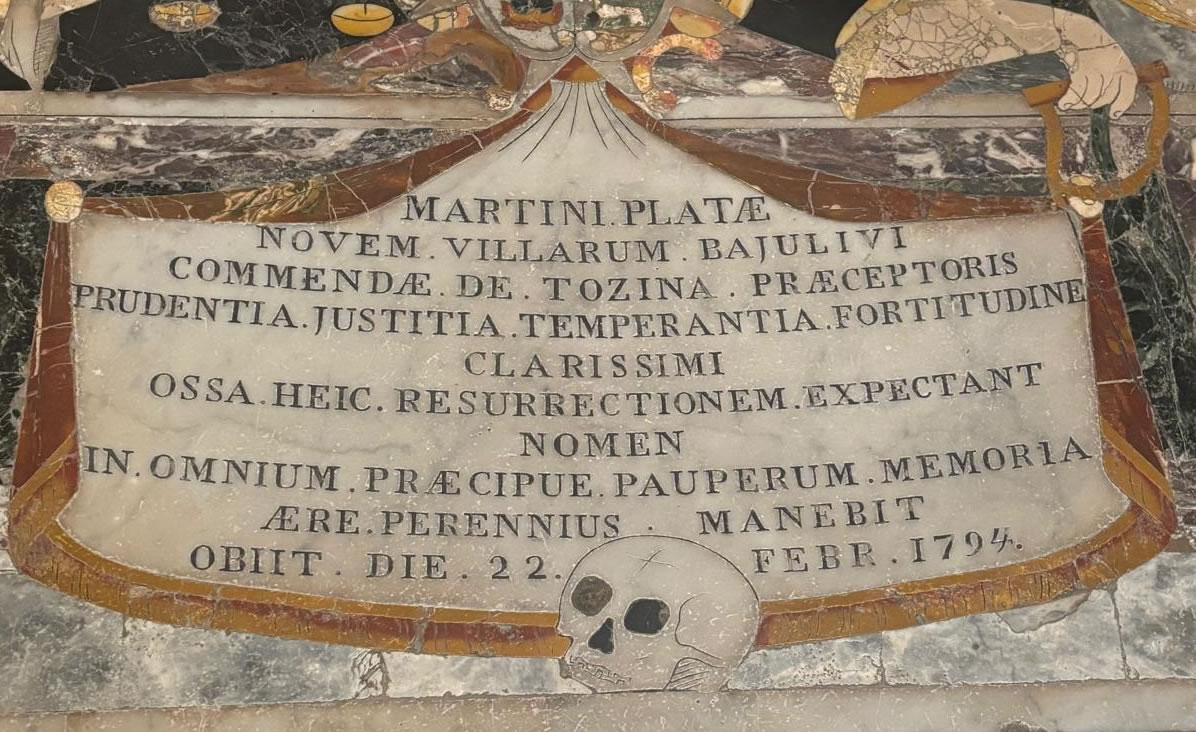
MARTINI PLATAE
NOVEM VILLARUM BAJULIVI
COMMENDAE DE TOZINA PRAECEPTORIS
PRUDENTIA JUSTITIA TEMPERANTIA FORTITUDINE
CLARISSIMI
OSSA HEIC RESURRECTIONEM EXPECTANT
NOMEN IN OMNIUM PRAECIPUE PAUPERUM MEMORIA
AERE PERENNIUS MANEBIT
OBIIT DIE 22 FEBR. 1794
English Translation
To Martino Plata,
Bailiff of the Nine Villages,
Preceptor of the Commandery of Tozina.
A most distinguished man
for prudence, justice, temperance, and fortitude.
His bones here await the resurrection.
His name, in the memory of all,
especially the poor,
will endure longer than bronze.
He died on 22 February 1794.
Artistic and Symbolic Features
The tomb is framed by elaborate Baroque ornamentation, including allegorical figures and a prominent skull motif at the base. Such imagery was common in the funerary art of the Knights, symbolising mortality and the inevitability of death, while also pointing toward Christian hope in resurrection.
The scroll-like cartouche containing the inscription is held by angelic figures, a motif representing divine acknowledgement and eternal remembrance.
Interpretation of the Inscription
The epitaph highlights four cardinal virtues:
- Prudentia – Prudence
- Justitia – Justice
- Temperantia – Temperance
- Fortitudo – Fortitude
These virtues were central to the identity of the Knights of St John, reflecting their dual role as religious and military figures.
The phrase “aere perennius” (“more lasting than bronze”) echoes classical Roman literature, emphasising the enduring legacy of the deceased through virtue and charitable memory.
The Tombs of St John’s Co-Cathedral
The tomb of Frà Martino Plata forms part of a vast collection of marble tombstones that cover the cathedral floor. These monuments date from the 16th to the 18th centuries and commemorate knights from across Europe, reflecting the international nature of the Order. :contentReference[oaicite:1]{index=1}
Each tombstone serves as both a memorial and a work of art, combining heraldry, symbolism, and inscriptions to preserve the legacy of the individual.
Historical Context
St John’s Co-Cathedral was built between 1573 and 1578 as the conventual church of the Knights of St John. Over time, it became the principal burial place for members of the Order, including knights, officials, and dignitaries. :contentReference[oaicite:2]{index=2}
The presence of such tombs within the church reflects a tradition of honouring the dead within sacred spaces, linking their memory with the spiritual life of the Order.
Condition and Preservation
Like many tombstones within the cathedral, the slab of Frà Martino Plata has experienced wear due to centuries of foot traffic. Conservation efforts aim to preserve these intricate works while maintaining their accessibility to visitors.
Visitor Experience
Visitors to St John’s Co-Cathedral can view the tomb as part of the broader experience of exploring one of Malta’s most important historical monuments. The tombs are integrated into the floor, offering a unique interaction with history.
The tomb of Frà Martino Plata provides insight into the values, responsibilities, and legacy of a senior member of the Order of St John.
Conclusion
The tomb of Frà Martino Plata is a fine example of the funerary art found within St John’s Co-Cathedral. Through its inscription, symbolism, and craftsmanship, it reflects the ideals and traditions of the Knights of St John.
As part of the cathedral’s extraordinary marble floor, it stands as a lasting tribute to a life marked by virtue, service, and enduring remembrance.