Location: St John’s Co-Cathedral, Valletta, Malta
Coordinates: 35.897883, 14.512519
Back to the Tomb map
Introduction
The tomb of Frà Romualdo Doz is one of the many richly decorated funerary monuments embedded within the marble floor of St John’s Co-Cathedral in Valletta. Like nearly 400 other tombstones in the cathedral, it forms part of a unique funerary pavement commemorating members of the Order of the Knights of St John.
This tomb stands out for its finely engraved Latin inscription and decorative composition, reflecting both the noble status of the individual commemorated and the artistic traditions of Baroque Malta.
Who was Frà Romualdo Doz?
Frà Romualdo Doz was a knight of the Order of St John, associated with the Langue of Aragon. The inscription identifies him as a patrician of Turin (Patritio Turiassensi), indicating noble Italian origins and highlighting the international composition of the Order.
Members of the Order were drawn from aristocratic families across Europe, serving both military and administrative roles. The title “Frà” denotes a professed knight, bound by religious vows and dedicated to the defence of the Catholic faith.
Latin Inscription and Translation
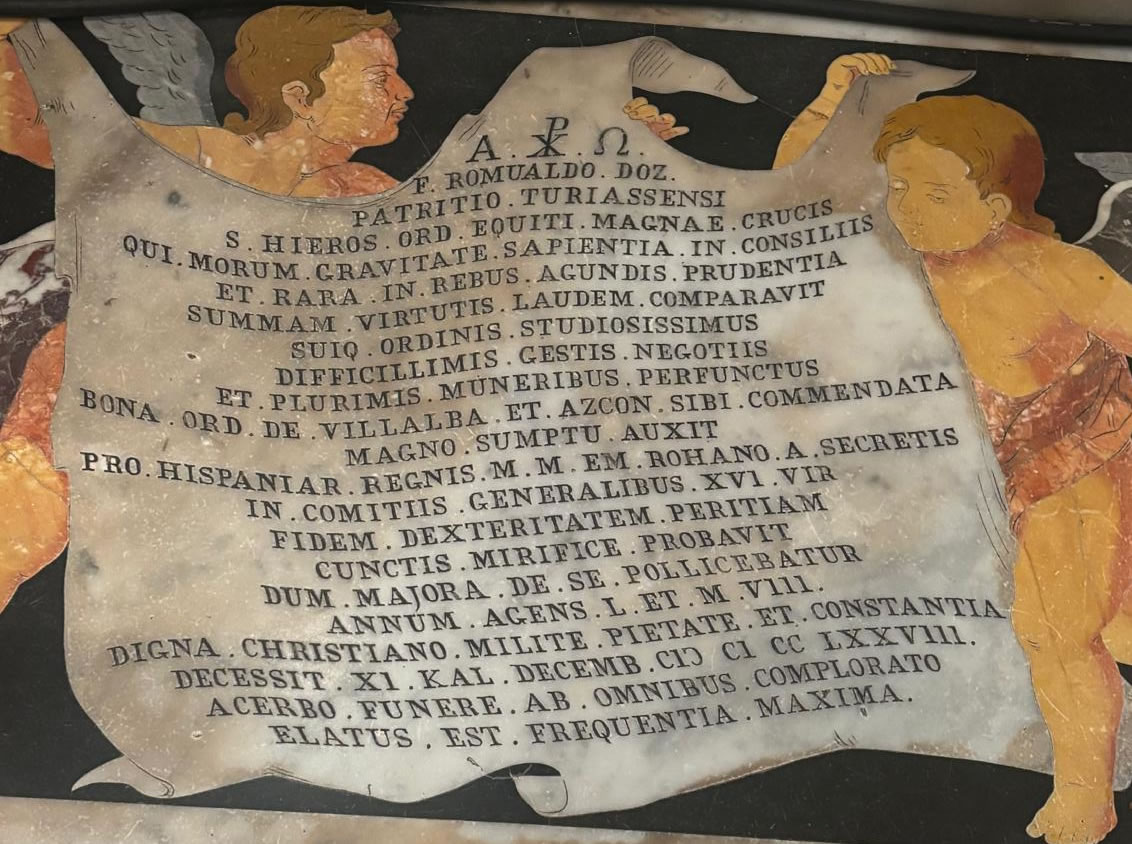
The tomb of Frà Romualdo Doz bears a detailed Latin epitaph praising his life, virtues, and service within the Order of St John. The inscription reads:
Original Latin Inscription
A. R. Ω.
F. ROMUALDO DOZ
PATRITIO TURIASSENSI
S. HIEROS. ORD. EQUITI MAGNAE CRUCIS
QUI MORUM GRAVITATE, SAPIENTIA IN CONSILIIS
ET RARA IN REBUS AGUNDIS PRUDENTIA
SUMMAM VIRTUTIS LAUDEM COMPARAVIT
SUI ORDINIS STUDIOSISSIMUS
DIFFICILLIMIS GESTIS NEGOTIIS
ET PLURIMIS MUNERIBUS PERFUNCTUS
BONA ORD. DE VILLALBA ET AZCON SIBI COMMENDATA
MAGNO SUMPTU AUXIT
PRO HISPANIARUM REGNIS
M.M. EM. ROHANO A SECRETIS
IN COMITIIS GENERALIBUS XVI VIR
FIDEM, DEXTERITATEM, PERITIAM
CUNCTIS MIRIFICE PROBAVIT
DUM MAIORA DE SE POLLICERETUR
ANNUM AGENS L ET M VIII
DIGNA CHRISTIANO MILITE PIETATE ET CONSTANTIA
DECESSIT XI KAL. DECEMB. CIƆ IƆCC LXXXVII
ACERBO FUNERE AB OMNIBUS COMPLORATO
ELATUS EST FREQUENTIA MAXIMA
English Translation
To the Almighty God (Alpha and Omega).
To Frà Romualdo Doz, a patrician of Turin,
Knight Grand Cross of the Holy Order of Jerusalem.
Who, by the gravity of his character, wisdom in counsel,
and rare prudence in action,
attained the highest praise of virtue.
Most devoted to his Order,
he carried out very difficult responsibilities
and fulfilled many offices.
The estates of Villalba and Azcon entrusted to him
he enlarged at great expense.
For the kingdoms of Spain,
serving as secretary to Grand Master Emmanuel de Rohan,
he was one of the sixteen members of the General Chapter.
He demonstrated to all, in a remarkable way,
his loyalty, skill, and expertise.
While he promised even greater achievements,
being in his 58th year,
with piety and constancy worthy of a Christian knight,
he died on 21 November 1787.
His bitter death, mourned by all,
he was carried to burial with a very great multitude.
Notes and Interpretation
- A. R. Ω. – Alpha and Omega, a symbol for God.
- S. Hieros. Ord. – Sacred Order of Jerusalem (Knights of St John).
- Magnae Crucis – Knight Grand Cross, a high-ranking title.
- Villalba and Azcon – Estates or commanderies under his administration.
- M.M. Em. Rohano – Grand Master Emmanuel de Rohan (r. 1775–1797).
- XVI vir – Member of a governing council of sixteen.
- XI Kal. Dec. – Roman calendar equivalent of 21 November.
- CIƆ IƆCC LXXXVII – Year 1787.
Artistic and Symbolic Features
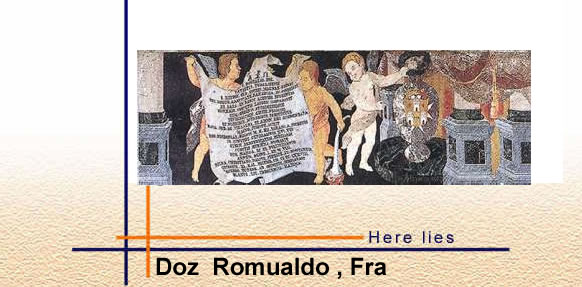
The tomb slab features a decorative composition typical of the period, combining Baroque artistic elements with symbolic imagery. The angels depicted holding the inscribed scroll suggest divine witness and the hope of salvation.
Such iconography was common in funerary art within St John’s Co-Cathedral, where tombstones served both as memorials and as expressions of faith. The marble inlay technique and detailed engraving demonstrate the high level of craftsmanship achieved by Maltese and European artisans working for the Order.
The Tombs of St John’s Co-Cathedral
The tomb of Frà Romualdo Doz forms part of one of the most remarkable features of the cathedral: its marble floor, composed entirely of tombstones belonging to knights and officers of the Order.
Each tombstone is uniquely designed, often incorporating coats of arms, allegorical figures, and inscriptions that recount the achievements and virtues of the deceased. Together, they create a vast and intricate mosaic that reflects the history and identity of the Knights of St John.
Historical Context
St John’s Co-Cathedral was built between 1573 and 1578 as the conventual church of the Order, under the patronage of Grand Master Jean de la Cassière.
Over time, it became not only a place of worship but also a burial site for the Order’s members. The inclusion of tombstones within the church floor reflects a tradition of honouring the dead within sacred spaces, symbolising the unity of the living and the deceased in faith.
Interpretation of the Inscription
The epitaph of Frà Romualdo Doz emphasises several key virtues:
- Gravitas (seriousness and dignity)
- Sapientia (wisdom)
- Prudentia (prudence)
- Virtus (moral excellence)
These qualities were central to the identity of the Knights of St John, who combined religious devotion with military and administrative responsibilities.
The inscription also references his contributions to councils and governance, suggesting that Frà Doz played an active role in the administration of the Order.
Condition and Preservation
Like many tombstones within the cathedral, the slab of Frà Romualdo Doz has experienced wear over time due to foot traffic and environmental factors. Conservation efforts continue to preserve these महत्वपूर्ण historical artefacts while allowing visitors to experience them within their original context.
Visitor Experience
Visitors to St John’s Co-Cathedral can view the tomb as part of the broader experience of exploring the cathedral’s interior. The tombs are integrated into the floor, encouraging visitors to engage directly with the history beneath their feet.
The tomb of Frà Romualdo Doz offers a glimpse into the life and legacy of an individual knight, while also contributing to the collective memory of the Order.
Conclusion
The tomb of Frà Romualdo Doz is a significant example of the funerary art found within St John’s Co-Cathedral. Through its inscription, artistic design, and historical context, it provides valuable insight into the values and traditions of the Knights of St John.
As part of the cathedral’s extraordinary marble floor, it stands as a lasting tribute to a life of service, faith, and honour in one of Malta’s most important historical monuments.