
Hidden beneath the magnificent nave of St John’s Co-Cathedral in Valletta, Malta, the Grand Masters’ Crypt is one of the most historically significant burial chambers of the Knights of St John. At the heart of this sacred space stands the altar of the crypt, a striking Baroque monument featuring a sculptural representation of the Crucifixion of Christ.
While the crypt is best known as the resting place of early Grand Masters, the altar serves as its spiritual and visual focal point, embodying the religious devotion and artistic sophistication of the Order.
Location and Setting
The altar is positioned within the Grand Masters’ Crypt, directly beneath the high altar of the cathedral. This subterranean chamber houses the tombs of the first Grand Masters who governed Malta following the arrival of the Knights in 1530.
Constructed from Maltese globigerina limestone and richly adorned with marble, the crypt combines solemnity with artistic grandeur. The altar stands slightly elevated, framed by classical architectural elements including pilasters and an arched niche.
The Crucifixion Sculpture
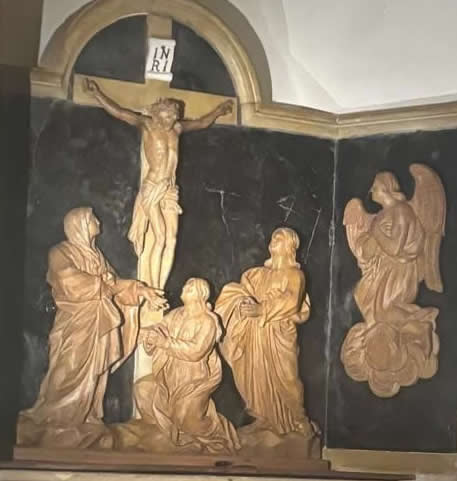
At the centre of the altar is a finely carved marble group depicting the Crucifixion of Jesus Christ. The composition includes:
- Christ on the Cross, bearing the inscription “INRI”
- The Virgin Mary, shown in mourning
- Saint John the Evangelist
- Additional figures, possibly Mary Magdalene
- An angel figure positioned to the side
This arrangement follows traditional Christian iconography, representing the moment of Christ’s death and the profound grief of his followers.
Symbolism of the Altar
The placement of a Crucifixion scene within the burial crypt is deeply symbolic. It reflects the central Christian belief in sacrifice, redemption, and eternal life — themes that resonate strongly within a funerary context.
For the Knights of St John, the altar would have held particular significance. As a religious and military order, their identity was rooted in the defence of Christianity. The image of Christ’s sacrifice served as both inspiration and spiritual anchor.
Baroque Artistic Style
The altar is a fine example of Baroque religious art, characterised by:
- Dramatic composition and emotional intensity
- Realistic human figures
- Strong contrasts between light and shadow
- Architectural framing elements
Although the cathedral was originally built in a restrained Mannerist style, its interior — including elements within the crypt — reflects the later Baroque transformation that defines its current appearance.
Historical Context
St John’s Co-Cathedral was constructed between 1573 and 1578 under Grand Master Jean de la Cassière. The crypt developed as the burial place for the early leaders of the Order, including Grand Master Jean de Valette, hero of the Great Siege of Malta in 1565.
The altar, while not tied to a single burial, forms part of the broader sacred environment that honours the legacy of these figures.
Restoration and Conservation
Over centuries, the crypt suffered from humidity, salt damage, and environmental wear. A major restoration project carried out between 2007 and 2020 addressed these issues, including the cleaning and conservation of the altar and its sculptures.
Specialist conservation techniques were used to stabilise the stone, remove deposits, and restore the original appearance of the artwork while preserving its historical integrity.
Relationship to the Grand Masters’ Tombs
Although the altar itself is not a tomb, it is surrounded by the burial sites of several early Grand Masters. These include:
- Jean de Valette (d. 1568)
- Pietro del Monte (d. 1572)
- Jean de la Cassière (d. 1581)
The altar serves as a spiritual centrepoint within this funerary setting, linking the physical remains of the Grand Masters with the religious beliefs they upheld.
Visitor Experience
Today, visitors to St John’s Co-Cathedral can view the Grand Masters’ Crypt from a designated area. The altar remains one of the most visually striking features of the space, offering a moment of reflection amid the rich historical surroundings.
👉 Explore more: St John’s Co-Cathedral Guide
Conclusion
The altar of the Grand Masters’ Crypt is more than a decorative feature — it is a powerful symbol of faith, sacrifice, and remembrance. Through its sculptural depiction of the Crucifixion, it connects the spiritual mission of the Knights of St John with the historical legacy preserved within the crypt.
As part of one of Malta’s most important heritage sites, the altar continues to inspire visitors and scholars alike, standing as a testament to the enduring fusion of art, religion, and history.
Frequently Asked Questions
What does the altar depict?
The altar features a marble sculpture of the Crucifixion of Jesus Christ, including figures such as the Virgin Mary and Saint John.
Is the altar a tomb?
No, the altar is not a tomb but a religious structure within the crypt.
When was the altar built?
The exact date is uncertain, but it is associated with the late 16th to early Baroque period of the cathedral.
Can visitors see the altar?
Yes, the altar can be viewed when visiting St John’s Co-Cathedral in Valletta.