Knight of the Order of Saint John | Military Commander | Chapel of Our Lady of Philermos
Home › St John's Co-Cathedral › Chapel of Our Lady of Philermos › Frà Claude de Blot Vivier

Introduction
Frà Claude de Blot Vivier was a distinguished knight of the Order of Saint John whose legacy survives through his richly symbolic tombstone in St John’s Co-Cathedral in Valletta, Malta. He died in 1672 at the age of 73, leaving behind a record of military leadership, administrative responsibility, and religious devotion typical of senior members of the Order during its golden age in Malta.
His burial within the Chapel of Our Lady of Philermos places him within one of the most spiritually significant areas of the cathedral. The chapel, associated with the revered Marian icon of the Knights, reflects the deep religious identity that shaped the lives of men such as Frà Claude.
Career within the Order of Saint John
Frà Claude de Blot Vivier belonged to the noble tradition of European knights who entered the Order of Saint John, dedicating themselves to both religious life and military service. His tomb inscription provides valuable insight into his career progression and responsibilities.
He held the rank of Commander, indicating that he was entrusted with the administration of a commandery, a key source of income and influence within the Order. His role extended beyond administration into active military service.
The inscription records that he served as a Lieutenant and later as a Captain, demonstrating a steady rise through the ranks. These positions required leadership, discipline, and the ability to command men both at sea and on land.
Military Service and the Expedition to Gigéri
One of the most significant aspects of Frà Claude’s career was his involvement in the expedition to Gigéri (modern Jijel in Algeria), a major military campaign in North Africa during the 17th century.
The inscription describes him as Dux Generalis in Africa, meaning he held the position of General Commander. This was a role of considerable importance, reflecting both his experience and the trust placed in him by the Order.
The campaign formed part of the wider struggle between Christian naval powers and Ottoman forces in the Mediterranean. His participation highlights Malta’s strategic role as a base for military operations in the region.
The phrase fortiter se gessit confirms that he distinguished himself through bravery, a quality highly valued among the Knights Hospitaller.
The Tomb in the Chapel of Our Lady of Philermos
The tomb of Frà Claude de Blot Vivier forms part of the famous marble pavement of St John’s Co-Cathedral, one of the most remarkable funerary floors in Europe. Each tombstone is a work of art, combining coloured marble inlays with symbolic imagery and inscriptions.
Located within the Chapel of Our Lady of Philermos, his tomb is set among those of other distinguished knights. The chapel itself was the spiritual heart of the Order, dedicated to the Virgin Mary under the title of Philermos.
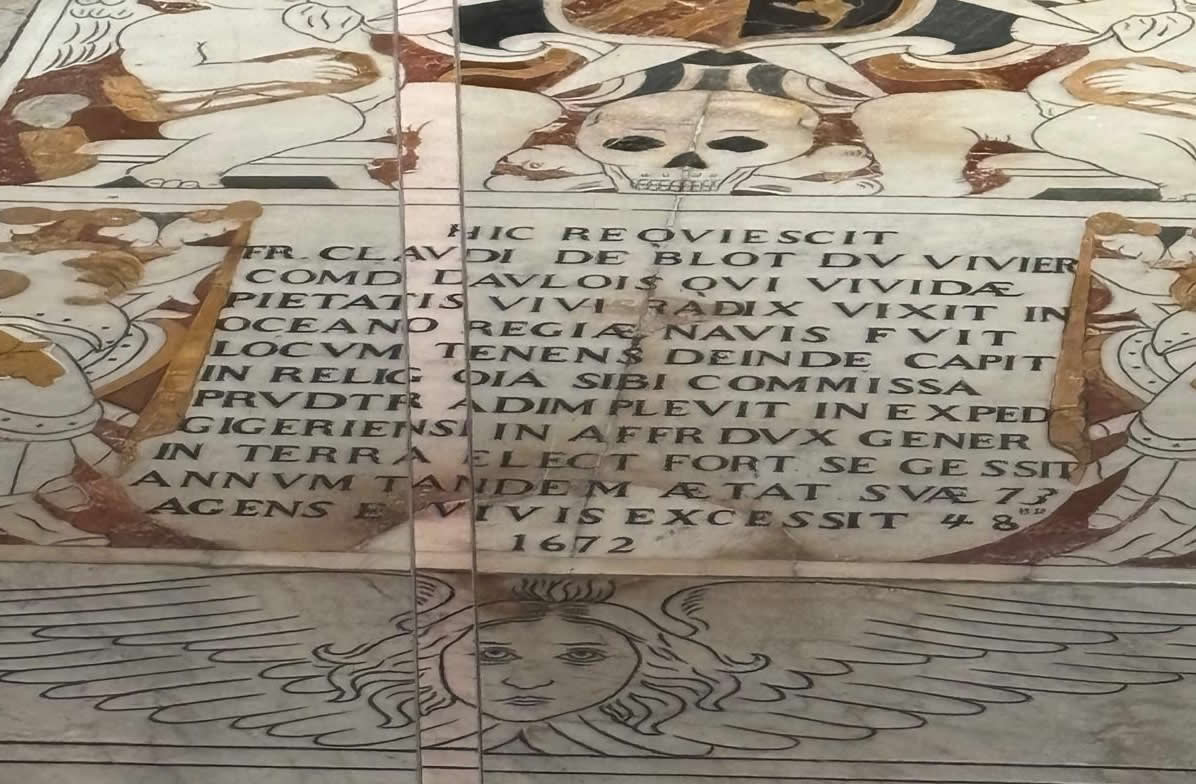
The placement of his burial within this chapel reflects both his status and his devotion. It situates him within the collective memory of the Order, preserved in one of Malta’s most important cultural and religious monuments.
Latin Inscription
HIC REQUIESCIT
FRATER CLAUDIUS DE BLOT DU VIVIER
COMMENDATOR D’AVLOIS
QUI VIVIDAE PIETATIS VIVAE RADIX VIXIT
IN LOCUM TENENS, DEINDE CAPITANEUS
IN RELIQUA OMNIA SIBI COMMISSA
PRUDENTER ADMINISTRAVIT
IN EXPEDITIONE GIGERIENSI
IN AFFRICA DUX GENERALIS
IN TERRA ELECTUS FORTITER SE GESSIT
ANNUM TANDEM AETATIS SUAE 73
AGENS E VIVIS EXCESSIT
ANNO 1672
English Translation
Here rests Brother Claude de Blot du Vivier, Commander of Aulx, who lived a life rooted in sincere and active piety.
He served as Lieutenant and later as Captain, and in all matters entrusted to him he carried out his duties with prudence.
During the expedition to Gigéri in Africa, he served as General Commander and conducted himself with bravery on land.
Finally, at the age of 73, he departed this life in the year 1672.
Symbolism and Meaning
The inscription follows a classical structure used throughout St John’s Co-Cathedral. It begins with the identification of the deceased, followed by a description of his virtues, his offices and achievements, and finally his death.
Particular emphasis is placed on his piety and prudence, qualities expected of a knight who balanced religious devotion with military duty. The reference to his role in Africa highlights the importance of Mediterranean campaigns in the history of the Order.
The wording reflects the Baroque mindset of the 17th century, where death was not seen as an end but as a transition, and where earthly achievements were framed within a spiritual narrative.
Historical Significance
Frà Claude de Blot Vivier represents the generation of knights who maintained the military and political strength of the Order of Saint John following the Great Siege of 1565.
His life illustrates the dual identity of the Knights as both warriors and religious figures. Through his service, he contributed to the continued presence of the Order as a major power in the Mediterranean.
Today, his tomb serves as a valuable historical source, providing insight into the careers, values, and commemorative practices of the Knights of Malta.
Visiting Today
Visitors to St John’s Co-Cathedral can view the tomb of Frà Claude de Blot Vivier within the Chapel of Our Lady of Philermos. The marble floor, composed of hundreds of tombstones, offers a unique visual record of the Order’s members.
The chapel remains one of the most atmospheric spaces within the cathedral, combining artistic beauty with deep historical and spiritual significance.
Key Facts
- Name: Frà Claude de Blot Vivier
- Died: 1672
- Age: 73
- Rank: Commander, General
- Campaign: Expedition to Gigéri (Algeria)
- Burial: Chapel of Our Lady of Philermos
- Location: St John’s Co-Cathedral, Valletta