Home › St John's Co-Cathedral › Main Nave › Frà Don Juan Ximenez de Vedoja
Grand Chancellor of the Order of Saint John | Buried in the Main Nave
Introduction
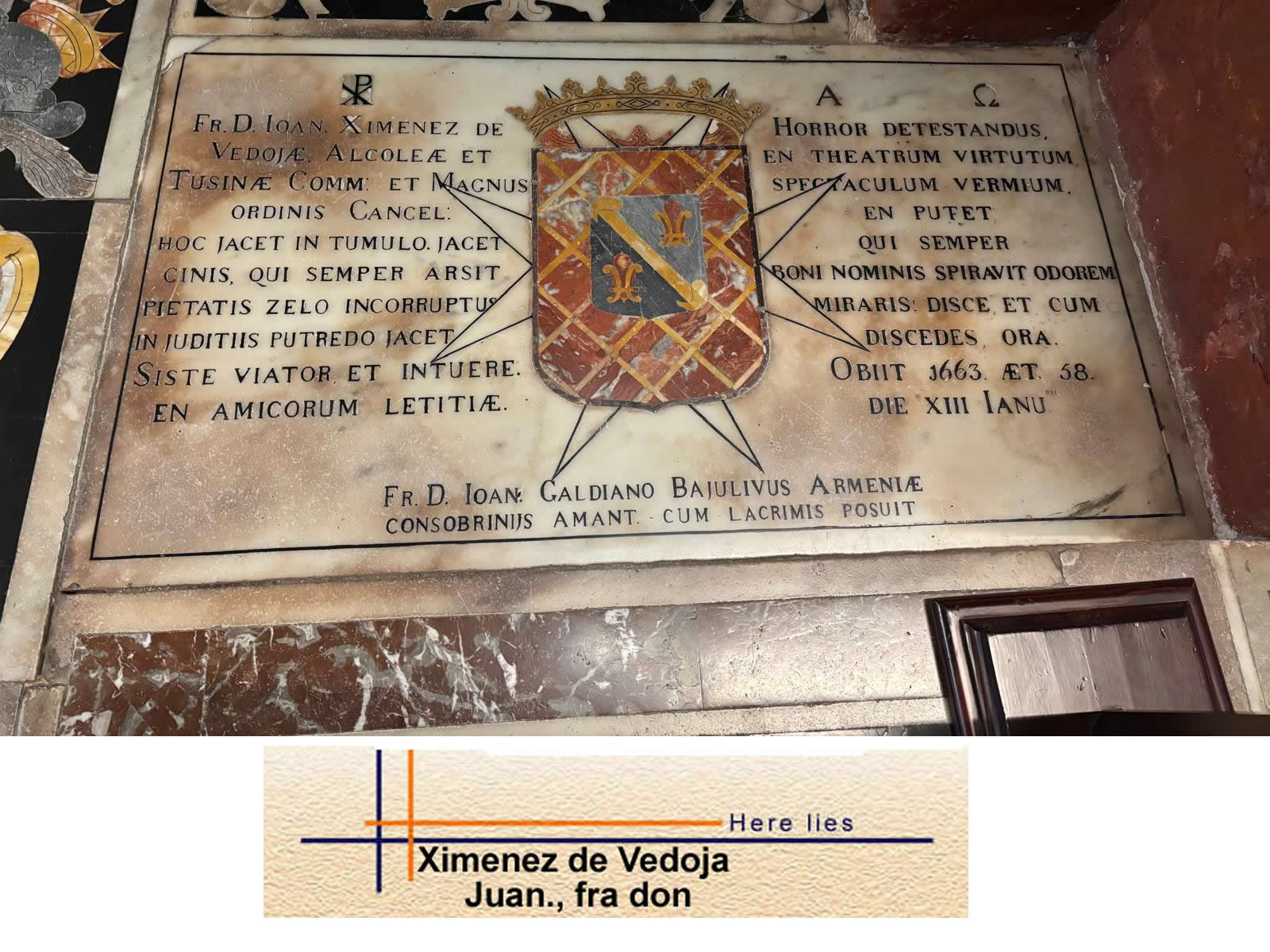
Frà Don Juan Ximenez de Vedoja was a prominent knight of the Order of Saint John who rose to the distinguished office of Grand Chancellor, one of the highest-ranking positions within the Hospitaller hierarchy. His life and legacy are preserved in the marble pavement of St John’s Co-Cathedral in Valletta, where he was laid to rest in the main nave following his death in 1663 at the age of 57.
His tombstone is notable not only for its historical importance but also for its richly expressive Latin inscription, which reflects the Baroque fascination with mortality, virtue, and the fleeting nature of human life. Positioned among the elaborate funerary slabs of the cathedral floor, his memorial forms part of one of the most remarkable artistic and historical ensembles in Europe.
The Office of Grand Chancellor
As Grand Chancellor of the Order of Saint John, Frà Don Juan Ximenez de Vedoja held a position of immense responsibility. The Grand Chancellor was entrusted with the administration of the Order’s official documents, correspondence, and archives. He also played a central role in governance, diplomacy, and legal affairs.
This office required not only administrative skill but also a deep understanding of the political and religious complexities of the Mediterranean world in the 17th century. The Order maintained relations with European monarchies, engaged in naval warfare, and governed the island of Malta, making the role of Grand Chancellor crucial to its functioning.
Life and Career
Frà Don Juan Ximenez de Vedoja was of noble origin, as indicated by his titles and positions. He served as Commander of several estates, including Alcolea and Tusina, reflecting his integration into the administrative structure of the Order.
Throughout his career, he demonstrated qualities of leadership, integrity, and devotion, which ultimately led to his appointment as Grand Chancellor. His responsibilities would have included overseeing official records, managing correspondence with foreign powers, and supporting the Grand Master in governance.
His life reflects the dual nature of the Knights of Malta, who combined religious commitment with political and military roles.
The Tomb in the Main Nave
The burial of Frà Don Juan Ximenez de Vedoja in the main nave of St John’s Co-Cathedral is a mark of distinction. The nave floor is reserved for knights of notable rank and achievement, with each tombstone forming part of the cathedral’s intricate marble pavement.
These tombstones are renowned for their artistic quality, featuring coloured marble inlays, heraldic symbols, and allegorical imagery. Together, they create a visual narrative of the Order’s history, commemorating the lives and achievements of its members.
His tomb occupies a place within this prestigious setting, ensuring that his memory remains part of the cathedral’s enduring legacy.
Latin Inscription
FR. D IOAN XIMENEZ DE VEDOJAE ALCOLEAE ET TUSINAE COMM ET MAGNUS ORDINIS CANCEL
HOC JACET IN TUMULO JACET CINIS QUI SEMPER ARSIT PIETATIS ZELO
INCORRUPTUS IN JUDITIIS PUTREDO JACET
SISTE VIATOR ET INTUERE
EN AMICORUM LETITAE HORROR DETESTANDUS
EN THEATRUM VIRTUTUM SPECTACULUM VERMIUM
EN PUTET QUI SEMPER BONI NOMINIS SPIRAVIT ODOREM
MIRARIS DISCE ET CUM DISCEDES ORA
OBIIT 1663 AET 57 DIE XIII IANU
FR. D. IOAN GALDIANO BAJULIVUS ARMENIAE CONSOBRINIUS AMANS CUM LACRIMIS POSUIT
English Translation
Here lies in this tomb the ashes of one who always burned with zeal for piety. Incorrupt in judgment, he now lies in decay.
Pause, traveller, and behold: what was once the joy of friends is now a horror to be shunned. Behold the theatre of virtues, now a spectacle for worms.
Behold how he decays, who once breathed the fragrance of a good name. You who marvel, learn—and when you depart, pray.
He died in 1663 at the age of 57, on the 13th day of January.
This monument was placed with tears by Frà Don Juan Galdiano, Bailiff of Armenia, his loving kinsman.
Interpretation and Symbolism
The inscription is a powerful example of Baroque funerary literature. It reflects the period’s preoccupation with mortality and the contrast between earthly honour and physical decay.
The phrase theatrum virtutum, spectaculum vermium (“theatre of virtues, spectacle of worms”) encapsulates the central message: even the most virtuous life ultimately yields to death.
The direct address to the reader—Siste viator (“Stop, traveller”)—invites reflection and spiritual contemplation. It transforms the tomb into a moral lesson, urging visitors to consider their own mortality and to pray for the deceased.
Historical Significance
Frà Don Juan Ximenez de Vedoja represents the administrative and intellectual leadership of the Order of Saint John during the 17th century. His role as Grand Chancellor placed him at the centre of the Order’s governance.
His tomb inscription provides valuable insight into the cultural and religious mindset of the time, illustrating how the Knights understood life, death, and legacy.
Today, his memorial continues to be an important part of the historical and artistic heritage of St John’s Co-Cathedral.
Visiting Today
Visitors to St John’s Co-Cathedral can view the tomb of Frà Don Juan Ximenez de Vedoja within the main nave. The marble pavement, composed of hundreds of tombstones, is one of the cathedral’s most striking features.
Exploring this space offers a unique opportunity to engage with the history of the Knights of Malta and to reflect on the lives commemorated within this extraordinary monument.
Key Facts
- Name: Frà Don Juan Ximenez de Vedoja
- Died: 13 January 1663
- Age: 57
- Rank: Grand Chancellor
- Burial: Main Nave
- Location: St John’s Co-Cathedral, Valletta