Home › St John's Co-Cathedral › Chapel of Our Lady of Philermos › Madonna of Philermos History
From Byzantium to Rhodes, Malta, Russia and Montenegro
Introduction
The Madonna of Philermos is one of the most important and venerated icons associated with the Order of Saint John. Its history spans more than a millennium, crossing empires, wars, and continents. From its origins in Byzantine Christianity to its present preservation in Montenegro, the icon has remained a powerful symbol of faith, protection, and continuity for the Knights Hospitaller.
Closely linked to the history of St John’s Co-Cathedral in Valletta, the icon was once enshrined in the Chapel of Our Lady of Philermos, where it was revered as a sacred protector of the Order.
Byzantine Origins and Early Tradition
The Madonna of Philermos is traditionally believed to date back to the early Christian period and is often attributed to Saint Luke the Evangelist. While this attribution reflects medieval devotional tradition rather than historical certainty, it underscores the deep spiritual importance attached to the icon.
The icon follows the Byzantine Hodegetria type, depicting the Virgin Mary pointing towards Christ as the source of salvation. Such icons were widely venerated for their protective qualities and were believed to guide the faithful.
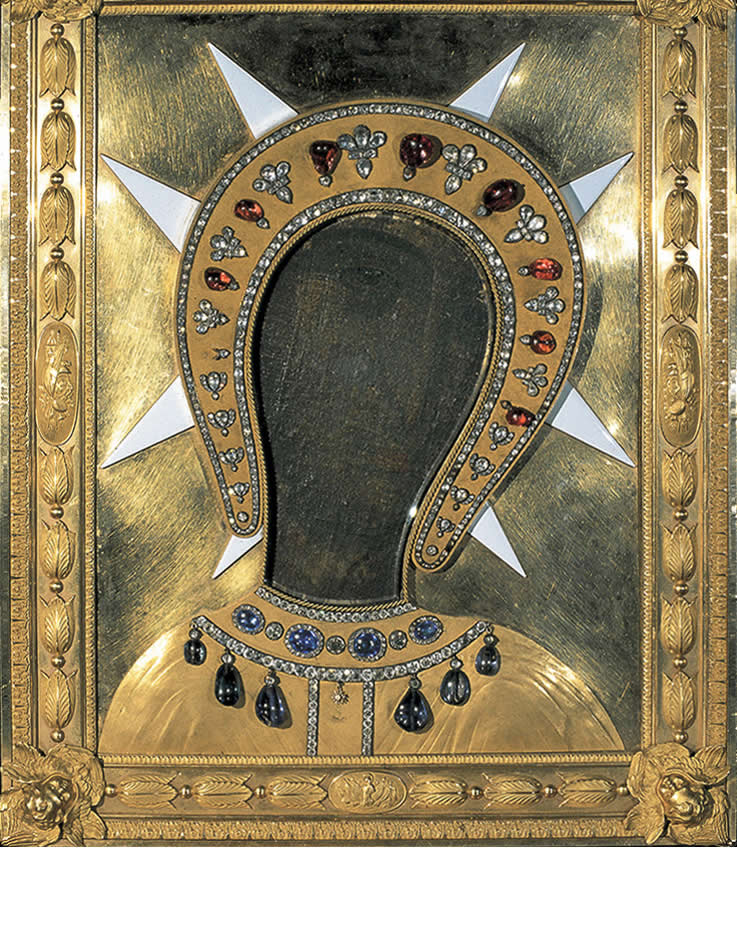
one part of the National Museum of Montenegro in the town of Cetinje.
The Shrine on Mount Philermos, Rhodes
The icon derives its name from Mount Philermos in Rhodes, where it was housed in a sanctuary before the arrival of the Knights of Saint John. The site became a place of pilgrimage, attracting devotion from across the region.
When the Knights established their rule in Rhodes in 1309, they adopted the icon as one of their most sacred relics, integrating it into their religious and ceremonial life.
The Knights of Rhodes and the Ottoman Threat
During their rule in Rhodes, the Knights relied on the Madonna of Philermos as a symbol of divine protection. The icon was particularly venerated during periods of conflict, including the sieges by Ottoman forces.
Its presence reinforced the spiritual identity of the Order and strengthened morale during times of siege and uncertainty.
Arrival in Malta (1530)
After the fall of Rhodes in 1522, the Knights carried the icon with them into exile. When they settled in Malta in 1530, the Madonna of Philermos became one of their most treasured possessions.
It was eventually placed in the Chapel of Our Lady of Philermos within St John’s Co-Cathedral in Valletta, where it was venerated for over two centuries.
The Icon in St John’s Co-Cathedral
Within the cathedral, the icon was richly adorned and displayed as a focal point of devotion. It was closely associated with the identity of the Knights and played a role in major religious ceremonies.
The presence of the Madonna of Philermos in Valletta symbolised continuity from Rhodes and affirmed Malta as the new spiritual centre of the Order.
The French Occupation and Exile (1798)
In 1798, the French forces under Napoleon Bonaparte captured Malta, forcing the Knights to abandon the island. The Madonna of Philermos was removed along with other sacred relics and taken into exile.
This marked the beginning of a complex journey across Europe, reflecting the broader upheavals of the time.
Russia and Imperial Custody
The icon eventually came under the protection of Tsar Paul I of Russia, who became associated with the Order of Saint John. In Russia, the Madonna of Philermos was incorporated into the imperial religious tradition and preserved as a sacred relic.
Revolution, War and Disappearance
Following the Russian Revolution, the icon was moved again for safekeeping. During the 20th century, particularly during the Second World War, its whereabouts became uncertain, adding to its mystique.
Eventually, the icon was rediscovered and identified, allowing it to be preserved once more.
The Madonna of Philermos Today
Today, the original icon of the Madonna of Philermos is preserved in the Art Museum, one of the principal departments of the National Museum of Montenegro, located in the historic town of Cetinje.
The museum safeguards the icon as one of its most important treasures, recognising both its religious significance and its unique connection to the history of the Order of Saint John.
Following its rediscovery in the late 20th century, after decades of uncertainty, the icon was formally identified and placed under museum protection. It is carefully conserved and remains accessible for study and veneration.
Although no longer present in Malta, the Madonna of Philermos retains a profound connection to St John’s Co-Cathedral, where it was once enshrined and venerated as the protectress of the Order.
Legacy and Significance
The Madonna of Philermos represents continuity across centuries of upheaval. It is a symbol not only of religious devotion but also of the resilience of the Order of Saint John.
Its journey—from Byzantium to Rhodes, Malta, Russia, and Montenegro—mirrors the broader history of the Mediterranean and Europe.
Today, it remains one of the most important surviving relics of the Knights Hospitaller.
Timeline of the Madonna of Philermos
Origins of the Icon
The Madonna of Philermos is traditionally believed to originate in the Byzantine period and attributed to Saint Luke.
Mount Philermos, Rhodes
The icon is enshrined on Mount Philermos, becoming an important pilgrimage site.
Knights of Saint John
The Knights adopt the icon as a sacred relic after establishing their rule in Rhodes.
Ottoman Sieges
The icon is invoked as a protector during the sieges of Rhodes.
Exile from Rhodes
The Knights depart Rhodes carrying the icon into exile.
Arrival in Malta
The icon is brought to Malta and becomes central to the Order’s devotion.
Valletta Enshrinement
The icon is placed in the Chapel of Our Lady of Philermos in St John’s Co-Cathedral.
French Occupation
Napoleon invades Malta and the icon is taken into exile once again.
Russia
The icon is placed under the protection of Tsar Paul I.
Revolution
The icon is moved during the Russian Revolution for safekeeping.
Rediscovery
The icon is rediscovered after decades of uncertainty.
Cetinje, Montenegro
The icon is preserved in the Art Museum of the National Museum of Montenegro.
FAQ
Where is the Madonna of Philermos today?
It is housed in the Art Museum of the National Museum of Montenegro in Cetinje.
Was it kept in Malta?
Yes, it was kept in St John's Co-Cathedral for over two centuries.
Why was it removed?
It was taken into exile following the French occupation of Malta in 1798.
Is it still associated with Malta?
Yes, it remains historically and spiritually connected to St John’s Co-Cathedral.